By Telos Press · Thursday, November 14, 2013 
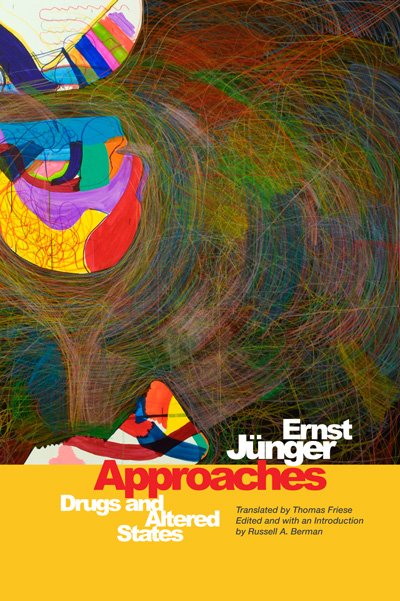
Ernst Jünger’s The Forest Passage explores the possibility of resistance: how the independent thinker can withstand and oppose the power of the omnipresent state. No matter how extensive the technologies of surveillance become, the forest can shelter the rebel, and the rebel can strike back against tyranny. Jünger’s manifesto is a defense of freedom against the pressure to conform to political manipulation and artificial consensus. A response to the European experience under Nazism, Fascism, and Communism, The Forest Passage has lessons equally relevant for today, wherever an imposed uniformity threatens to stifle liberty
Continue reading →
By Telos Press · Monday, November 4, 2013 We’re pleased to announce that Matthias Küntzel’s Jihad and Jew-Hatred: Islamism, Nazism, and the Roots of 9/11 is now available for purchase as a Kindle eBook. To purchase the eBook, visit the Amazon.com product page or buy it from within your Kindle reader or mobile Kindle app.
Continue reading →
By Telos Press · Monday, October 21, 2013 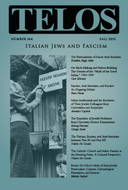 On Saturday, October 26, the Telos-Paul Piccone Institute and the Centro Primo Levi will host a panel discussion on Telos 164: Italian Jews and Fascism. The discussion will be held at Casa Italiana Zerilli Marimò, 24 West 12th Street, in New York City, from 1 pm to 4pm. Following the discussion, there will be a cocktail reception that will include Maria Piccone’s delicious “amaretti” cookies, in honor of Telos‘s 45th Anniversary. We hope to see you there! On Saturday, October 26, the Telos-Paul Piccone Institute and the Centro Primo Levi will host a panel discussion on Telos 164: Italian Jews and Fascism. The discussion will be held at Casa Italiana Zerilli Marimò, 24 West 12th Street, in New York City, from 1 pm to 4pm. Following the discussion, there will be a cocktail reception that will include Maria Piccone’s delicious “amaretti” cookies, in honor of Telos‘s 45th Anniversary. We hope to see you there!
Continue reading →
By Telos Press · Monday, October 14, 2013 On Saturday, October 26, the Telos-Paul Piccone Institute and the Centro Primo Levi will host a panel discussion on Telos 164: Italian Jews and Fascism. The discussion will be held at Casa Italiana Zerilli Marimò, 24 West 12th Street, in New York City, from 1 pm to 4pm. We hope to see you there
Continue reading →
By Telos Press · Monday, September 16, 2013 Karel Kosík and Dialectics of the Concrete Prague, June 4–6, 2014
A conference organised by the Department for the Study of Modern Czech Philosophy, Institute of Philosophy, Academy of Sciences of the Czech Republic.
In 1963 Karel Kosík published his path-breaking book Dialectics of the Concrete. It made an impact on both Marxist and non-Marxist thinkers, in Czechoslovakia and throughout the world. In this work Kosík set for himself an ambitious task—to re-think the basic concepts of the Marxist philosophical tradition and to employ them in the analysis of social reality. In the course of his analysis he touched on a wide array of issues that are still relevant today, including the problem of mystification or the “pseudo-concrete,” the social role of art, the conception of reality as a concrete totality, the conception of the human being as an onto-formative being, the systematic connection between labour and temporality, the relationship between praxis and labour, and the explanatory power of the dialectical method.
Continue reading →
By Telos Press · Monday, June 17, 2013 The Difficulty of Democracy: Diagnoses and Prognoses
February 14–16, 2014
New York
In spite of its advantages as an ideal form of government, democracy has proven to be remarkably difficult to establish and to maintain in reality. While it remained a rare exception for much of human history, its spread in the modern world has not had the character of a triumphant march but rather of a tortured path dominated by failed attempts, transformations into dictatorship, and degenerations into civil war. Even the most successful cases, Great Britain, France, and the United States, were marked by a concurrence of the rise of democratic institutions with an imperialist expansion that created a de facto hierarchy of citizens and non-citizens familiar also in ancient Athens. The purpose of the Eighth Annual Telos conference will be to analyze the key characteristics of democracy in order to determine, first, the precise advantages and disadvantages of this form of government in comparison to alternatives, second, the reasons for its rarity and volatility, and, third, the factors that are essential for its stability. We welcome paper submissions that address issues such as classical and modern theories of democracy, case studies of successful or failed democracies around the world, antinomies and conflicts within established democracies, revolutionary movements as progenitors of democracy, degeneration of democracies into other forms of government, the importance of culture and representation for founding and maintaining democracy, and the economic requirements and consequences of democracy. Please send an abstract and short c.v. to dtpan@uci.edu by August 31, 2013.
Continue reading →
|
|