By Telos Press · Friday, September 4, 2026 Karl Wittfogel’s 1957 magnum opus, Oriental Despotism: A Comparative Study of Total Power, came out at the peak of the Cold War. As a former Marxist, Wittfogel saw analysis of what he called “hydraulic despotism” in premodern Asian bureaucratic empires as of more than merely regional or historical interest. With an eye to Soviet and Maoist developments, he argued that “[t]otal power, far from merely meekly withering away, is spreading like a virulent and aggressive disease. It is this condition that recalls man’s previous experience with extreme forms of despotic rule.”
Wittfogel contrasted “hydraulic societies” with feudalism and modern capitalism. Driven by ecological imperatives of irrigation and flood control, bureaucratic systems emerged in much of Asia and achieved sustained domination over rival power centers in society. Just as private property existed on the sufferance of political power, so too did individual ambition and social prestige gravitate to state service. While this model prevailed longest and most consistently in settings like ancient Egypt, Mughal India, and premodern China, it found analogues elsewhere whenever material conditions and rulers’ convenience converged, including the Roman and Inka Empires. No part of the world, Wittfogel warned, was immune to hydraulic taming of free peoples; they succumbed on the frontier more easily than they might imagine. In the Cold War context of modern state socialism, indeed, such hierarchical systems could penetrate even more deeply into daily life: “The industrial despotism of the fully developed and totally managerial apparatus society combines total political power with total social and intellectual domination.”
Continue reading →
By Telos Press · Monday, August 24, 2026 In today’s episode of the Telos Press Podcast, Telos editor David Pan talks with Alvise Capria about his article “Sous l’œil des Chinois: The Reception of Carl Schmitt in Contemporary Chinese Political Thought,” from Telos 215 (Summer 2026): China and Sovereignty. An excerpt of the article appears here. In their conversation they discuss the primary reasons that Chinese scholars look to Schmitt when thinking about political theory; the distinct currents in the Chinese reception of Schmitt, including Taiwan, Liu Xiaofeng, political constitutionalism (Chen Duanhong and Gao Quanxi), and the New Left (Wang Hui and Cui Zhiyuan), and how these currents are distinguished from each other; how the Chinese engagement with Schmitt is part of an attempt to develop an indigenous political theory, and how successful that attempt has been. If your university has an online subscription to Telos, you can read the full article at the Telos Online website. For non-subscribers, learn how your university can begin a subscription to Telos at our library recommendation page. Print copies of Telos 215 are available for purchase in our online store.
Continue reading →
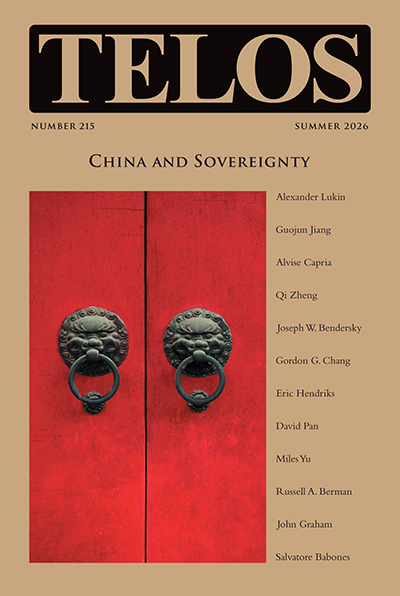
By David Pan · Friday, July 17, 2026 Telos 215 (Summer 2026): China and Sovereignty is now available for purchase in our store. Individual subscriptions to Telos are also available in both print and online formats.
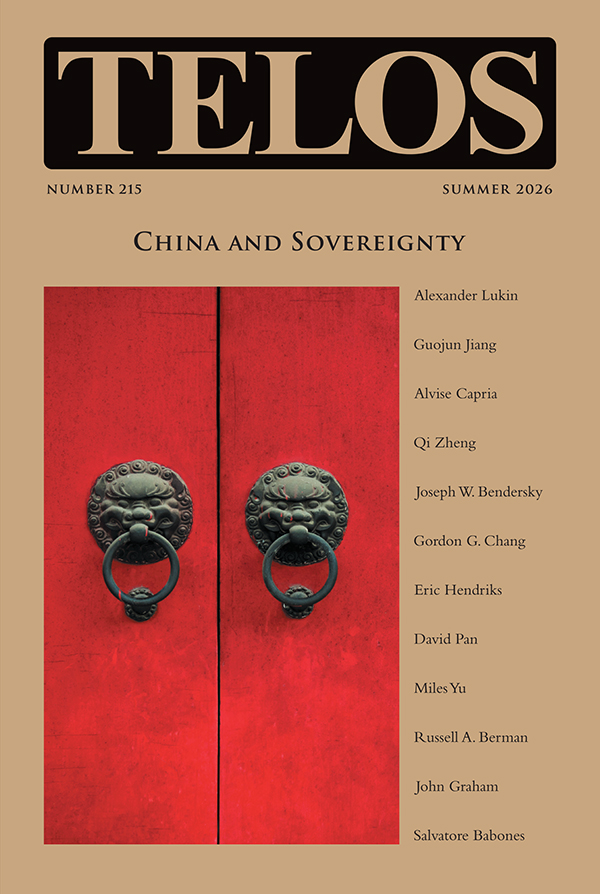 China remains the inscrutable elephant in the room for the world’s political theorists and policymakers. Its growing importance to the world’s economy and politics compels us to continue to analyze its ideological currents and political conflicts. While scholars inside and outside of China struggle with the Chinese Communist Party’s attempts to censor debate, it is all the more necessary to engage scholars in productive discussions that provide real analysis rather than talking points. The essays in this issue on China and sovereignty discuss how China has engaged with Western thinkers, in particular Karl Marx, Michel Foucault, and Carl Schmitt, to develop its own basis for sovereignty and its vision for world order. Subsequently, our authors offer conflicting perspectives on the nature of the Chinese government and how the United States should respond to China’s rise. China remains the inscrutable elephant in the room for the world’s political theorists and policymakers. Its growing importance to the world’s economy and politics compels us to continue to analyze its ideological currents and political conflicts. While scholars inside and outside of China struggle with the Chinese Communist Party’s attempts to censor debate, it is all the more necessary to engage scholars in productive discussions that provide real analysis rather than talking points. The essays in this issue on China and sovereignty discuss how China has engaged with Western thinkers, in particular Karl Marx, Michel Foucault, and Carl Schmitt, to develop its own basis for sovereignty and its vision for world order. Subsequently, our authors offer conflicting perspectives on the nature of the Chinese government and how the United States should respond to China’s rise.
Continue reading →
By David Pan · Sunday, July 12, 2026 
July 12th marks 22 years since the passing of Paul Piccone. His vision, energy, and charisma created Telos and continues to inspire all of us who are connected with it, whether or not we had the good fortune of knowing him personally. He was always committed to following the truth, wherever it might lead him. This explains the complicated trajectory of interests in the history of Telos, from the Frankfurt School and Jean Baudrillard to Carl Schmitt and Ernst Jünger, from left-wing politics to populism, from debates about the 1980s peace movements to discussions of radical orthodoxy, from phenomenology to postliberalism. This continuing movement could not be constrained by disciplinary boundaries, but it would be misleading to consider the mix of topics as simply eclectic or interdisciplinary. We would be failing if we were simply drawing attention to obscure writers or movements. Rather, we seek to focus on what is vitally relevant but not yet recognized as such. The vagaries of Telos‘s trajectory reflect targeted shifts in attention that respond to new insights and current problems. This sixth sense was the key to Piccone’s genius. We cannot claim to have maintained it, but this remains the telos in Telos. As we commemorate Paul Piccone, we also rededicate ourselves to continuing his vision.
Continue reading →
By Telos Press · Monday, April 27, 2026 CALL FOR PAPERS
War and Time: Russia’s Invasion of Ukraine and the Eclipse of Peace
Coedited by Michael Marder and Denys Sultanhaliiev
In what appears to be a peculiar paradox of our time, the Russo-Ukrainian war—initially a profound rupture in the European political imagination—has gradually receded into the background noise of global media circulation. Saturated coverage has not yielded conceptual clarity. On the contrary, despite the overwhelming volume of commentary, there remains a striking absence of sustained theoretical engagement with the war’s implications for political thought. Rather than catalyzing new frameworks, the conflict has too often been instrumentalized as confirmatory evidence for already established positions.
This special issue of Telos seeks to address this philosophical void.
Continue reading →
By Eric Hendriks and David Pan · Friday, April 3, 2026 Telos 214 (Spring 2026): China Keywords II is now available for purchase in our store. Individual subscriptions to Telos are also available in both print and online formats.
 Modern China emerged through the struggle with the customs and traditions of imperial China. This struggle continues in present-day attempts to think through how earlier customs, on the one hand, remain active in Chinese culture and, on the other, have been transformed by China’s modernization. And then there are the customs that have been cut off by modernity; to what extent and in which ways can or should they be revived? Modern China emerged through the struggle with the customs and traditions of imperial China. This struggle continues in present-day attempts to think through how earlier customs, on the one hand, remain active in Chinese culture and, on the other, have been transformed by China’s modernization. And then there are the customs that have been cut off by modernity; to what extent and in which ways can or should they be revived?
The central challenge is that China has undergone spectacular political and social transformations over the past century, meaning that older ideas and customs must now operate within an entirely new sociopolitical context. Consider how different the political imagination was in imperial (neo-)Confucian China, which placed the imperial court at the center of the cosmos. Before the late nineteenth and early twentieth centuries, China saw itself as Zhongguo (中国) or Zhonghua (中华), meaning the “Middle Kingdom” and the “central civilization,” respectively. Thus, far from conceiving itself as merely one country among others, it imagined itself as the morality-carrying center of the tianxia (天下), “all under heaven,” which could only be harmoniously ordered if its Chinese center itself was properly ordered.
Continue reading →
|
|