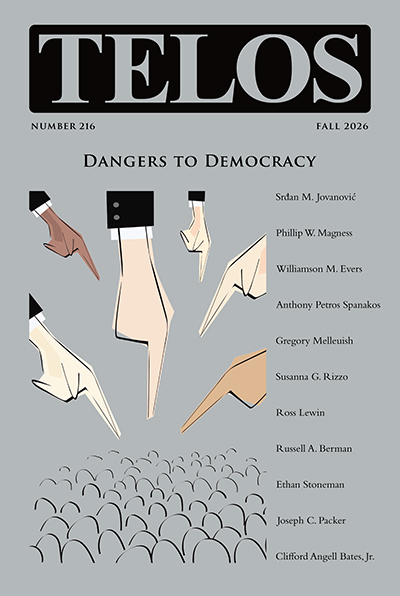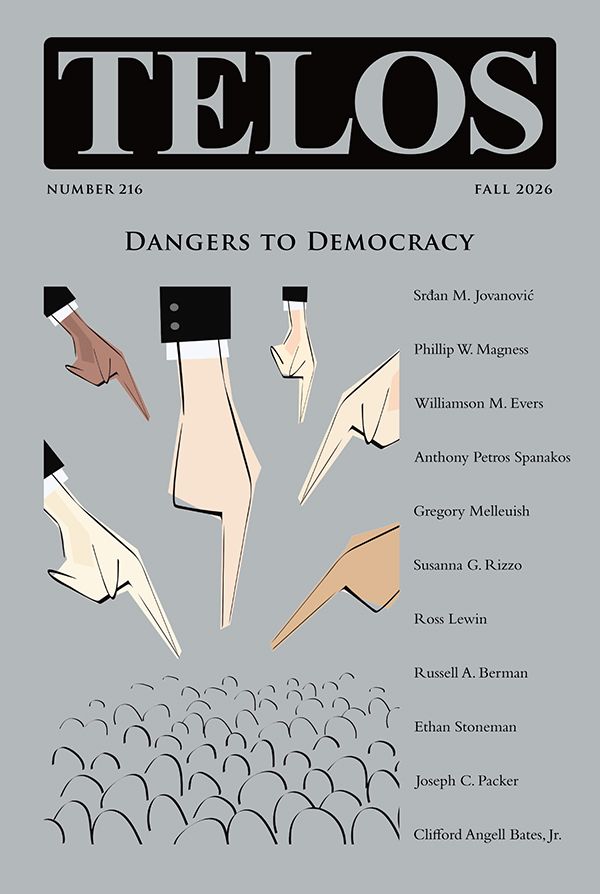
Telos 216 (Fall 2026): Dangers to Democracy
As a form of government that depends on the people for decision-making, democracy requires, on the one hand, a basic unity of the people in terms of their political theological goals and, on the other hand, the procedural mechanisms that can translate popular sentiments into political decisions. A breakdown of the former can lead to civil war. A deterioration of the latter can lead to the suppression of independent associations by a demagogue or a faction. Democracies can thus die either through too little unity or too much. While our investigations of politics have often focused on the issue of political theology, Telos 216 is devoted to the dangers to democracy posed by the declining commitment to open debate, evidence-based reasoning, and pluralism.
The Illiberal Turn on the Left: Speech Regulation, Racial Identity, and Anti-Imperialist Alliances as Epistemic Failures
Srđan M. Jovanović
The Rise of Critical Race Theory: An Empirical Assessment
Part I: From Educational Frustration to the Lost Decade
Phillip W. Magness and Williamson M. Evers
Democratizing or Destroying Democracy: Tocqueville and Contemporary Challenges in and to Democracies (open access)
Anthony Petros Spanakos
Mirroring the Image? Trump, Thucydides, and the Theater of Democracy
Gregory Melleuish and Susanna G. Rizzo
Imagine: The DSA, Israel, and the Politics of Redemption
Ross Lewin
Two Kinds of War: Ukraine, Gaza, and the Strategic Watershed
Russell A. Berman
Notes and Commentary
Esoteric Writing in the Age of Generative AI
Ethan Stoneman and Joseph C. Packer
Reviews
The Sacred and the Secular: Marcel Gauchet’s Theological-Political Lens on Democracy’s Post-Totalitarian Trajectory
Clifford Angell Bates, Jr.