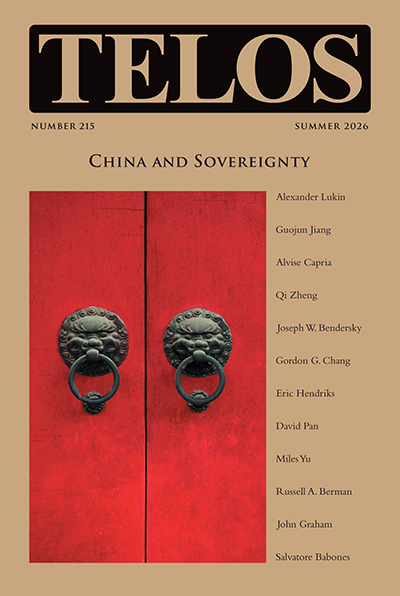
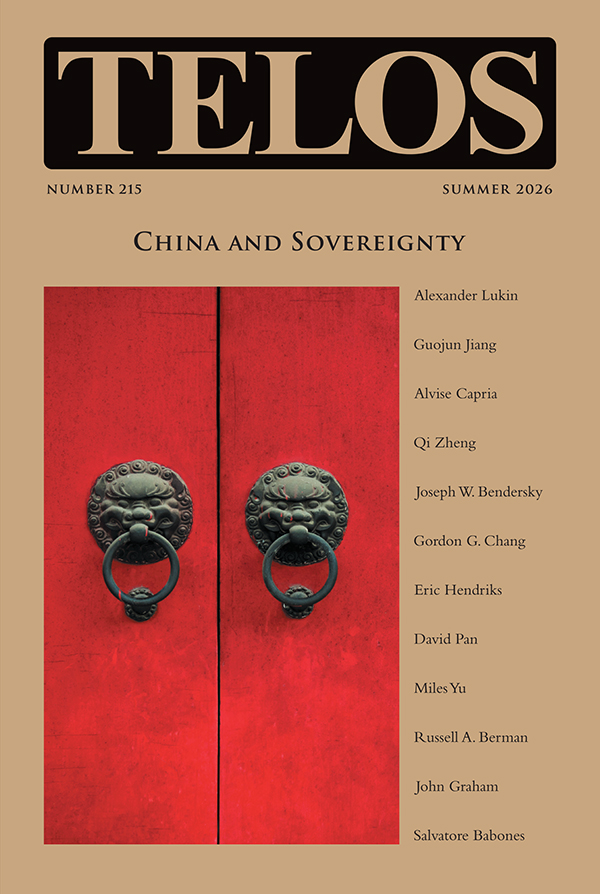
In today’s episode of the Telos Press Podcast, Telos editor David Pan talks with Alvise Capria about his article “Sous l’œil des Chinois: The Reception of Carl Schmitt in Contemporary Chinese Political Thought,” from Telos 215 (Summer 2026): China and Sovereignty. An excerpt of the article appears below. In their conversation they discuss the primary reasons that Chinese scholars look to Schmitt when thinking about political theory; the distinct currents in the Chinese reception of Schmitt, including Taiwan, Liu Xiaofeng, political constitutionalism (Chen Duanhong and Gao Quanxi), and the New Left (Wang Hui and Cui Zhiyuan), and how these currents are distinguished from each other; how the Chinese engagement with Schmitt is part of an attempt to develop an indigenous political theory, and how successful that attempt has been. If your university has an online subscription to Telos, you can read the full article at the Telos Online website. For non-subscribers, learn how your university can begin a subscription to Telos at our library recommendation page. Print copies of Telos 215 are available for purchase in our online store.
Sous l’œil des Chinois: The Reception of Carl Schmitt in Contemporary Chinese Political Thought
Alvise Capria
1. Introduction: Schmitt in China between Emergency and Order
 Carl Schmitt was, for better or worse, one of the great thinkers of the twentieth century. A constitutional jurist across Wilhelmine, Weimar, Nazi, and later Federal Germany, he left his mark on law, politics, and even culture. Still influential in crises—from 9/11 to Covid-19—he is famed as the “father of exceptionalism,” arguing that sovereign authority founds order by suspending normality.[1]
Despite his compromised past, Schmitt’s enduring resonance, even among his critics, becomes clear once we grasp the radical sociopolitical problems he enables us to confront. His central task is to explain how political and legal order maintains itself, especially when faced with the unexpected.[2] Schmitt’s project is to secure the durability of order by mobilizing symbolic, political, ideological, and juridical mechanisms that prevent disintegration. He names this endeavor a “sociology of legal concepts,” first articulated as ”political theology,”[3] then reconfigured—after engaging institutionalists like Maurice Hauriou and Santi Romano—as ”concrete thought of order and formation” (Konkretes Ordnungs- und Gestaltungsdenken).[4] At its core lies a single guiding question: how is order constituted, maintained, and legitimated within political and legal structures? For Schmitt, understanding this process is not merely descriptive but fundamentally political, as it reveals the conditions under which authority persists.
In China, this juncture has been acutely recognized: for over thirty years, Schmitt’s works have been widely translated and discussed, prompting the term “Schmitt fever.”[5] These readings, rather than faithfully interpreting Schmitt, illuminate the shifting dynamics within China’s constitutional framework.[6] They reveal an intellectual need to abandon or transform key Marxist categories, even when seeking to radicalize them. This phenomenon shows how Western political concepts are repurposed within a profoundly different context. Schmitt is emblematic—so much so that some claim those silent on him are not taken seriously.[7] Beneath the alarmed reactions[8] lies a deeper conceptual movement: a Chinese effort to rethink political categories amid post-Mao transformations, crafting a hybrid model irreducible to mere anti-liberalism.[9] The West has largely overlooked the so-called “Schmitt fever,” limiting its attention to journalistic summaries. The Anglo-American world is an exception, with studies proliferating over the past decade.[10] Yet these interpretations often presume that Schmitt’s Chinese reception is merely totalitarian or anti-libertarian, serving as ideological support for regime stances. While this holds some truth—particularly regarding governance issues like Hong Kong—such a reductive lens risks obscuring the deeper conceptual and philosophical-political dynamics at play. In short, it risks missing the symptomatic reason why behind this revival of Schmitt.
My proposal instead suggests that the recovery of Schmitt is not merely a tactical ex-post justification for anti-liberal party positions, but part of a broader Chinese need to take a self-conscious stance on modern sovereignty and the state. This article investigates why Schmitt is revived from a seemingly distant horizon, and how specific concepts—constitution, representation, exception, decision—are selected to frame political relations, envisioning shared plurality through a Western lens. Ultimately, it asks what it means to think about Chinese constitutional processes (traditionally of a Marxist framework, but resonant with a political conceptuality that is not necessarily only Western) with Schmitt, and what this can bring to the dimension of philosophical-political research.
Continue reading this article at the Telos Online website. If your library does not yet subscribe to Telos, visit our library recommendation page to let them know how.
1. Bonnie Honig, Emergency Politics: Paradox, Law, Democracy (Princeton, NJ: Princeton Univ. Press, 2009), p. 15; Mariano Croce and Andrea Salvatore, “Little Room for Exceptions: On Misunderstanding Carl Schmitt,” History of European Ideas 47, no. 7 (2021): 1169–83. Some interpreters argue that Schmitt entirely dominates the field of political emergency studies, e.g., Nomi Claire Lazar, States of Emergency in Liberal Democracies (Cambridge: Cambridge Univ. Press, 2009), while others, studying the emergency measures implemented to counter the Covid-19 pandemic, speak openly of “Schmittian remedies,” like Gàbor Mèszàros, “Carl Schmitt in Hungary: Constitutional Crisis in the Shadow of Covid-19,” Review of Central and East European Law 46, no. 1 (2021): 69–90. Finally, as it is well known, Agamben, in theorizing his studies on sacredness and the state of exception, starts from Schmitt; see Giorgio Agamben, Homo Sacer: Sovereign Power and Bare Life, trans. Daniel Heller-Roazen (Stanford, CA: Stanford Univ. Press, 1998), and State of Exception, trans. Kevin Attell (Chicago: Univ. of Chicago Press, 2005).
2. Jens Meierhenrich and Oliver Simons, eds., The Oxford Handbook of Carl Schmitt (Oxford: Oxford Univ. Press, 2016), pp. 3–58.
3. Among the most important interpreters of this conception, we recall Carlo Galli, Genealogia della politica (Bologna: Il Mulino, 2010); Montserrat Herrero, The Political Discourse of Carl Schmitt (London: Rowman & Littlefield, 2015); Klaus Kodalle, Politik als Macht und Mythos: Carl Schmitts ‘Politische Theologie’ (Stuttgart: W. Kohlhammer, 1973); John P. McCormick, Carl Schmitt: Critique of Liberalism: Against Politics as Technology (Cambridge: Cambridge Univ. Press, 1994).
4. Mariano Croce and Andrea Salvatore, The Legal Theory of Carl Schmitt (New York: Routledge, 2013); Mariano Croce and Marco Goldoni, The Legacy of Pluralism (Stanford, CA: Stanford Univ. Press, 2020).
5. Libin Xie and Haig Patapan, “Schmitt Fever: The Use and Abuse of Carl Schmitt in Contemporary China,” International Journal of Constitutional Law 18, no. 1 (2020): 130–46.
6. A good introduction to the history of China remains Wang Hui, China from Empire to Nation-State, trans. Michael Gibbs Hill (Cambridge, MA: Harvard Univ. Press, 2004).
7. Bernd Grodau, “Pekings Blick nach Plettenberg,” Legal Tribune Online, February 26, 2011, https://www.lto.de/recht/feuilleton/f/china-entdeckt-carl-schmitt-pekings-blick-nach-plettenberg.
8. I refer, as a general example, to the article that recently reignited the debate, a piece by Chan Che, an American writer of Chinese origin, who emphasized Schmitt’s dangerous links to the Third Reich and its “dictatorial” interpretation by the Beijing regime to justify the exceptional repressive measures that have taken place in recent years. See Chan Che, “The Nazi Inspiring China’s Communists,” The Atlantic, December 2020, https://www.theatlantic.com/international/archive/2020/12/nazi-china-communists-carl-schmitt/617237/. More cautiously, Mark Lilla in 2010 pointed out the Schmitt’s revival but considered it just alongside revival of Leo Strauss. See Mark Lilla, “Reading Strauss in Beijing,” The New Republic, December 17, 2010, https://newrepublic.com/article/79747/reading-leo-strauss-in-beijing-china-marx.
9. On which, precisely, an attempt is made to apply the Schmitt phenomenon, often together with the simultaneous revival of Leo Strauss, as well explained in Kay Marchal and Carl K. Y. Shaw, Carl Schmitt and Leo Strauss in the Chinese-Speaking World (Lanham, MD: Lexington Books, 2017). On how the critique of liberalism is grafted onto Schmitt, see Ellen Kennedy, Constitutional Failure: Carl Schmitt in Weimar (Durham, NC: Duke Univ. Press, 2004); and John P. McCormick, Carl Schmitt’s Critique of Liberalism: Against Politics as Technology (Cambridge: Cambridge Univ. Press, 1994).
10. Among others, mention should be made of these important contributions: Lucas Brang, “Carl Schmitt and the Evolution of Chinese Constitutional Theory: Conceptual Transfer and the Unexpected Paths of Legal Globalisation,” Global Constitutionalism 9, no. 1 (2020): 117–54; Lilla, “Reading Strauss in Beijing”; Marchal and Shaw, Carl Schmitt and Leo Strauss in the Chinese-Speaking World; Zheng Qi, Carl Schmitt, Mao Zedong and the Politics of Transition (New York: Palgrave Macmillan, 2015).