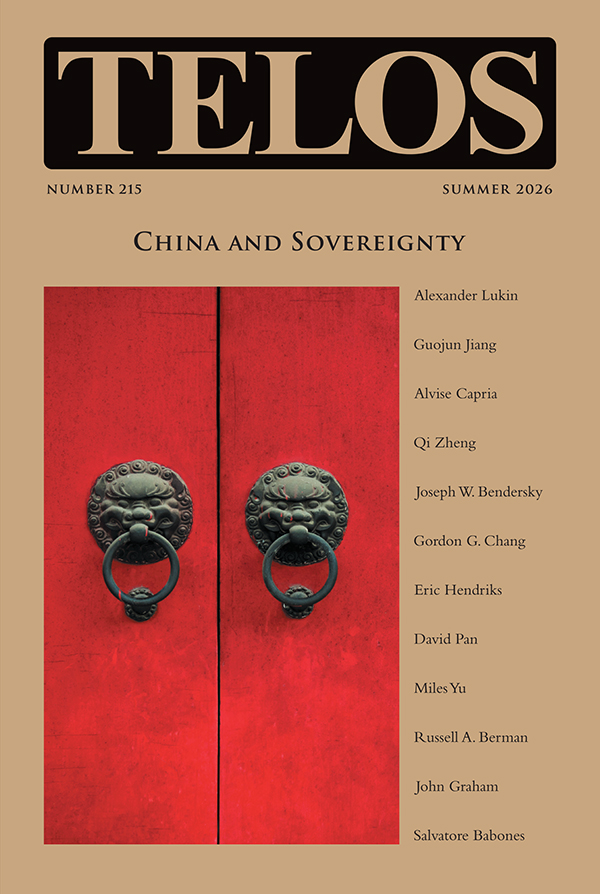
In today’s episode of the Telos Press Podcast, Telos editor David Pan talks with Alvise Capria about his article “Sous l’œil des Chinois: The Reception of Carl Schmitt in Contemporary Chinese Political Thought,” from Telos 215 (Summer 2026): China and Sovereignty. An excerpt of the article appears here. In their conversation they discuss the primary reasons that Chinese scholars look to Schmitt when thinking about political theory; the distinct currents in the Chinese reception of Schmitt, including Taiwan, Liu Xiaofeng, political constitutionalism (Chen Duanhong and Gao Quanxi), and the New Left (Wang Hui and Cui Zhiyuan), and how these currents are distinguished from each other; how the Chinese engagement with Schmitt is part of an attempt to develop an indigenous political theory, and how successful that attempt has been. If your university has an online subscription to Telos, you can read the full article at the Telos Online website. For non-subscribers, learn how your university can begin a subscription to Telos at our library recommendation page. Print copies of Telos 215 are available for purchase in our online store.
|
Telos 215 (Summer 2026): China and Sovereignty is now available for purchase in our store. Individual subscriptions to Telos are also available in both print and online formats.
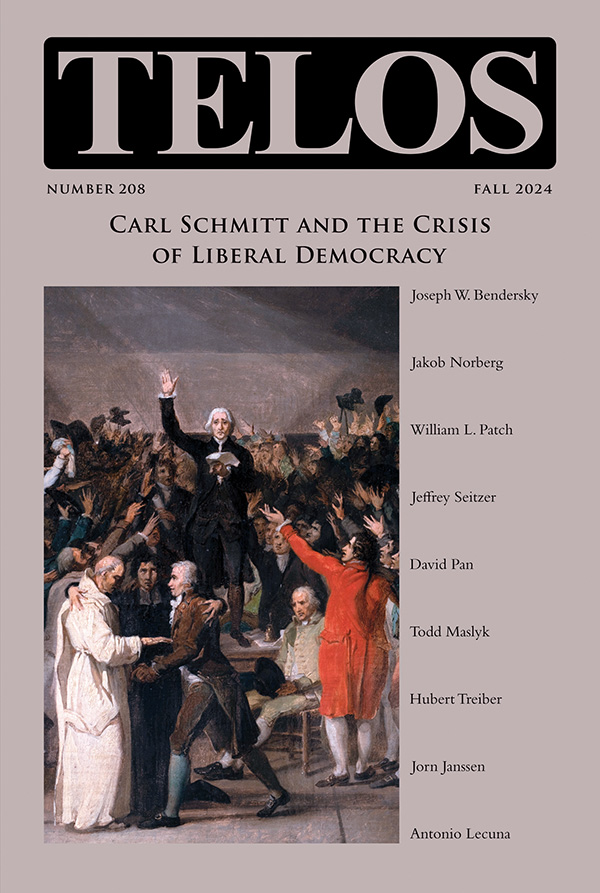
Telos 208 (Fall 2024): Carl Schmitt and the Crisis of Liberal Democracy is now available for purchase in our store. Individual subscriptions to Telos are also available in both print and online formats.
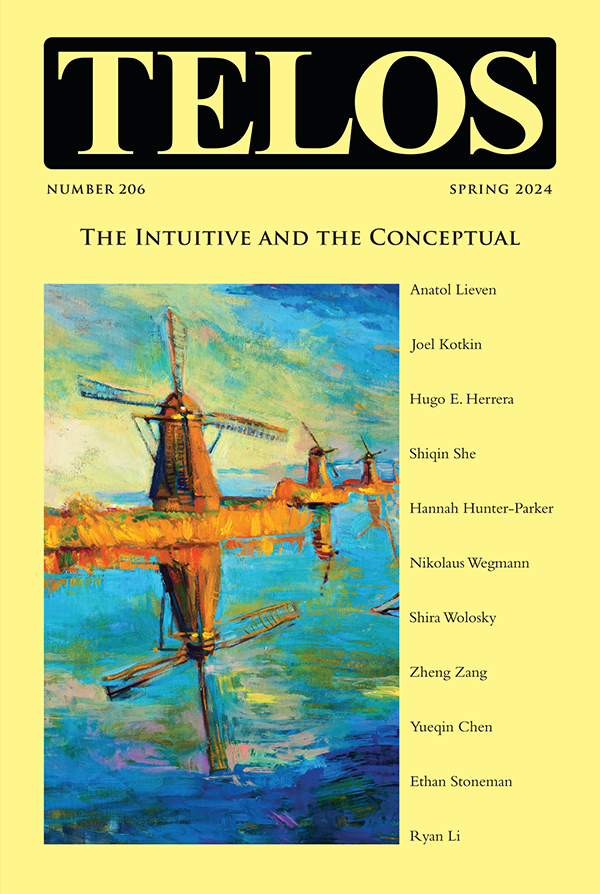
Meanwhile, authoritarian governments in places such as China, Russia, Iran, and North Korea have becoming increasingly aggressive in opposing liberal democracies as threats to their own legitimacy. In doing so, they have attempted to provide theoretical justifications for their authoritarian rule that are based in anti-Western and anti-colonial discourses that align with critiques of the West advanced by left-leaning academics in liberal democracies. Because they are based on freedom of expression and freedom of conscience, liberal democracies must allow open public spheres whose dynamics could take unforeseen directions that end up undermining the cultural and procedural foundations of liberal democratic governance. While the American Revolution provides the best example of the success of liberal democracy, the French Revolution and the Weimar Republic demonstrate spectacular failures. Outside of the West, the contrast between Taiwan and China and between Indonesian democracy and the Iranian Revolution indicate that we can find the same contrasts between failure and success in East Asia and in the Islamic world. Telos 206 (Spring 2024): The Intuitive and the Conceptual is now available for purchase in our store. Individual subscriptions to Telos are also available in both print and online formats.
In today’s episode of the Telos Press Podcast, David Pan talks with John Milbank about his article “A Tale of Two Monsters and Four Elements: Variations of Carl Schmitt and the Current Global Crisis,” from Telos 201 (Winter 2022). An excerpt of the article appears here. In their conversation they discuss the three idioms into which Milbank divides Carl Schmitt’s thought; why they should be seen as separate idioms rather than different aspects of a single perspective; the extent of overlap between the idioms; whether the decisionist Schmitt is as arbitrary as he is made out to be; the characteristics of a medieval European conception of nomos that Schmitt wishes to retrieve; the similarities between Schmitt’s third idiom of global regions and both Nazism and Russian theorists like Gumilev, Panarin, and Dugin; Schmitt’s decisionism, basic values, identity, and thinking through popular sovereignty. If your university has an online subscription to Telos, you can read the full article at the Telos Online website. For non-subscribers, learn how your university can begin a subscription to Telos at our library recommendation page. Print copies of Telos 201 are available for purchase in our online store. In today’s episode of the Telos Press Podcast, David Pan talks with Courtney Hodrick about her article “From Neoreaction to Alt-Right: A Schmittian Perspective,” from Telos 198 (Spring 2022). An excerpt of the article appears here. In their conversation they discuss Carl Schmitt’s understanding of the relationship between liberalism and democracy, and how the separation of the two from each other leads to two versions of extreme right thinking; the general outlines of Mencius Moldbug’s rejection of politics in favor of markets and the relationship between this approach and Schmitt’s understanding of politics as based in the friend/enemy distinction; why Moldbug is an example of what Schmitt defines as liberal; how Moldbug’s ideas contrast with those of Richard Spencer and the extent to which Spencer is a Schmittian; and Curtis Yarvin’s recent shift away from his previous rejections of nationalism and whether this shift represents a merging of neoreaction with alt-right populism. If your university has an online subscription to Telos, you can read the full article at the Telos Online website. For non-subscribers, learn how your university can begin a subscription to Telos at our library recommendation page. Print copies of Telos 198 are available for purchase in our online store. |
   |
|||
|
Privacy Policy · Data Protection Copyright © 2026 Telos Press Publishing · All Rights Reserved |
||||