By David Pan · Friday, March 19, 2021 Telos 194 (Spring 2021): Political Theology Today is now available for purchase in our store. Individual subscriptions to Telos are also available in both print and online formats.
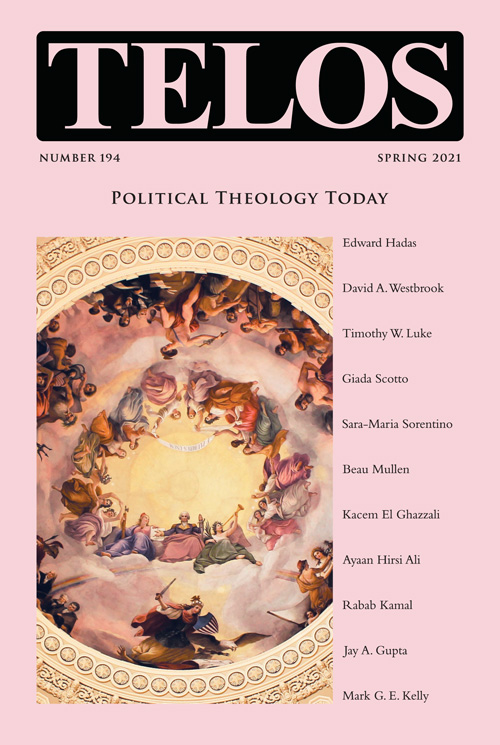 What does political theology mean today? At the Telos-Paul Piccone Institute conference from which many of the essays in this issue originated, a primary goal was to discuss the crisis of secular liberalism and “how faith is reshaping culture and politics today.” But even this project perhaps limits too much the scope of political theology, implying that we have a choice between reason and faith, or that political theology is a commitment to faith rather than an analysis of the element of faith that underlies all of our endeavors. The idea of political theology begins with the premise that every existing human order is built upon some understanding of ultimate meaning. The task would then be to analyze the kind of meaning that each existing order embodies and determine the kinds of decisions about meaning that are made and need to be made at various points in its history. Even secular liberalism, to the extent that it constitutes an existing order, presumes some answer to this question of meaning, and a closer look at the political theology of the United States reveals a mythic dimension that underlies its liberal democratic processes. The essays in this issue examine the political theological underpinnings of economy, politics, technology, and religion, laying out the ways in which these areas of human life develop not as autonomous spheres but as the result of struggles over a set of political theological choices. What does political theology mean today? At the Telos-Paul Piccone Institute conference from which many of the essays in this issue originated, a primary goal was to discuss the crisis of secular liberalism and “how faith is reshaping culture and politics today.” But even this project perhaps limits too much the scope of political theology, implying that we have a choice between reason and faith, or that political theology is a commitment to faith rather than an analysis of the element of faith that underlies all of our endeavors. The idea of political theology begins with the premise that every existing human order is built upon some understanding of ultimate meaning. The task would then be to analyze the kind of meaning that each existing order embodies and determine the kinds of decisions about meaning that are made and need to be made at various points in its history. Even secular liberalism, to the extent that it constitutes an existing order, presumes some answer to this question of meaning, and a closer look at the political theology of the United States reveals a mythic dimension that underlies its liberal democratic processes. The essays in this issue examine the political theological underpinnings of economy, politics, technology, and religion, laying out the ways in which these areas of human life develop not as autonomous spheres but as the result of struggles over a set of political theological choices.
Continue reading →
By Russell A. Berman · Monday, March 8, 2021 To read more in depth from Telos, subscribe to the journal here.
 A distinctive feature of public debate in Germany involves prominent literary authors, especially novelists, expounding on current political matters in major newspapers. Thomas Brussig’s essay “Risk More Dictatorship,” translated here, belongs to this genre. Known especially for his satire of East Germany, Heroes Like Us, Brussig chose a provocative title that seems to echo and respond to Chancellor Willy Brandt’s appeal more than fifty years ago to “risk more democracy.” Brandt was speaking in 1969 at a pivotal moment in the history of West Germany, indeed of the whole world, in the face of the protests during the previous year; Brussig in contrast appeals for “more dictatorship” in the face of the coronavirus pandemic, which he depicts as a potentially similar turning moment, with an accelerated “learning process,” that calls old certainties into question. These include the “end of history” claim that liberal democracy is inevitable; Brussig suggests that the “impotence” of democracies in the face of the pandemic raises the question as to whether other forms of government might be superior. The Chinese model of dictatorship casts a shadow across the essay. A distinctive feature of public debate in Germany involves prominent literary authors, especially novelists, expounding on current political matters in major newspapers. Thomas Brussig’s essay “Risk More Dictatorship,” translated here, belongs to this genre. Known especially for his satire of East Germany, Heroes Like Us, Brussig chose a provocative title that seems to echo and respond to Chancellor Willy Brandt’s appeal more than fifty years ago to “risk more democracy.” Brandt was speaking in 1969 at a pivotal moment in the history of West Germany, indeed of the whole world, in the face of the protests during the previous year; Brussig in contrast appeals for “more dictatorship” in the face of the coronavirus pandemic, which he depicts as a potentially similar turning moment, with an accelerated “learning process,” that calls old certainties into question. These include the “end of history” claim that liberal democracy is inevitable; Brussig suggests that the “impotence” of democracies in the face of the pandemic raises the question as to whether other forms of government might be superior. The Chinese model of dictatorship casts a shadow across the essay.
Continue reading →
By Telos Press · Monday, February 22, 2021 In the Spring issue of American Affairs, Blake Smith writes at length about Carl Schmitt’s “The Tyranny of Values,” the title essay of the collection The Tyranny of Values and Other Texts, published by Telos Press. Edited by Russell A. Berman and Samuel Garrett Zeitlin, translated by Samuel Garrett Zeitlin, and with a preface by David Pan, Schmitt’s The Tyranny of Values and Other Texts is now available for purchase in our online store. Save 20% off the list price by using the coupon code BOOKS20 during the checkout process.
An excerpt from the review:
 To those familiar with his most famous writings, it may seem that Carl Schmitt is an enemy of liberalism. In texts such as The Concept of the Political (1932) and Legality and Legitimacy (1932), Schmitt critiqued the Weimar Republic and the liberal tradition, the weaknesses of which Weimar seemed to embody. Liberalism, Schmitt argued, depends on systematic neutralizations—fictions by which all individuals and points of view are imagined to be equal, and by which the confrontations of political life seem to be transformed into peaceful, rule-governed debates with open-ended, undetermined outcomes. His writings during the Nazi era endorsed a new understanding of politics in which such deceptive procedures are replaced by the decisions of a charismatic leader who acts on behalf of a homogeneous people against its internal and external foes. Radicals of the Right and Left have found inspiration in Schmitt’s analysis of liberalism and calls for moving beyond it to a realistic and engaged theory that recognizes the insuperable conflicts at the heart of politics. To those familiar with his most famous writings, it may seem that Carl Schmitt is an enemy of liberalism. In texts such as The Concept of the Political (1932) and Legality and Legitimacy (1932), Schmitt critiqued the Weimar Republic and the liberal tradition, the weaknesses of which Weimar seemed to embody. Liberalism, Schmitt argued, depends on systematic neutralizations—fictions by which all individuals and points of view are imagined to be equal, and by which the confrontations of political life seem to be transformed into peaceful, rule-governed debates with open-ended, undetermined outcomes. His writings during the Nazi era endorsed a new understanding of politics in which such deceptive procedures are replaced by the decisions of a charismatic leader who acts on behalf of a homogeneous people against its internal and external foes. Radicals of the Right and Left have found inspiration in Schmitt’s analysis of liberalism and calls for moving beyond it to a realistic and engaged theory that recognizes the insuperable conflicts at the heart of politics.
Continue reading →
By Telos Press · Tuesday, December 29, 2020 In today’s episode of the Telos Press Podcast, Camelia Raghinaru talks with David Pan about his article “State, Movement, People: Representation and Race in the Construction of Political Identity,” from Telos 189 (Winter 2019). An excerpt of the article appears here. If your university has an online subscription to Telos, you can read the full article at the Telos Online website. For non-subscribers, learn how your university can begin a subscription to Telos at our library recommendation page. Purchase a print copy of Telos 189 in our online store.
Listen to the podcast here.
Continue reading →
By Telos Press · Thursday, December 10, 2020 In today’s episode of the Telos Press Podcast, Camelia Raghinaru talks with Devin Singh about his article “Exceptional Economy: Sovereign Exchanges in Carl Schmitt and Giorgio Agamben,” from Telos 191 (Summer 2020). An excerpt of the article appears here. If your university has an online subscription to Telos, you can read the full article at the Telos Online website. For non-subscribers, learn how your university can begin a subscription to Telos at our library recommendation page. Purchase a print copy of Telos 191 in our online store.
Listen to the podcast here.
Continue reading →
By Telos Press · Friday, February 21, 2020 Writing in the new issue of Philosophy in Review, Adam Sliwowski reviews Carl Schmitt’s The Tyranny of Values and Other Texts, translated by Samuel Garrett Zeitlin, edited by Russell A. Berman and Samuel Garrett Zeitlin, with a preface by David Pan. Order your copy in our online store, and save 20% on the list price by using the coupon code BOOKS20 during the checkout process.
An excerpt:
 The works of Carl Schmitt—a German jurist and political theorist infamous for his involvement with National Socialism—continue to have wide international appeal, influencing scholars in a number of fields from political science and jurisprudence to political-theology and existential philosophy. Nevertheless, much of his prolific oeuvre, written over the span of almost 70 years, remains untranslated into English. With The Tyranny of Values and Other Texts, Samuel Garrett Zeitlin takes a step in filling this gap with an edited collection of finely translated and helpfully annotated texts that appear in English for the first time. This collection of occasional pieces, spanning from the Weimar era to the Cold War, shows Schmitt responding to a diverse array of socio-political exigencies and world-historical developments, while also shedding light on many of the central themes of Schmitt’s work, such as the distinction between legality and legitimacy, land and sea, the nomos of the earth, and the figure of the partisan. The works of Carl Schmitt—a German jurist and political theorist infamous for his involvement with National Socialism—continue to have wide international appeal, influencing scholars in a number of fields from political science and jurisprudence to political-theology and existential philosophy. Nevertheless, much of his prolific oeuvre, written over the span of almost 70 years, remains untranslated into English. With The Tyranny of Values and Other Texts, Samuel Garrett Zeitlin takes a step in filling this gap with an edited collection of finely translated and helpfully annotated texts that appear in English for the first time. This collection of occasional pieces, spanning from the Weimar era to the Cold War, shows Schmitt responding to a diverse array of socio-political exigencies and world-historical developments, while also shedding light on many of the central themes of Schmitt’s work, such as the distinction between legality and legitimacy, land and sea, the nomos of the earth, and the figure of the partisan.
Continue reading →
|
|