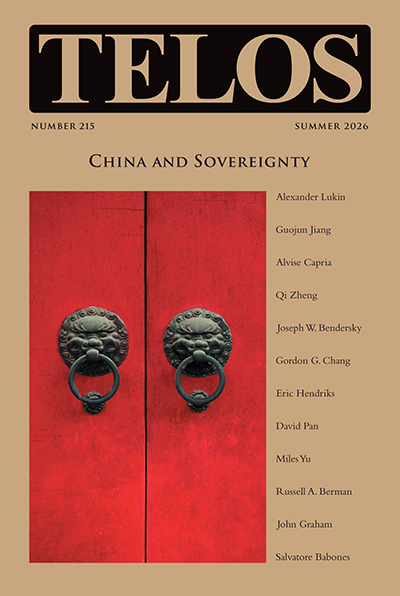
Telos 215 (Summer 2026): China and Sovereignty is now available for purchase in our store. Individual subscriptions to Telos are also available in both print and online formats.
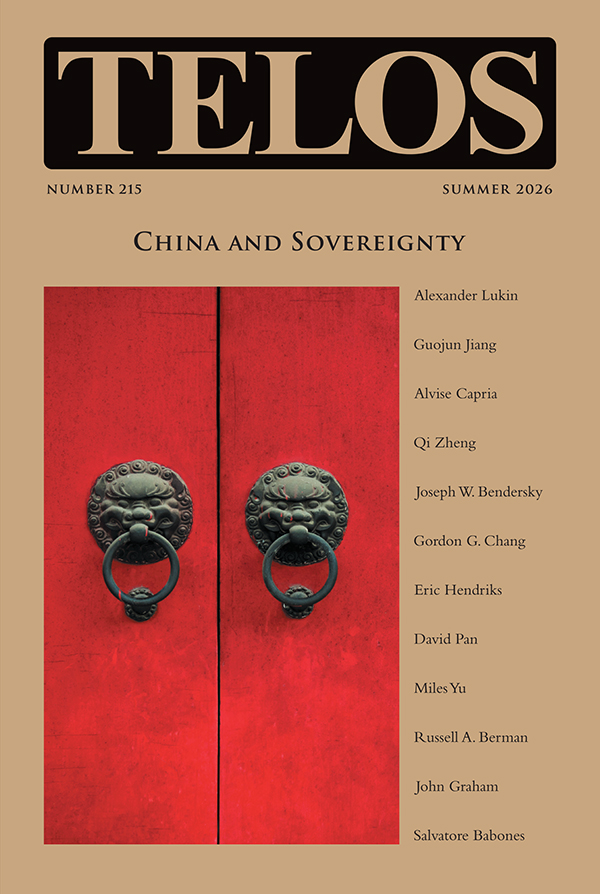 China remains the inscrutable elephant in the room for the world’s political theorists and policymakers. Its growing importance to the world’s economy and politics compels us to continue to analyze its ideological currents and political conflicts. While scholars inside and outside of China struggle with the Chinese Communist Party’s attempts to censor debate, it is all the more necessary to engage scholars in productive discussions that provide real analysis rather than talking points. The essays in this issue on China and sovereignty discuss how China has engaged with Western thinkers, in particular Karl Marx, Michel Foucault, and Carl Schmitt, to develop its own basis for sovereignty and its vision for world order. Subsequently, our authors offer conflicting perspectives on the nature of the Chinese government and how the United States should respond to China’s rise.
We begin with two essays that attempt to understand the landscape of modern Chinese thought. Alexander Lukin provides an overview of the reception of the Chinese Cultural Revolution in China, the Soviet Union, and the West. Chinese theorists have argued that it was either a left-wing aberration or a revisionist (i.e., counterrevolutionary) movement. Yet there have also been recent attempts to praise the Cultural Revolution for its left-wing purity and its ability to criticize an existing bureaucracy. Lukin argues that the Cultural Revolution was fundamentally an educational project, albeit a brutal one. Because the masses and intelligentsia were insufficiently communist in their thinking, cultural revolution was necessary in order to educate people. As such, the Cultural Revolution was not linked to Chinese traditions such as Confucianism but was rather a continuation of Marxist ideas. It envisioned a purification of thinking and policy in order to bring about the realization of a Marxist world that demands from all according to their abilities and provides to all according to their needs. This social justice goal required the continuation of communal structures and centralized distribution that had been delegitimated by the disaster of the Great Leap Forward. Consequently, the Cultural Revolution was an attempt to promote those policies through a forced education campaign that sought to create equality by dissolving differences between urban and rural, workers and peasants, and intellectual and manual labor. Lukin further argues that Western critical theory was similar to the Cultural Revolution to the extent that it focused, from the Frankfurt School onward, on an ideological agenda that sought to mobilize the masses for a socialist project after it became clear that they were not interested in such a project. The “woke” movement thus has the task of finding oppressed victims to take over the role of the proletariat and provide the ideological rallying point for a socialist transformation. Lukin sees the primary significance of recent Chinese thought as providing a haven for the socialist project of creating equality of outcomes. China embraced Marxism as a dominant ideology in the twentieth century, and the Cultural Revolution was the culmination of this attempt to overturn traditional modes of thinking.
By contrast, Guojun Jiang argues that China’s mode of thought was long dominated by perspectives that prevented such revolutionary moments. She focuses on the longer trajectory of Chinese thought to argue that the Chinese cultural tradition did not experience the shift from resemblance to representation that Michel Foucault describes in the West. Jiang depicts the process of naming in the Chinese Confucian tradition as an example of a Foucauldian merging of power with knowledge. Names establish order, both by providing the correct names but also by enforcing a particular order and hierarchy. Rather than rejecting or overturning such order, critique in China took a Daoist form that invoked a state of nature as something that exists outside the naming process. Daoist critique does not reject any particular order but points to the contradictory character of order itself. This alternative mode of critique exists within an order while “transforming the subject’s mode of perception rather than merely denouncing the structures that shape it.” As opposed to criticizing any particular structure, Daoism criticizes structure itself, even as it maintains the possibility of transformation on a subjective level. Jiang suggests that this form of critique has been the dominant one in the Chinese tradition, though she does not speculate about the reasons for the wholesale rejection of that tradition with the move toward Marxism and the Cultural Revolution.
Recent Chinese political theory has engaged intensively with the work of Carl Schmitt. In our special section on Schmitt in China, our authors present different ideas about the reasons for this interest and the ways in which Schmitt’s work intersects with that of key political theorists in China.
Alvise Capria argues that China’s turn to Schmitt results from the specific situation in which China’s political theorists accept market structures that preclude a return to the politics of class war but also reject the political pluralism typically connected with economic liberalism. Schmitt’s political theory offers a way of imagining how this combination can maintain stability. From the Chinese Schmittian perspective, his analysis of sovereignty is valuable because it treats law not as a universal framework that might pose a challenge to political power, but as a consequence of a particular conception of sovereignty, whatever that conception may be. By prioritizing the political over the legal, Schmitt’s theory offers different possibilities for imagining a post-Mao yet anti-liberal trajectory for China.
In a similar attempt to understand how the Chinese interest in Schmitt stems from the goal of supporting state power, Qi Zheng argues that the Chinese reception of Schmitt has generally downplayed his Nazi sympathies in order to focus on the connection between the critique of liberal democracy and the goal of maintaining the stability of the state. Chinese Schmitt scholars interpret his shift from support for the Weimar Republic to collaboration with the Nazi Party not as an opportunistic move but as a consequence of his belief that the pursuit of individual rights and freedom had undermined the political unity of the state by neglecting the importance of defining enemies. Accordingly, the significance of Schmitt for Chinese communists has been to serve as a warning against pursuing liberal democracy and an encouragement to find alternative structures for Chinese political order that can guarantee state power. Liberal interpreters of Schmitt in China, principally Zhou Lian, have not challenged this reading of Schmitt’s turn to Nazism. Instead, Zhou has largely taken over the narrative that the sovereign decision on the enemy leads inevitably to a rejection of liberal democracy, but he does this in order to reject Schmitt’s thought. In contending that his decisionism is fundamentally opposed to public debate and the rule of law, Zhou sees Schmitt’s work as both inseparable from his Nazism and as a danger to attempts to shift China toward liberal democratic values and structures.
By contrast, Joseph Bendersky foregrounds Schmitt’s support for liberal democracy and antipathy toward communism to refute the idea that his work is well suited for use by Chinese political theorists to justify communism. While Schmitt recognized in Mao someone who supported the idea of a fragmentation of the world into a few large Großräume (super-regions), the current Chinese use of this idea in fact tends toward an extension of a unified Chinese sovereignty over the world, an idea that Schmitt vehemently opposed. As Bendersky argues, Schmitt’s conception of Großraum was fundamentally anti-universalistic. While his insights into the nature of politics may have broad applicability, the focus on popular sovereignty makes his work unsuitable for justifying Chinese authoritarianism and messianic expansionism.
The origin of our section on China, Taiwan, and the United States illustrates the current difficulties in sponsoring real debate between different perspectives about China. The Telos-Paul Piccone Institute organized a second China-themed conference in New York on March 20–21, 2026, on “The Chinese New Leviathan” as a follow up to its March 2025 conference on “China Keywords.” A number of academics from China, Taiwan, Europe, and the United States participated, including Wang Hui as the keynote speaker. The plan was to include as wide a variety of perspectives as possible. Toward that end, the Institute sought to also invite Gordon Chang and Miles Yu, key critics of the Chinese Communist Party, to engage with its defenders. Unfortunately, many if not all of the participants from China would have withdrawn from the event if Chang and Yu were also going to be present. Rather than accept this withdrawal, the Institute decided to stage two events. The conference in New York went on as planned, but without the presence of Chang and Yu. In addition, though, the Institute organized a separate conference at the University of California, Irvine, on May 4, 2026, where Chang and Yu could engage with other scholars with differing perspectives. We present the initial results of this event here in a special section on China, Taiwan, and the United States.
The first three essays, by Gordon Chang, Eric Hendriks, and me, attempt to describe the nature of the challenge from China to the United States and the world. Chang argues that China’s communism needs terror in order to survive. The return to strongman rule with Xi Jinping fulfills that need. Liberal democracy, however, poses an ideological threat to China’s communists because it offers an alternative vision that opposes such terror. Accordingly, China’s communists seek to occupy Taiwan because it presents an example of a successful democracy that grew out of Chinese traditions. Further, China’s communists are fighting proxy wars all over the world against the United States in order to sow the chaos that they believe can eventually undermine liberal democracy worldwide.
Hendriks opposes the idea that China’s political order can be summed up in a single term such as “totalitarianism.” Instead, he argues that China combines three different layers. First, China is a differentiated and sophisticated society that is modern and global to the extent that it includes autonomously functioning fields such as “commerce, science, media, technology, sports, and law,” in which each field is an independent system with its own frameworks that are adapted to global institutions and practices. Second, China is a Leninist party-state in which all institutions are integrated into and ruled over by the Chinese Communist Party. Third, China has a civilizational legacy that provides a unique set of perspectives and practices that shape current institutions. Hendriks insists on this complexity of layers in order to counter “polemical caricatures” of China as an evil other to liberal democracy.
My own essay focuses on the way in which the Chinese Communist Party has been attempting to rewrite the rules of global order. Contrary to the idea that sovereignty and law are opposed to each other, I argue that any establishment of sovereignty requires both power and a conception of order. Moral considerations cannot be separated from the exercise of power, and the rules of global order will reflect the character of those who are able to establish a particular set of rules through sovereign decisions that reflect their principles. In its rhetoric, the CCP insists on the inviolability of state sovereignty and presents a rhetoric of universality in the idea of a “shared community of human destiny.” Yet the true meaning of CCP power reveals itself in its actions, in which it uses economic and military coercion to dominate East Asia and to suppress alternative perspectives on global order. In its actions, the CCP is attempting to establish its own vision of global order that protects totalitarianism and undermines popular sovereignty as embodied in separate nation-states.
Miles Yu, Russell Berman, and John Graham provide recommendations for U.S. policy regarding China. Yu argues that the conflict between China and the United States centers on an ideological divide between totalitarian control and popular self-government as the basis of political order. Though it opposes liberal democracy, China still has access to global markets, capital, technology, and educational institutions to an extent never achieved by previous U.S. adversaries such as the Soviet Union. In addition, China takes advantage of the openness of U.S. institutions to influence and threaten those institutions with its United Front propaganda strategy. Consequently, Yu argues that the United States must pursue a comprehensive strategy that includes protecting its democratic and educational institutions from foreign interference, re-establishing the military power to maintain peace through deterrence, strengthening global alliances, and rebuilding the U.S. industrial base.
Russell Berman argues that the ideological and moral questions regarding China are secondary to the strategic issues. However we classify its form of governance and its degree of freedom, it is clear that China is challenging U.S. power and its structuring of international order. Whether to classify China as authoritarian or totalitarian does not change the analysis of how the world should respond to its growing economic, technological, and military power. Consequently, the focus should be on the strategic responses to China rather than on an ideological battle. Berman agrees with Yu that the focus of U.S. policy should be on developing military deterrence, rebuilding the U.S. industrial base, and protecting the integrity of its educational and political institutions.
Also downplaying the importance of ideology, John Graham draws an opposite conclusion about policy. He argues that trade causes peace and that China’s trading relationships with the rest of the world will prevent war. As the world becomes more interconnected through trade, he looks forward to the inevitable end of war. He challenges both the United States and China to reduce their military spending and nuclear arsenals. This would allow more money to be spent on the real problems both countries face: improving social safety nets and combatting climate change.
Finally, Salvatore Babones responds to the essays by Eric Hendriks and me in Telos 214, in which we responded to his initial critique of our introduction to Telos 213.[1] Against Hendriks, Babones contends that the Chinese vision of a “human community of shared destiny” is propaganda and not political thought. In response to my essay, he argues that the term “authoritarianism” denotes a discrete regime type and not an opposite to liberalism. He also disputes the idea that the “rule of custom and law” is a good characterization of liberalism.
1. Salvatore Babones, “Authoritarianism, Democracy, Legitimacy—and the Capacity of Regimes to Support Intellectual Production,” Telos 214 (Spring 2026): 127–38; Eric Hendriks, “Chinese Political Thought Is a Worthy Interlocutor: A Response to Salvatore Babones,” Telos 214 (Spring 2026): 139–51; David Pan, “Authoritarianism and Totalitarianism in China: Reply to Salvatore Babones and Eric Hendriks,” Telos 214 (Spring 2026):152–63.
David Pan is Professor of European Languages and Studies at the University of California, Irvine, and has previously held positions at Washington University in St. Louis, Stanford University, Penn State University, and McKinsey and Company. He is the author of Primitive Renaissance: Rethinking German Expressionism (2001) and Sacrifice in the Modern World: On the Particularity and Generality of Nazi Myth (2012). He has also published on J. G. Herder, Heinrich von Kleist, Friedrich Nietzsche, Franz Kafka, Walter Benjamin, Ernst Jünger, Bertolt Brecht, Carl Schmitt, and Theodor Adorno. He is the Editor of Telos.