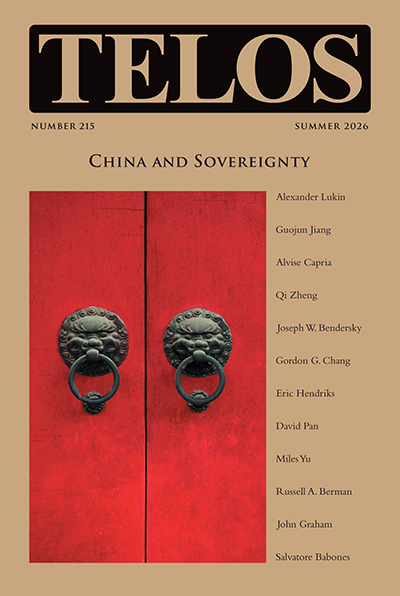
By David Pan · Friday, July 17, 2026 Telos 215 (Summer 2026): China and Sovereignty is now available for purchase in our store. Individual subscriptions to Telos are also available in both print and online formats.
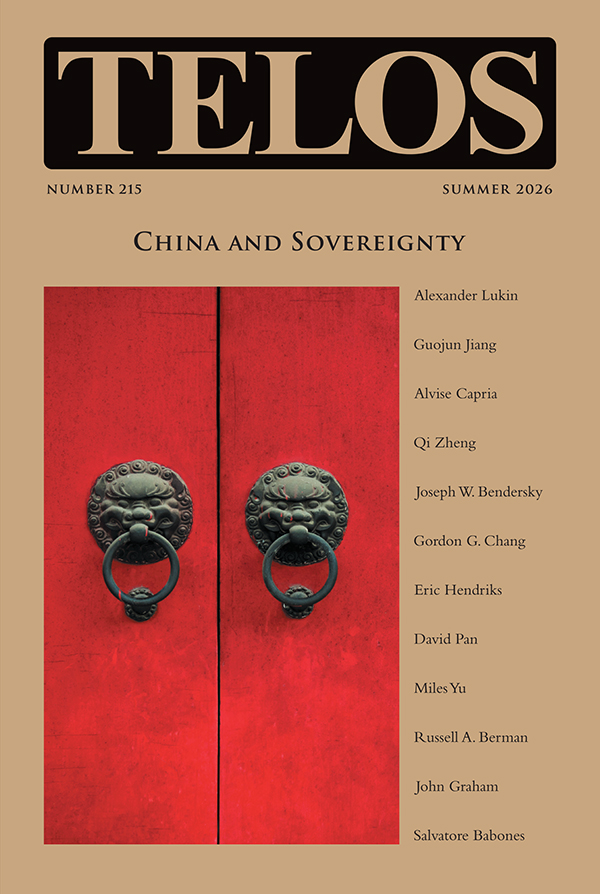 China remains the inscrutable elephant in the room for the world’s political theorists and policymakers. Its growing importance to the world’s economy and politics compels us to continue to analyze its ideological currents and political conflicts. While scholars inside and outside of China struggle with the Chinese Communist Party’s attempts to censor debate, it is all the more necessary to engage scholars in productive discussions that provide real analysis rather than talking points. The essays in this issue on China and sovereignty discuss how China has engaged with Western thinkers, in particular Karl Marx, Michel Foucault, and Carl Schmitt, to develop its own basis for sovereignty and its vision for world order. Subsequently, our authors offer conflicting perspectives on the nature of the Chinese government and how the United States should respond to China’s rise. China remains the inscrutable elephant in the room for the world’s political theorists and policymakers. Its growing importance to the world’s economy and politics compels us to continue to analyze its ideological currents and political conflicts. While scholars inside and outside of China struggle with the Chinese Communist Party’s attempts to censor debate, it is all the more necessary to engage scholars in productive discussions that provide real analysis rather than talking points. The essays in this issue on China and sovereignty discuss how China has engaged with Western thinkers, in particular Karl Marx, Michel Foucault, and Carl Schmitt, to develop its own basis for sovereignty and its vision for world order. Subsequently, our authors offer conflicting perspectives on the nature of the Chinese government and how the United States should respond to China’s rise.
Continue reading →
By Arash Falasiri · Monday, March 23, 2015  In his Critique of Judgment, Kant explains how “subjective judgments” resemble theoretical claims about truth in that they claim universal assent, even though they do not have an objective basis for doing so. In other words, although they are subjective, they assert a strict sense of objectivity and claim a universal ground for truth. Therefore, the proof of the validity of these judgments cannot be found in a specific “observable feature” of the object, but rather in the “actual intersubjective agreement.” While truth in his third Critique is neither a matter of the intellect nor a thing reducible to conceptual realm, it seems that he offers a different sense of truth that influenced the major trends in continental philosophy. One can trace this sense of truth as it provides a ground not only to “test the limits of our historical era” but also “to go beyond them.” In his Critique of Judgment, Kant explains how “subjective judgments” resemble theoretical claims about truth in that they claim universal assent, even though they do not have an objective basis for doing so. In other words, although they are subjective, they assert a strict sense of objectivity and claim a universal ground for truth. Therefore, the proof of the validity of these judgments cannot be found in a specific “observable feature” of the object, but rather in the “actual intersubjective agreement.” While truth in his third Critique is neither a matter of the intellect nor a thing reducible to conceptual realm, it seems that he offers a different sense of truth that influenced the major trends in continental philosophy. One can trace this sense of truth as it provides a ground not only to “test the limits of our historical era” but also “to go beyond them.”
Continue reading →
By Dimitris Gakis · Monday, January 12, 2015 Dimitris Gakis’s “Wittgenstein and Marx on Reification, Language, and Commonality” appears in Telos 169 (Winter 2014). Read the full version online at the Telos Online website, or purchase a print copy of the issue in our store.
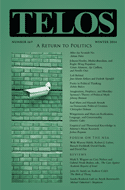 The article is primarily occupied with some of the affinities that can be discerned between the philosophical outlooks of (later) Wittgenstein and Marx. Starting from a short account of the connections that can be drawn between Wittgenstein and Marx from a historico-biographical and a metaphilosophical point of view, we focus then on three main points on which their philosophical perspectives converge. The first one has to do with Marx’s concept of reification and Wittgenstein’s deep criticism against those approaches to language and meaning that exhibit reificatory characteristics. The second one is related, first, to their common conception of language as a matter of social praxis and their shared rejection of the idea of a private language and, second, to their common prioritization of everyday language over what they often call metaphysical or philosophical language which they take to be a distorted and deceiving form of everyday language. The third and last point regards the shared emphasis of Wittgenstein and Marx on the notion of the “common” and on the communal aspects of human life and praxis. The article concludes with a reference to some of Wittgenstein’s criticisms against certain aspects of Marxist thought, such as scientism, determinism, and economism, and a brief discussion of how Wittgenstein’s later philosophy may be viewed as a (potentially) significant contribution to the cause of personal and social autonomy. The article is primarily occupied with some of the affinities that can be discerned between the philosophical outlooks of (later) Wittgenstein and Marx. Starting from a short account of the connections that can be drawn between Wittgenstein and Marx from a historico-biographical and a metaphilosophical point of view, we focus then on three main points on which their philosophical perspectives converge. The first one has to do with Marx’s concept of reification and Wittgenstein’s deep criticism against those approaches to language and meaning that exhibit reificatory characteristics. The second one is related, first, to their common conception of language as a matter of social praxis and their shared rejection of the idea of a private language and, second, to their common prioritization of everyday language over what they often call metaphysical or philosophical language which they take to be a distorted and deceiving form of everyday language. The third and last point regards the shared emphasis of Wittgenstein and Marx on the notion of the “common” and on the communal aspects of human life and praxis. The article concludes with a reference to some of Wittgenstein’s criticisms against certain aspects of Marxist thought, such as scientism, determinism, and economism, and a brief discussion of how Wittgenstein’s later philosophy may be viewed as a (potentially) significant contribution to the cause of personal and social autonomy.
Continue reading →
By Carlos Gasperi · Friday, May 9, 2014 The following paper was presented at the Eighth Annual Telos Conference, held on February 15–16, 2014, in New York City.
 In the following, I address the question of Venezuelan democracy under the fourteen-year mandate of recently deceased President Hugo Chávez from the philosophical perspective of Karl Marx’s The Eighteenth Brumaire to Louis Bonaparte. Recent Latin American history of the past twenty years has seen a resurgence of leftist governments sympathetic to Cuba’s Marxist revolutionary ideals of the 1960s, where Venezuela is no exception. Focusing on one particular event in Venezuela’s contemporary history, I wish to accomplish two things. The first is to convince my audience that Nicolás Maduro’s inauguration ceremony of his then newly appointed presidential cabinet in late-April 2013 is the sharpest expression of the current failed state and non-direction of Chavismo in Venezuela, or more precisely, what I call the dissolution of its sensus communis. Second, I wish to advance a philosophical question for discussion among audience members, namely, does replicating a historically prior political ideology ever secure success for democracy within present historical circumstances; more succinctly, in other words, do anachronistic political experiments produce volatile democracies? In the following, I address the question of Venezuelan democracy under the fourteen-year mandate of recently deceased President Hugo Chávez from the philosophical perspective of Karl Marx’s The Eighteenth Brumaire to Louis Bonaparte. Recent Latin American history of the past twenty years has seen a resurgence of leftist governments sympathetic to Cuba’s Marxist revolutionary ideals of the 1960s, where Venezuela is no exception. Focusing on one particular event in Venezuela’s contemporary history, I wish to accomplish two things. The first is to convince my audience that Nicolás Maduro’s inauguration ceremony of his then newly appointed presidential cabinet in late-April 2013 is the sharpest expression of the current failed state and non-direction of Chavismo in Venezuela, or more precisely, what I call the dissolution of its sensus communis. Second, I wish to advance a philosophical question for discussion among audience members, namely, does replicating a historically prior political ideology ever secure success for democracy within present historical circumstances; more succinctly, in other words, do anachronistic political experiments produce volatile democracies?
Continue reading →
By Vincent Geoghegan · Monday, January 13, 2014 Vincent Geoghegan’s “Marcuse and ‘the Christian Bourgeois Concept of Freedom'” appears in Telos 165 (Winter 2013). Read the full version online at the Telos Online website, or purchase a print copy of the issue in our store.
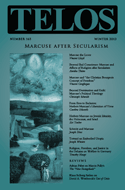 Current talk of the post-secular necessarily invites analysis of the nature of the secular, particularly its historical genesis and subsequent development. The task is to reject what Charles Taylor in A Secular Age has termed “subtraction stories” of the emergence of secularism, involving simplistic assumptions about the inexorable evaporation and attenuation of the religious, and instead understand the complex constitutive role religion has played in the construction of the secular. Marcuse’s work is of interest in this respect because beginning with his 1930s analysis of what he terms “the Christian bourgeois concept of freedom” within the Protestant Reformation, he explores the ways in which he believes modern secular society emerged out of Christianity. Current talk of the post-secular necessarily invites analysis of the nature of the secular, particularly its historical genesis and subsequent development. The task is to reject what Charles Taylor in A Secular Age has termed “subtraction stories” of the emergence of secularism, involving simplistic assumptions about the inexorable evaporation and attenuation of the religious, and instead understand the complex constitutive role religion has played in the construction of the secular. Marcuse’s work is of interest in this respect because beginning with his 1930s analysis of what he terms “the Christian bourgeois concept of freedom” within the Protestant Reformation, he explores the ways in which he believes modern secular society emerged out of Christianity.
Continue reading →
By J. F. Dorahy · Tuesday, April 16, 2013 As an occasional feature on TELOSscope, we highlight a past Telos article whose critical insights continue to illuminate our thinking and challenge our assumptions. Today, J. F. Dorahy looks at Joel Whitebook’s “Saving the Subject: Modernity and the Problem of the Autonomous Individual,” from Telos 50 (Winter 1981).
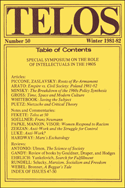 Autonomy is, arguably, the most fundamental concept in the discursive constellation of modernity. If it is apposite, and I believe it is, to think in terms of the differentiation between political, socio-economic, and cultural modernities, then it is clear that the concept of autonomy—either with reference to the autonomous individual or the autonomous work of art—is a constitutive force within each sphere. In “Saving the Subject: Modernity and the Problem of the Autonomous Individual,” Joel Whitebook offers a historically nuanced overview of the difficulties involved in thinking the “autonomous individual” under the conditions of a dynamic and increasingly complex modernity. Whitebook’s piece is wide-ranging and fuses a deep psychoanalytic insight with a robust sociological consciousness: a fusion that accompanies, to my mind, the best critical theory. To be sure, the many subtleties and divergences that emerge from Whitebook’s dialectic are resistant to a full reconstruction within this preview. Rather, I would like to simplify Whitebook’s account by drawing out the three historical epochs examined by Whitebook and say a few things regarding the key aspects of Whitebook’s reading of Marx and Freud and Adorno and Habermas as thinkers who most significantly appreciate the problematic nature of the modern, autonomous individual. Finally, I conclude by arguing for the innovative character of Whitebook’s thoughts regarding the centrality of affective relationships in the formation of the autonomous individual. Autonomy is, arguably, the most fundamental concept in the discursive constellation of modernity. If it is apposite, and I believe it is, to think in terms of the differentiation between political, socio-economic, and cultural modernities, then it is clear that the concept of autonomy—either with reference to the autonomous individual or the autonomous work of art—is a constitutive force within each sphere. In “Saving the Subject: Modernity and the Problem of the Autonomous Individual,” Joel Whitebook offers a historically nuanced overview of the difficulties involved in thinking the “autonomous individual” under the conditions of a dynamic and increasingly complex modernity. Whitebook’s piece is wide-ranging and fuses a deep psychoanalytic insight with a robust sociological consciousness: a fusion that accompanies, to my mind, the best critical theory. To be sure, the many subtleties and divergences that emerge from Whitebook’s dialectic are resistant to a full reconstruction within this preview. Rather, I would like to simplify Whitebook’s account by drawing out the three historical epochs examined by Whitebook and say a few things regarding the key aspects of Whitebook’s reading of Marx and Freud and Adorno and Habermas as thinkers who most significantly appreciate the problematic nature of the modern, autonomous individual. Finally, I conclude by arguing for the innovative character of Whitebook’s thoughts regarding the centrality of affective relationships in the formation of the autonomous individual.
Continue reading →
|
|