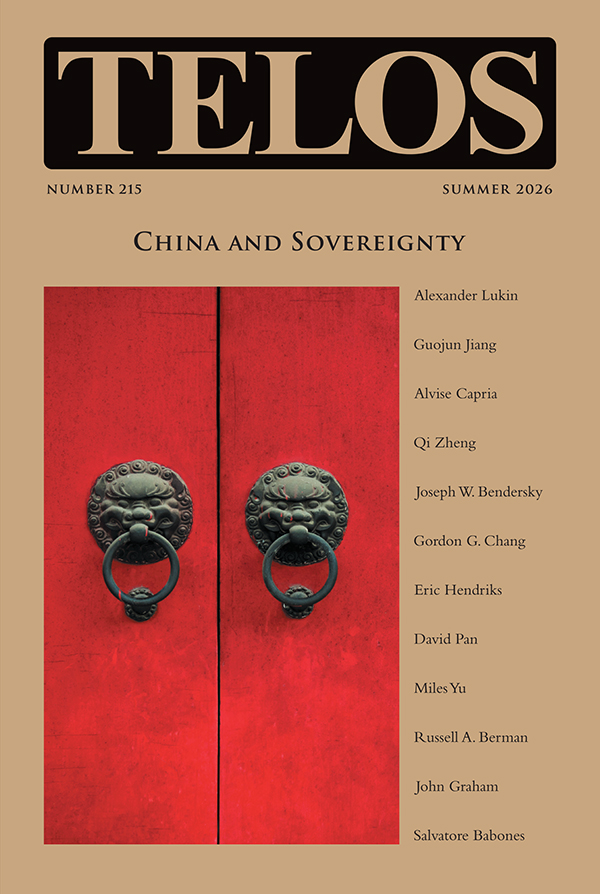
In today’s episode of the Telos Press Podcast, Telos editor David Pan talks with Alvise Capria about his article “Sous l’œil des Chinois: The Reception of Carl Schmitt in Contemporary Chinese Political Thought,” from Telos 215 (Summer 2026): China and Sovereignty. An excerpt of the article appears here. In their conversation they discuss the primary reasons that Chinese scholars look to Schmitt when thinking about political theory; the distinct currents in the Chinese reception of Schmitt, including Taiwan, Liu Xiaofeng, political constitutionalism (Chen Duanhong and Gao Quanxi), and the New Left (Wang Hui and Cui Zhiyuan), and how these currents are distinguished from each other; how the Chinese engagement with Schmitt is part of an attempt to develop an indigenous political theory, and how successful that attempt has been. If your university has an online subscription to Telos, you can read the full article at the Telos Online website. For non-subscribers, learn how your university can begin a subscription to Telos at our library recommendation page. Print copies of Telos 215 are available for purchase in our online store.
|
Telos 215 (Summer 2026): China and Sovereignty is now available for purchase in our store. Individual subscriptions to Telos are also available in both print and online formats.
|
   |
|||
|
Privacy Policy · Data Protection Copyright © 2026 Telos Press Publishing · All Rights Reserved |
||||