By Qi Zheng · Wednesday, July 24, 2019 Qi Zheng’s “Carl Schmitt, Justice of War, and Individual Citizen’s Obligation” appears in Telos 187 (Summer 2019). Read the full article at the Telos Online website, or purchase a print copy of the issue in our online store. Individual subscriptions to Telos are available in both print and online formats.
 Carl Schmitt produced the original text of “The International Crime of the War of Aggression and the Principle ‘Nullum crimen, nulla poena sine lege‘” in 1945. The fundamental issue of the text concerns an individual citizen’s obligation in international law toward his national government in the event of an unjust war. Schmitt’s analysis of the issue is based on his perception of politics as the relationship between protection and obedience. However, his understanding of this relationship is not consistent with what he proposed in his other major works, i.e., that the relationship is a collective one. In order to support the argument in his 1945 text, Schmitt completely abandoned his collective understanding of the relationship and changed it to an individualistic understanding. This paper explores the subtle but important change in Schmitt’s argument. Carl Schmitt produced the original text of “The International Crime of the War of Aggression and the Principle ‘Nullum crimen, nulla poena sine lege‘” in 1945. The fundamental issue of the text concerns an individual citizen’s obligation in international law toward his national government in the event of an unjust war. Schmitt’s analysis of the issue is based on his perception of politics as the relationship between protection and obedience. However, his understanding of this relationship is not consistent with what he proposed in his other major works, i.e., that the relationship is a collective one. In order to support the argument in his 1945 text, Schmitt completely abandoned his collective understanding of the relationship and changed it to an individualistic understanding. This paper explores the subtle but important change in Schmitt’s argument.
This paper is divided into two sections. The first section reconstructs Schmitt’s arguments on an individual citizen’s right to resistance in international law. It focuses on two questions: whether an individual citizen has the right to judge the justice of war and whether individuals have an obligation in international law to disobey the government if they find that their government is conducting an unjust war. The second section examines Schmitt’s argument about the relationship between protection and obedience.
Continue reading →
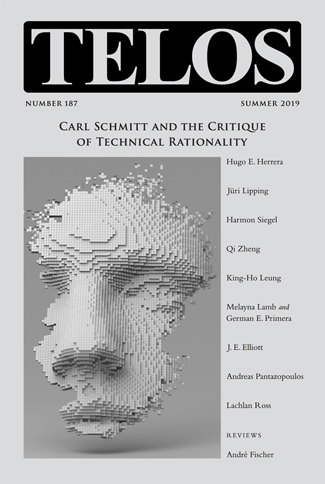
By David Pan · Monday, June 17, 2019 Telos 187 (Summer 2019) is now available for purchase in our store. Individual subscriptions to Telos are also available in both print and online formats.
After a modern era of technological progress that has led humans to believe in their increasing ability to control nature, we are reaching a point at which this power on a small scale has given way to increasing uncertainty and uncontrollability on the large scale. Not only are the specific effects of climate change difficult to predict and control, the only mechanisms available for such control—agreement and cooperation across national and cultural divides—are not the stuff of engineering but of politics. So with every technological advance that promises to bring us more control over our lives, we as a species are facing ever greater risks and uncertainties. The question concerning technology has become the unpredictability and uncontrollability of its development itself. The key difficulty is a problem of a tension between community or national interests and species-wide interests. While there might be an ethical imperative on a species-wide level to exercise self-restraint in pursuing dangerous technologies such as nuclear weapons, gene manipulation, or coal-fired power plants, such self-restraint could very well lead to the decline or even annihilation of the group that exercises it. The path forward will not be revealed by new technological advances, which can easily create more problems than they solve, but through the development of new ethical, political, and affective frameworks by which people understand themselves and their connections to the rest of the world. This issue of Telos, devoted to Carl Schmitt and the critique of technical rationality, investigates the ways in which Schmitt’s critique moved him toward ways of considering law, politics, and human history as fundamentally uncertain movements, requiring strategies that accept such unpredictability even as we try to intervene in our historical development as a species.
Continue reading →
By Telos Press · Friday, February 1, 2019 Writing at Infrapolitical Deconstruction, Gerardo Muñoz reviews the new English translation of Carl Schmitt’s The Tyranny of Values and Other Texts, now available from Telos Press Publishing. Order your copy in our online store, and save 20% on the list price by using the coupon code BOOKS20 during the checkout process.
An excerpt:
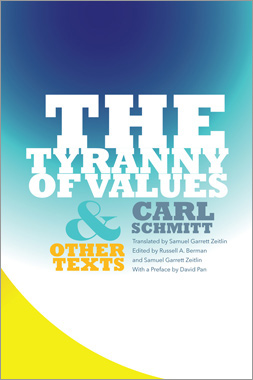 As David Pan correctly observes in the Preface, the Schmitt that we encounter here is one that is confronting the transformations of political enmity in light of a gloomy and dangerous takeover of a global civil war. In fact, one could most definitely argue that the Schmitt thinking within the Cold War epochality is one that is painstakingly searching for a “Katechon,” that restraining force inherited from Christian theology in order to give form to the ruination of modern legal and political order. The global civil war, cloaked under a sense of acknowledged Humanism, now aimed at the destruction of the enemy social’s order and form of life. This thematizes the existential dilemma of a jurist who was consciousness of the dark shadow floating over the efficacy of Western jurisprudence. In other words, the post-war Schmitt is one marked by a profound Hamletian condition in the face of the technical neutralization of every effective political theology. This condition puts Schmitt on the defensive, rather than on the offensive, as his later replies to Erik Peterson, Hans Blumenberg, or Jacob Taubes render visible. As David Pan correctly observes in the Preface, the Schmitt that we encounter here is one that is confronting the transformations of political enmity in light of a gloomy and dangerous takeover of a global civil war. In fact, one could most definitely argue that the Schmitt thinking within the Cold War epochality is one that is painstakingly searching for a “Katechon,” that restraining force inherited from Christian theology in order to give form to the ruination of modern legal and political order. The global civil war, cloaked under a sense of acknowledged Humanism, now aimed at the destruction of the enemy social’s order and form of life. This thematizes the existential dilemma of a jurist who was consciousness of the dark shadow floating over the efficacy of Western jurisprudence. In other words, the post-war Schmitt is one marked by a profound Hamletian condition in the face of the technical neutralization of every effective political theology. This condition puts Schmitt on the defensive, rather than on the offensive, as his later replies to Erik Peterson, Hans Blumenberg, or Jacob Taubes render visible.
Continue reading →
By Telos Press · Monday, December 17, 2018 New from Telos Press: The Tyranny of Values and Other Texts, by Carl Schmitt. Translated by Samuel Garrett Zeitlin, edited by Russell A. Berman and Samuel Garrett Zeitlin, and with a preface by David Pan. Order your copy in our online store, and save 20% on the list price by using the coupon code BOOKS20 during the checkout process.
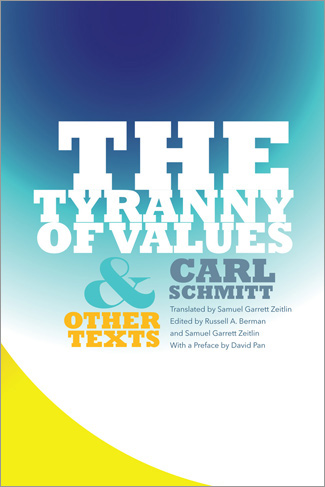 Written during the Weimar Republic, the Nazi era, and the Cold War, this collection of occasional pieces provides an instructive look at the ways in which Carl Schmitt employed his theories in order to make judgments about contemporary historical events and problems. Covering topics such as the political significance of universalism and jurisprudence, the meaning of the partisan, the world-historical significance of the Cold War, the deterioration of metaphysics into “values,” the relationship between theoretical concepts and concrete historical situations, and his views on thinkers such as Machiavelli, Bodin, and Rousseau, these essays establish a revealing counterpoint to his more formal work. They react on the one hand directly to contemporary political questions and demonstrate the way in which he saw the immediate historical significance of his ideas. On the other hand, he also feels free to provide in these pieces the kinds of methodological reflections that help us to better understand the particular epistemological framework that makes his thought so unique. Written during the Weimar Republic, the Nazi era, and the Cold War, this collection of occasional pieces provides an instructive look at the ways in which Carl Schmitt employed his theories in order to make judgments about contemporary historical events and problems. Covering topics such as the political significance of universalism and jurisprudence, the meaning of the partisan, the world-historical significance of the Cold War, the deterioration of metaphysics into “values,” the relationship between theoretical concepts and concrete historical situations, and his views on thinkers such as Machiavelli, Bodin, and Rousseau, these essays establish a revealing counterpoint to his more formal work. They react on the one hand directly to contemporary political questions and demonstrate the way in which he saw the immediate historical significance of his ideas. On the other hand, he also feels free to provide in these pieces the kinds of methodological reflections that help us to better understand the particular epistemological framework that makes his thought so unique.
Continue reading →
By Russell A. Berman · Wednesday, December 12, 2018 Telos 185 (Winter 2018) is now available for purchase in our store. Individual subscriptions to Telos are also available in both print and online formats.
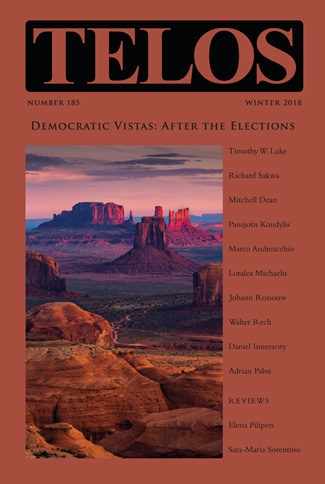 Recall the 2016 campaign and even more the aftermath of the Trump victory: otherwise reasonable people rushed into heated rhetoric regarding the imminence of dictatorship and the end of democracy as we know it. Comparisons of the America of 2016 and Germany of 1933 proliferated, while denunciations of Republicans as Nazis or Nazi collaborators became common. It would be a worthwhile project for a student or scholar of American culture to cull through those statements and confront their authors with them today: if they were so wrong in 2016, what value is their judgment today, moving forward? Recall the 2016 campaign and even more the aftermath of the Trump victory: otherwise reasonable people rushed into heated rhetoric regarding the imminence of dictatorship and the end of democracy as we know it. Comparisons of the America of 2016 and Germany of 1933 proliferated, while denunciations of Republicans as Nazis or Nazi collaborators became common. It would be a worthwhile project for a student or scholar of American culture to cull through those statements and confront their authors with them today: if they were so wrong in 2016, what value is their judgment today, moving forward?
For those predictions were simply and utterly wrong. Of course, the Republican in the White House and the Republican-controlled Congress pursued a version of a conservative agenda (although not always with success, as in the case of health care). But the rule of law prevailed, courts could decide against the government, the liberal part of the press has been articulate in its critique of administration policies, and, in a quite normal and proper manner, the midterm elections took place. American institutions have proven much more robust than the hysterics of little faith claimed in 2016. Those prophets of dictatorship owe us an accounting—or actually an apology—for their hyperbole. They significantly trivialized what really happened under the Nazi dictatorship, and they cavalierly slandered that slightly less than half of the American electorate that voted for Trump. Time for some critical self-reflection? This is not at all a suggestion that they must endorse the president, but it is way past time for them to concede that his supporters are not a priori Nazis, no matter how much juvenile fun name-calling affords.
Continue reading →
By Russell A. Berman · Monday, June 11, 2018 Telos 183 (Summer 2018), celebrating the fiftieth anniversary of the journal Telos, is now available for purchase in our store.
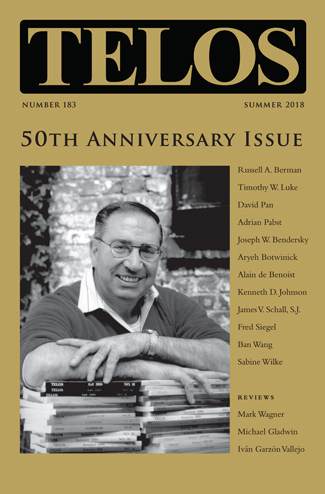 Telos began this anniversary year with our previous issue’s exploration of the legacy of Martin Luther King, Jr., tragically assassinated fifty years ago in April. That too was 1968, the excitement of profound social change and the bitter taste of disappointment. So much in our culture today remains framed by that specific polarity. Now, in this issue of the journal, we take stock more broadly: not a judgment on that one year but a return to some of the key themes that have defined Telos. We have been able to carry on these discussions thanks to the vision of the founder, Paul Piccone, the support of our publisher, Mary Piccone, the dedication of our editorial group, the intellectual agility of our authors, and the loyalty of our readers. Thanks to all. Telos began this anniversary year with our previous issue’s exploration of the legacy of Martin Luther King, Jr., tragically assassinated fifty years ago in April. That too was 1968, the excitement of profound social change and the bitter taste of disappointment. So much in our culture today remains framed by that specific polarity. Now, in this issue of the journal, we take stock more broadly: not a judgment on that one year but a return to some of the key themes that have defined Telos. We have been able to carry on these discussions thanks to the vision of the founder, Paul Piccone, the support of our publisher, Mary Piccone, the dedication of our editorial group, the intellectual agility of our authors, and the loyalty of our readers. Thanks to all.
Continue reading →
|
|