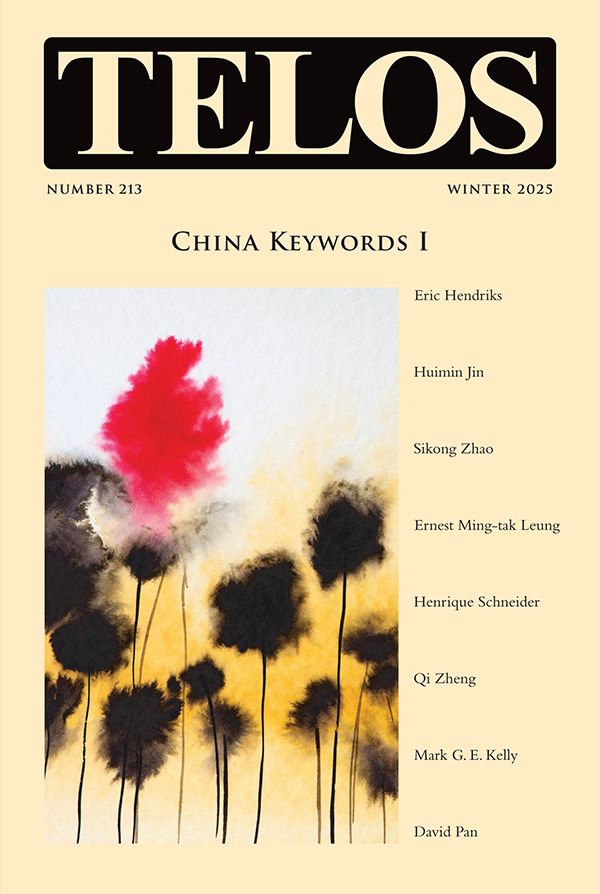
Telos 213 (Winter 2025): China Keywords I
Western analysis often treats China as a projection and reflection of its own values, to be measured from afar. Meanwhile, China’s internal public image is carefully curated by the state and guided by its own conceptual frameworks: feedback governance, cultural subjectivity, hybrid state capitalism. This issue, edited by Eric Hendriks and David Pan, builds on the work of the Telos–Paul Piccone Institute’s China Initiative and its inaugural “China Keywords” conference in New York, asking whether Chinese ideas and institutions can be seen not merely as objects to analyze but as subjects capable of self-analysis and interpretation within a more global framework. Whether you consider China as an ally, competitor, or foe, these essays by authors inside and outside of China provide valuable insights into its domestic debates, historical trajectory, and strategic commitments.
Introduction
Eric Hendriks and David Pan
Cultural Self-Confidence (文化自信) and Cultural Subjectivity (文化主体性): An Ontology of Self and Subject (open access)
Huimin Jin
Daobi (倒逼): “Reverse Force” on the Chinese Path to Modernization
Sikong Zhao
Controls (統制): The Origins and Logic of Modern Chinese Technocracy
Ernest Ming-tak Leung
State-Owned Enterprises (国有企业): Their Evolution and Persistence in Contemporary China
Henrique Schneider
Chinese Liberalism (中国自由主义): Contemporary Chinese Liberal Intellectuals and Their “Failed Fight”
Qi Zheng
Debating Postliberalism
Postliberalism as Ethos
Mark G. E. Kelly
Defending Liberalism against Its Postliberal Critics
David Pan
Reviews
Chinese Cosmopolitanism (世界主义): A Review of Two Brilliantly Polemical Books
Eric Hendriks