As an occasional feature on TELOSscope, we highlight a past Telos article whose critical insights continue to illuminate our thinking and challenge our assumptions. Today, Maja Sidzinska looks at Joan Landes’s “Feminism and the Internationals” from Telos 49 (Fall 1981).
Although 2012 is being hailed as the new Year of the Woman and women’s votes were solicited and cited as pivotal to the outcome of the U.S. presidential election, Joan Landes’s 1981 article “Feminism and the Internationals” provides a timely reminder about the strategic ways that women’s and feminist movements have been deployed in service of political agendas in body politics past. Landes illustrates the historical subordination of women’s and feminist concerns in socialist paradigms and states, shows that the personal was treated as apolitical, and alludes to male epistemic authority as begetting these developments. From the vantage point of Marxist socialism, the problem with feminism is that it undermines the unified class struggle by introducing a competing concern—gender—that threatens the cohesion of the socialist movement.
Fred Siegel’s talk, “Liberalism and Socialism: The Twisted Path to Reconciliation,” was delivered at the 2011 Telos Conference, held in New York City on January 15–16, 2011.
Telos 135: Germany after the Totalitarianisms, Part I is available for purchase in our store.
With the collapse of the Soviet Union and the end of the Cold War, a widespread rethinking of political history and social theory commenced. Questions long frozen in the glacial stand-off between East and West began to thaw out, and the ideological mythologies of the twentieth century were subjected to new scrutiny. Why had the century of modernity been so centrally catastrophic? What was the nature of the worst offenders, the totalitarian regimes—especially in Germany, Italy, and Russia—that had generated so much violence? How could intellectuals and public opinion alike have facilely regarded Nazi Germany and fascist Italy as nearly identical formations (when they displayed so many differences)? And how could Stalinist Russia have been hailed as a positive alternative to Nazi Germany (when they displayed so many similarities)? With the disappearance of the Soviet Union, these interrogations could be pursued without the agenda, baggage, and defensiveness of the previous historical era. The question of the totalitarian state could finally be posed with the advantage of historical distance..
Our website uses cookies to enhance your experience and show you more relevant content. For more information, please see our privacy policy. By using our site, you agree to our use of cookies.
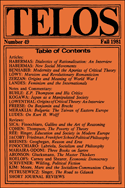 Although 2012 is being hailed as the new Year of the Woman and women’s votes were solicited and cited as pivotal to the outcome of the U.S. presidential election, Joan Landes’s 1981 article “Feminism and the Internationals” provides a timely reminder about the strategic ways that women’s and feminist movements have been deployed in service of political agendas in body politics past. Landes illustrates the historical subordination of women’s and feminist concerns in socialist paradigms and states, shows that the personal was treated as apolitical, and alludes to male epistemic authority as begetting these developments. From the vantage point of Marxist socialism, the problem with feminism is that it undermines the unified class struggle by introducing a competing concern—gender—that threatens the cohesion of the socialist movement.
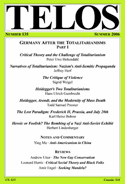 With the collapse of the Soviet Union and the end of the Cold War, a widespread rethinking of political history and social theory commenced. Questions long frozen in the glacial stand-off between East and West began to thaw out, and the ideological mythologies of the twentieth century were subjected to new scrutiny. Why had the century of modernity been so centrally catastrophic? What was the nature of the worst offenders, the totalitarian regimes—especially in Germany, Italy, and Russia—that had generated so much violence? How could intellectuals and public opinion alike have facilely regarded Nazi Germany and fascist Italy as nearly identical formations (when they displayed so many differences)? And how could Stalinist Russia have been hailed as a positive alternative to Nazi Germany (when they displayed so many similarities)? With the disappearance of the Soviet Union, these interrogations could be pursued without the agenda, baggage, and defensiveness of the previous historical era. The question of the totalitarian state could finally be posed with the advantage of historical distance..