By James Santucci · Thursday, August 9, 2012 As an occasional feature on TELOSscope, we highlight a past Telos article whose critical insights continue to illuminate our thinking and challenge our assumptions. Today, James Santucci looks at Paul Piccone’s “Towards a Socio-Historical Interpretation of the Scientific Revolution” in Telos 1 (Spring 1968). This essay was also republished as part of the anthology Confronting the Crisis: Writings of Paul Piccone, available from Telos Press.
Paul Piccone begins this essay with a word of caution for anyone looking back at the scientific revolution:
The scientific revolution of the 16th century is popularly thought of as having freed mankind from superstition and myth. This account, however, runs into difficulties when it is realized that superstition and myth are still with us and, furthermore, that institutionalized irrationality is a predominant feature of 20th century society.
 The popularly held view that Piccone mentions doesn’t just arrive at different conclusions about what happened in history; it requires a completely different view of how history happens. History, in this view, has been continuously building toward modernity, and the triumph of rationalism and science in the sixteenth century were culture’s first steps toward the superior ways of being and thinking that we have today. The signal that our ways of being and thinking today are superior, of course, is that we have them today, and what could possibly be more modern? The popularly held view that Piccone mentions doesn’t just arrive at different conclusions about what happened in history; it requires a completely different view of how history happens. History, in this view, has been continuously building toward modernity, and the triumph of rationalism and science in the sixteenth century were culture’s first steps toward the superior ways of being and thinking that we have today. The signal that our ways of being and thinking today are superior, of course, is that we have them today, and what could possibly be more modern?
Continue reading →
By Juan Carlos Donado · Wednesday, August 8, 2012 As an occasional feature on TELOSscope, we highlight a past Telos article whose critical insights continue to illuminate our thinking and challenge our assumptions. Today, Juan Carlos Donado looks at Heidegger’s 1933 letter to Carl Schmitt, published under the title “Heidegger and Schmitt: The Bottom Line” in Telos 72 (Summer 1987).
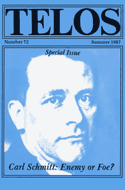 The date was August 22, 1933. Only ten days before, Winston Churchill had spoken publicly for the first time about the dangers of German re-armament. Almost exactly two months later, Germany would withdraw from the League of Nations. During that same year, Martin Heidegger would controversially speak in public about Hitler’s referendum, stating: “The National Socialist revolution is not merely the taking over of a present-at-hand power in the state by another power that has grown sufficiently [strong] for it, but rather this revolution brings the complete overturning [Umwälzung] of our German Dasein.” The date was August 22, 1933. Only ten days before, Winston Churchill had spoken publicly for the first time about the dangers of German re-armament. Almost exactly two months later, Germany would withdraw from the League of Nations. During that same year, Martin Heidegger would controversially speak in public about Hitler’s referendum, stating: “The National Socialist revolution is not merely the taking over of a present-at-hand power in the state by another power that has grown sufficiently [strong] for it, but rather this revolution brings the complete overturning [Umwälzung] of our German Dasein.”
Continue reading →
By Matt Applegate · Tuesday, August 7, 2012 A new manifesto for the radical Left is vital, and it is to emerge from whispers, riddles, and aphorisms without lapsing into dogma, pure utopia, or party politics. Its focus will be on practice and action, but it will refuse to take command of the future. A new manifesto is, if it is to be all of these things at once, improvisation. These are a few of the basic features and premises of Adorno and Horkheimer’s 1956 dialogue, posthumously titled Towards a New Manifesto. Writing and dialoging in the wake and in the midst of fascist reign in Western Europe and Imperial Japan, Adorno and Horkheimer attempt to revision a primary genre of resistance by critically assessing what gains and what limitations philosophy presents for the Twentieth century. Indeed, at the time of their dialogue, political forms and power constellations are at a crossroads. Democracy has emerged as the dominant political form in the free world, and the stage is set for the global emergence of free market capitalism. At the same time, Adorno and Horkheimer are skeptical of their current political situation in the West and claim that “it is not just worse” than prior moments in history, it lacks direction in the face of horrific human rights violations and a shifting political landscape.
Continue reading →
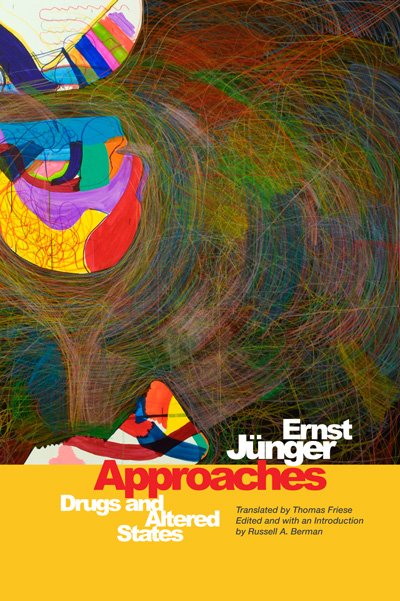
By Telos Press · Wednesday, August 1, 2012 Telos Press Publishing is pleased to announce the upcoming publication of Ernst Jünger’s The Adventurous Heart: Figures and Capriccios, now available for the first time in English translation. Pre-order your copy at the Telos Press website and save 10% off the cover price.
The Adventurous Heart: Figures and Capriccios
by Ernst Jünger
 Translated by Thomas Friese Translated by Thomas Friese
Edited by Russell A. Berman
With an introduction by Eliah Bures and Elliot Neaman
Release date: September 1
The 1938 version of Ernst Jünger’s The Adventurous Heart: Figures and Capriccios must be considered a key text in the famous German writer’s sprawling oeuvre. In this volume, which bears comparison to the Denkbilder of the Frankfurt School, Jünger assembles sixty-three short, often surrealistic prose pieces—accounts of dreams, nature observations, biographical vignettes, and critical reflections on culture and society—providing, as he puts it, “small models of another way of seeing things.” Here Jünger experiments with a new method of observation and thinking, uniting lucid and precise observation with the unconstrained receptivity of dreams.
Continue reading →
By Wes Tirey · Tuesday, July 31, 2012 Sean Franzel’s article “Toward an Anti-Monumental Literary-Critical Style: Notes on Walter Benjamin and Jean Paul” appears in Telos 159 (Summer 2012). Read the full version online at the Telos Online website or purchase a print copy of the issue here.
Wes Tirey: Can you tell us about how your article explores the question of the “public sphere”?
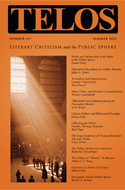 Sean Franzel: My article explores the question of the public sphere rather indirectly, mainly via the assumption that the project of literary criticism involves the critic positioning him or herself vis-à-vis other critical voices. Criticism seems unavoidably to imply the existence of a/plural community/ies of discourse that debate the status of certain shared objects or topics of interest. My article focuses on two specific critics who take issue with modes of canonical or hegemonic critical discourse that heroize literary and philosophical figures and that cast them as larger-than-life personalities. In its modern form, these discourses begin in the Romantic period, and their legacies reach into twentieth-century authoritarianism as well as into contemporary celebrity culture. My article is interested in different ways that critics resist this heroizing, monumentalizing discourse. Additionally, I suppose that my article presumes the idea that the notion of the “public sphere” references a place where individuals take on certain public personae; in this context, I view figures such as Jean Paul and Walter Benjamin as seeking to counteract the fetishization of larger-than-life heroic public personalities. Sean Franzel: My article explores the question of the public sphere rather indirectly, mainly via the assumption that the project of literary criticism involves the critic positioning him or herself vis-à-vis other critical voices. Criticism seems unavoidably to imply the existence of a/plural community/ies of discourse that debate the status of certain shared objects or topics of interest. My article focuses on two specific critics who take issue with modes of canonical or hegemonic critical discourse that heroize literary and philosophical figures and that cast them as larger-than-life personalities. In its modern form, these discourses begin in the Romantic period, and their legacies reach into twentieth-century authoritarianism as well as into contemporary celebrity culture. My article is interested in different ways that critics resist this heroizing, monumentalizing discourse. Additionally, I suppose that my article presumes the idea that the notion of the “public sphere” references a place where individuals take on certain public personae; in this context, I view figures such as Jean Paul and Walter Benjamin as seeking to counteract the fetishization of larger-than-life heroic public personalities.
Continue reading →
By Brendan O'Connor · Monday, July 30, 2012 As an occasional feature on TELOSscope, we highlight a past Telos article whose critical insights continue to illuminate our thinking and challenge our assumptions. Today, Brendan O’Connor looks at Joseph Ferrandino’s “Joyce and Phenomenology,” from Telos 2 (Fall 1968).
 In “Joyce and Phenomenology,” Joseph Ferrandino proposes a “phenomenological reading” of James Joyce’s Ulysses, and while he admits that much of the epic eludes such sweeping, categorical interpretations, he maintains that “in terms of aims and methods, Ulysses can only be seen as a concrete application of what Husserl means by phenomenology” (84). Ferrandino provides an excellent gloss on Husserl and his notoriously difficult philosophy before he delves into the equally difficult Joyce. Ferrandino explains that the aim of Husserl’s phenomenology is “to get back to the ‘things themselves.’ This is done by suspending judgment . . . reducing the immediate experience to the operations of the life-world (the phenomenological reduction), and then constituting again the whole in its proper subjective sense” (87). Joyce, in objectifying individual experience so deftly, enables us, as readers, to consider our own experience from a sort of literary remove. Ferrandino understands this to be analogous, even equivalent, to the work of the phenomenologist: “It is from this viewpoint that the reader can come to grasp the proper meaning of the experience, just as the phenomenologist who has performed the reduction can view the bracketed experience and its correct sense” (91). The reader’s experience of Ulysses, Ferrandino argues, is a reflexive one, and by bringing us into an awareness of ourselves as readers the text also aligns us with Joyce as the author: “We, as readers, have access to the same viewpoint that Joyce has. We are not Stephen walking on the strand contemplating philosophical problems. The philosophical is not the object of our act of awareness. It is Stephen’s object. Our object is Stephen’s act of awareness and its object” (90). In “Joyce and Phenomenology,” Joseph Ferrandino proposes a “phenomenological reading” of James Joyce’s Ulysses, and while he admits that much of the epic eludes such sweeping, categorical interpretations, he maintains that “in terms of aims and methods, Ulysses can only be seen as a concrete application of what Husserl means by phenomenology” (84). Ferrandino provides an excellent gloss on Husserl and his notoriously difficult philosophy before he delves into the equally difficult Joyce. Ferrandino explains that the aim of Husserl’s phenomenology is “to get back to the ‘things themselves.’ This is done by suspending judgment . . . reducing the immediate experience to the operations of the life-world (the phenomenological reduction), and then constituting again the whole in its proper subjective sense” (87). Joyce, in objectifying individual experience so deftly, enables us, as readers, to consider our own experience from a sort of literary remove. Ferrandino understands this to be analogous, even equivalent, to the work of the phenomenologist: “It is from this viewpoint that the reader can come to grasp the proper meaning of the experience, just as the phenomenologist who has performed the reduction can view the bracketed experience and its correct sense” (91). The reader’s experience of Ulysses, Ferrandino argues, is a reflexive one, and by bringing us into an awareness of ourselves as readers the text also aligns us with Joyce as the author: “We, as readers, have access to the same viewpoint that Joyce has. We are not Stephen walking on the strand contemplating philosophical problems. The philosophical is not the object of our act of awareness. It is Stephen’s object. Our object is Stephen’s act of awareness and its object” (90).
Continue reading →
|
|