Following my recent articles in the New York Times, “If Peas Can Talks, Should We Eat Them?” and “Is Plant Liberation on the Menu,” I have been debating the question of plant ethics with Professor Gary Francione (Rutgers University). The three installments of our debate are now available on the blog of Columbia University Press: part 1, part 2, and part 3. In our discussion, Professor Francione and I have addressed issues surrounding veganism, plant sentience, anthropocentrism, environmental justice, the possibility of non-conscious intentionality, and the controversial difference between vegetal response and a mechanical reaction.
|
Writing at The Inside Agenda blog, Wodek Szemberg examines contemporary radicalism through the lens of Milan Kundera’s notion of “political kitsch”: Here is another way in which Kundera describes the essence of political kitsch: “Kitsch causes two tears to flow in quick succession. The first tear says: How nice to see children running on the grass! The second tear says: How nice to be moved, together with all mankind, by children running on the grass!” It’s the second tear that is at issue. It’s one of our fundamental individual rights to be moved by children running on grass, or by puppies or kittens. The problem arises when predilection for all things sweet, cute, and peaceful is turned into political action. As an occasional feature on TELOSscope, we highlight a past Telos article whose critical insights continue to illuminate our thinking and challenge our assumptions. Today, Tomash Dabrowski looks at Karl Korsch’s “Ten Theses on Marxism Today,” from Telos 26 (Winter 1975–76). Congratulations to Adrian Pabst, one of our Telos editorial associates, on the publication of his new book, Metaphysics: The Creation of Hierarchy, published by Eerdmans with the Centre of Theology and Philosophy, as part of their Interventions series. This comprehensive and detailed study of individuation reveals the theological nature of metaphysics. Adrian Pabst argues that ancient and modern conceptions of “being”—or individual substance—fail to account for the ontological relations that bind beings to each other and to God, their source. On the basis of a genealogical account of rival theories of creation and individuation from Plato to “postmodernism,” Pabst proposes that the Christian Neo-Platonic fusion of biblical revelation with Greco-Roman philosophy fulfills and surpasses all other ontologies and conceptions of individuality. Please visit the Centre of Theology and Philosophy website for ordering information. Eva Geulen’s “Passion in Prose” appears in Telos 158 (Spring 2012). Read the full version online at the Telos Online website, or purchase a print copy of the issue here. |
   |
|||
|
Privacy Policy · Data Protection Copyright © 2026 Telos Press Publishing · All Rights Reserved |
||||
 Although the work of Karl Korsch was cardinal to subsequent theoretical developments within the twentieth-century Marxist canon, the appreciation of his work is usually eclipsed in intellectual history by the long shadow cast by Lukács over the development of what would later be called “Western Marxism.” Nevertheless, the belated rediscovery of Korsch’s work by the New Left was certainly in part due to the fact that Korsch’s position was the more heretical in the eyes of the Soviet variant of Marxist orthodoxy. Although Lukács dismissed the dogmatic hagiography of Marx’s conclusions, he nevertheless introduced his magnum opus, History and Class Consciousness, with the “scientific conviction” in the method of dialectical materialism. Even provided that all of Marx’s findings would be proven false, genuine Marxist method would nevertheless yield a privileged relationship to history.
 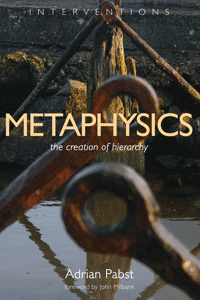 “This book does nothing less than to set new standards in combining philosophical with political theology. Pabst’s argument about rationality has the potential to change debates in philosophy, politics, and religion.” (from the foreword by John Milbank)
 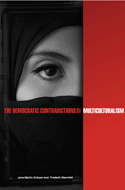 On Tuesday, June 5, at 7pm, St. Mark’s Bookshop and Telos Press Publishing will present a reading and discussion with Jens-Martin Eriksen and Frederik Stjernfelt about their new book The Democratic Contradictions of Multiculturalism. The discussion will be hosted by Russell Berman and Tim Luke. The reading will take place at St. Mark’s Bookshop, located at 31 Third Avenue, between 8th and 9th Streets, in New York City. This is a free event. For directions and additional information about St. Mark’s Bookshop, please visit their
 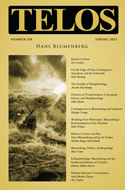 The article compares and contrasts Odo Marquard’s and Hans Blumenberg’s views on skepticism and its relationship to literature. Whereas Marquard’s skepticism can perceive literature only as “exile of serenity,” Blumenberg’s skeptical attitude toward skepticism leads to a very different notion of literature and a different exegetical praxis. The latter can be observed in Blumenberg’s volume on Matthäuspassion.