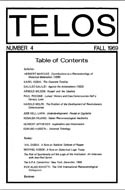
By Juan Carlos Donado · Thursday, March 15, 2012 As an occasional feature on TELOSscope, we highlight a past Telos article whose critical insights continue to illuminate our thinking and challenge our assumptions. Today, Juan Carlos Donado looks at Paul Piccone’s “Science, Art and Revolution: An Introduction to Galileo as a Poet,” from Telos 4 (Fall 1969).
 Even if Paul Piccone in fact mistakenly attributes the poem Contro Gli Aristotelici to Galileo—as scholars such as Charles B. Schmitt claim—the conclusion remains invariably the same. Piccone, of course, is not alone in this: the mistake originated in an early article written by the great Galilean scholar Antonio Favaro (1869–1922), responsible for the colossal twenty-volume edition of Galileo’s Opere. Favaro himself corrected the mistake one year later in a much lesser known article, but in print the attribution was already made and Jacopo Soldani’s satire, for years, was adopted by Galileo’s pen. Even if Paul Piccone in fact mistakenly attributes the poem Contro Gli Aristotelici to Galileo—as scholars such as Charles B. Schmitt claim—the conclusion remains invariably the same. Piccone, of course, is not alone in this: the mistake originated in an early article written by the great Galilean scholar Antonio Favaro (1869–1922), responsible for the colossal twenty-volume edition of Galileo’s Opere. Favaro himself corrected the mistake one year later in a much lesser known article, but in print the attribution was already made and Jacopo Soldani’s satire, for years, was adopted by Galileo’s pen.
Continue reading →
By Gary Shapiro · Thursday, March 8, 2012 This paper was presented at the 2012 Telos Conference, “Space: Virtuality, Territoriality, Relationality,” held on January 14–15, in New York City.
Nietzsche-Schmitt Dialogue
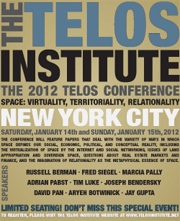 Carl Schmitt’s TheNomos of the Earth and related work conduct a generally unacknowledged dialogue with Nietzsche; both Schmitt’s geophilosophy and Nietzsche’s politics of the earth are clarified by unearthing this dialogue. Schmitt rarely mentions Nietzsche in his published works (excepting Glossarium) and then to marginalize or distance him. Carl Schmitt’s TheNomos of the Earth and related work conduct a generally unacknowledged dialogue with Nietzsche; both Schmitt’s geophilosophy and Nietzsche’s politics of the earth are clarified by unearthing this dialogue. Schmitt rarely mentions Nietzsche in his published works (excepting Glossarium) and then to marginalize or distance him.
Nietzsche and Schmitt are both paradigmatic geophilosophical thinkers, in Deleuze and Guattari’s sense—they conceptualize territorialization, deterritorialization, and reterritorialization, and they raise questions about the future of the earth. Schmitt’s Nomos articulates problems of earthly order and orientation in the post-Columbian age. Nietzsche’s Zarathustra descends a mountain, calls on the urban multitude to think the direction of the earth (Sinn der Erde), even to sacrifice themselves for it. Later, he explicitly raises the question of hegemony—who will be the lords of the earth?
Continue reading →
By Mohammad Rafi · Tuesday, March 6, 2012 This paper was presented at the 2012 Telos Conference, “Space: Virtuality, Territoriality, Relationality,” held on January 14–15, in New York City.
In 2004 the German national football team was invited to Azadi Stadium in Teheran for a friendly game against Iran’s national team. While the German anthem was being played before the game, a large number of Iranians collectively greeted their German guests by performing the Nazi salute. Although this display of naiveté came as a shock to millions of viewers on live German TV, it should not come as a surprise in light of Nazi Germany’s historical propagandist involvement in Iran. Whereas the history of the relations between the two nations dates back to 1873, an affinity was reinforced in the Weimar years and strengthened through the propagation of an Aryan myth during the Nazi reign. I will discuss two pivotal historical associations between Germany and Iran, one based on the Aryan myth grounded in racist ideology, the other connection concerns intellectual influences of German anti-modernists on Iranian thinkers. Both points serve to shed light on a relationship that demands awareness, especially now that tensions between the West and Iran are continuously increasing.
Continue reading →
By Hamza Zeghlache · Friday, March 2, 2012 This paper was presented at the 2012 Telos Conference, “Space: Virtuality, Territoriality, Relationality,” held on January 14–15, in New York City.
It is almost impossible to consider architecture independently from space. Indeed, the definition of architecture should implicitly or explicitly include this concept. The first role of architecture is to create and manipulate space. Any architectural object is not only a contained element in space but also an element that participates in the orientation of space and therefore in the making of a place out of a space. Moreover, the architectural object makes space act within a performing stage and defines it as a closed or open space. There is no architecture or architectural action without space. The human use of space and values with which society imbues spatial relations signifies the ground of architecture.
Continue reading →
By Telos Press · Thursday, March 1, 2012 Telos Press is pleased to announce the publication of The Democratic Contradictions of Multiculturalism by Jens-Martin Eriksen and Frederik Stjernfelt. Purchase your copy in our store, and save 20% off the list price.
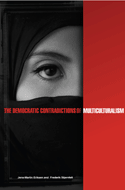 In The Democratic Contradictions of Multiculturalism, Jens-Martin Eriksen and Frederik Stjernfelt examine the ideology and the reality of multiculturalism, assessing the implications of this controversial concept for contemporary politics. They explore many urgent issues, including the responses to the Muhammad cartoons, laws against blasphemy and the hijab, the Islamic ban on apostasy, and the growing restrictions on speech and religion that threaten the freedom that democracy ought to protect. This book is an erudite manifesto for freedom and a confrontation with any kind of attempt—be it left or right—to fence people within their cultures. In The Democratic Contradictions of Multiculturalism, Jens-Martin Eriksen and Frederik Stjernfelt examine the ideology and the reality of multiculturalism, assessing the implications of this controversial concept for contemporary politics. They explore many urgent issues, including the responses to the Muhammad cartoons, laws against blasphemy and the hijab, the Islamic ban on apostasy, and the growing restrictions on speech and religion that threaten the freedom that democracy ought to protect. This book is an erudite manifesto for freedom and a confrontation with any kind of attempt—be it left or right—to fence people within their cultures.
Continue reading →
By Telos Press · Tuesday, February 28, 2012 Time and Location
St. Francis College, Maroney Forum for Arts, Culture & Education
180 Remsen Street, Brooklyn Heights, NY 11201
Wednesday, March 28, 7:00–9:00pm
Free and open to the public
St. Francis College with Telos Press, Encounter Books and The New York Chapter of the National Association of Scholars presents a debate on the virtues of liberal Western Civilization compared to its Islamic rivals, as expressed in author Ibn Warraq’s new book, Why the West is Best, on Wednesday, March 28, at 7:00pm in St. Francis College’s Maroney Forum for Arts, Culture & Education.
Continue reading →
|
|