By Telos Press · Thursday, October 14, 2010 From Telos 152 (Fall 2010), David Gross’s “A New Direction: The Religious Critique of Modern Culture.” Read the full version at TELOS Online website.
Abstract
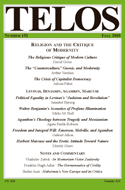 In their analyses of modern life, cultural critics in the twentieth and twenty-first centuries have drawn on many strains of thought but have generally overlooked religion as a source of Kritik. This article investigates the observations and insights that can be found in certain Western religious (and, more particularly, Catholic) traditions, and then assesses their overall value or usefulness for contemporary cultural criticism. In their analyses of modern life, cultural critics in the twentieth and twenty-first centuries have drawn on many strains of thought but have generally overlooked religion as a source of Kritik. This article investigates the observations and insights that can be found in certain Western religious (and, more particularly, Catholic) traditions, and then assesses their overall value or usefulness for contemporary cultural criticism.
Continue reading →
By Jennifer Wang · Tuesday, September 28, 2010 On Tuesdays at the TELOSscope blog, we highlight a past Telos article whose critical insights continue to illuminate our thinking and challenge our assumptions. Today, Jennifer Wang looks at Mary-Jane Rubenstein’s “Relationality: The Gift After Ontotheology,” from Telos 123 (Spring 2002).
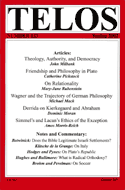 The term ontotheology has come to mean the relegation of God to a being among beings, or, even further, the entrapment of God within Being. In “Relationality: The Gift After Ontotheology,” Mary-Jane Rubenstein asks whether we must discard Being as an improper name of God and adopt what she takes to be a unilateral concept of the gift in order to overcome ontotheology. Drawing on John Milbank, she proposes that we think of Being and the gift as conditioned on Trinitarian exchange, a conception that accentuates reciprocity rather than either self-abandonment, never-ending obligation, or perpetual uncertainty. The term ontotheology has come to mean the relegation of God to a being among beings, or, even further, the entrapment of God within Being. In “Relationality: The Gift After Ontotheology,” Mary-Jane Rubenstein asks whether we must discard Being as an improper name of God and adopt what she takes to be a unilateral concept of the gift in order to overcome ontotheology. Drawing on John Milbank, she proposes that we think of Being and the gift as conditioned on Trinitarian exchange, a conception that accentuates reciprocity rather than either self-abandonment, never-ending obligation, or perpetual uncertainty.
Continue reading →
By Telos Press · Monday, September 20, 2010 Please note: the deadline for proposals has been extended to October 1, 2010.
Rituals of Exchange and States of Exception:
Continuity and Crisis in Politics and Economics
January 15-16, 2011
New York City
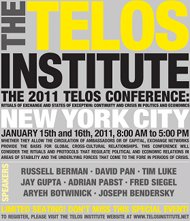 Whether they allow the circulation of ambassadors or of capital, exchange networks provide the basis for global cross-cultural relationships. Though liberal democratic governments pride themselves on the rationality of their procedures, diplomatic protocols and the give-and-take of parliamentary politics attest to complex customs that lie at the heart of such practices. Similarly, recent crises have demonstrated that international financial markets cannot be reduced to a numbers game, however complex, but function on the foundation of a network of promises whose dependability is a matter of habits. Focusing on the contemporary world, this conference will investigate the rituals and protocols that regulate political and economic relations in areas of stability and the underlying forces that come to the fore in periods of crisis. We encourage submissions of paper proposals from scholars in a variety of disciplines including critical theory, philosophy, literature, politics, theology, anthropology, political economy, and cultural studies. Whether they allow the circulation of ambassadors or of capital, exchange networks provide the basis for global cross-cultural relationships. Though liberal democratic governments pride themselves on the rationality of their procedures, diplomatic protocols and the give-and-take of parliamentary politics attest to complex customs that lie at the heart of such practices. Similarly, recent crises have demonstrated that international financial markets cannot be reduced to a numbers game, however complex, but function on the foundation of a network of promises whose dependability is a matter of habits. Focusing on the contemporary world, this conference will investigate the rituals and protocols that regulate political and economic relations in areas of stability and the underlying forces that come to the fore in periods of crisis. We encourage submissions of paper proposals from scholars in a variety of disciplines including critical theory, philosophy, literature, politics, theology, anthropology, political economy, and cultural studies.
Continue reading →
By Russell A. Berman · Monday, September 13, 2010 Enlightenment and modernity, the social formation with which it has been inextricably entwined, have had a complicated relationship with religion. Of course there have been important moments of genuine compatibility, when trust in reason converged with trust in God. A deist imagination animated the philosophers of the eighteenth century, including the leading figures of the American Revolution, who did not shy away from declaring that our inalienable rights derived from a Creator who had endowed us with them. The revolutionary act displaced the divine right of kings with the divine rights of all, and Thomas Jefferson could conclude that bold statement with “a firm reliance on the protection of Divine Providence.” While such modern thinkers valued faith, we can easily identify faithful believers who were simultaneously at home in the tradition of reason: Aquinas, Maimonides, and Avicenna, or more recently, Benedict XVI, consistently claiming that faith and reason belong together.
Continue reading →
By Jennifer Wang · Tuesday, September 7, 2010 On Tuesdays at the TELOSscope blog, we reach back into the archives and highlight an article whose critical insights continue to illuminate our thinking and challenge our assumptions. Today, Jennifer Wang looks at Amos Morris-Reich’s “Simmel’s and Lacan’s Ethics of the Exception,” from Telos 123 (Spring 2002).
In “Simmel’s and Lacan’s Ethics of the Exception,” Amos Morris-Reich examines in parallel the theoretical proximity of Simmel and Lacan’s post-Kantian ethics of the exception. Historically, the Kantian universal rule met its end at the outbreak of World War I, the horrors of which opened up space for theories on the exception to the rule that did not consider such a structure oxymoronic. The theories of both Lacan and Simmel address the monstrosity of the twentieth century, but are not exclusive to it. They are shown to formulate a structure of rule and exception that takes for inputs life, death, and money. To the question posed by medieval robbers (“your life or your money?”), life is unanimously chosen but what’s of interest is the contradictory ethics grounding each decision.
Continue reading →
By Adrian Pabst · Tuesday, August 17, 2010 The ongoing debate about budget deficits, public debt, and the case for or against austerity reflects old ideological disagreements that ignore the new realities of late-modern capitalism. Both left and right rehash virtually the same arguments since Reagan and Thatcher, but lack the imagination for genuinely fresh ideas and transformative policies.
Continue reading →
|
|