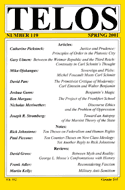
By Philip Crone · Tuesday, September 15, 2009 Each Tuesday in the TELOSscope blog, we reach back into the archives and highlight an article whose critical insights continue to illuminate our thinking and challenge our assumptions. Today, Philip Crone looks at Catherine Pickstock’s “Justice and Prudence: Principles of Order in the Platonic City,” from Telos 119 (Spring 2001), as well as a response to Pickstock’s article from Donald C. Hodges and Christopher A. Pynes.
 Recent discussions surrounding the death of Senator Ted Kennedy and talk about health care reform have reintroduced some of the most fundamental questions about justice and society into American political discourse. As ill-informed and histrionic as many of today’s arguments are, the matters being discussed are of great importance. And while at first it may not seem to have much relevance to the issues currently discussed, Plato’s Republic is in many ways the first comprehensive and influential work of Western political philosophy. The key questions of the Republic—the roles of social groups, the ideal qualifications for civic leaders, and the guiding principles for society—continue to have great contemporary relevance. Recent discussions surrounding the death of Senator Ted Kennedy and talk about health care reform have reintroduced some of the most fundamental questions about justice and society into American political discourse. As ill-informed and histrionic as many of today’s arguments are, the matters being discussed are of great importance. And while at first it may not seem to have much relevance to the issues currently discussed, Plato’s Republic is in many ways the first comprehensive and influential work of Western political philosophy. The key questions of the Republic—the roles of social groups, the ideal qualifications for civic leaders, and the guiding principles for society—continue to have great contemporary relevance.
Continue reading →
By Timothy W. Luke · Friday, September 11, 2009 Coming on November 1, Matthias Küntzel’s Jihad and Jew-Hatred: Islamism, Nazism and the Roots of 9/11 will be available in paperback format. Pre-order your copy now and save 20% off the cover price.
“In this short, powerful, passionate and thoughtful book, Matthias Küntzel explores how and why radical Islam emerged as the most important political and ideological movement in world politics to place hatred of the Jews at the center of its ideology and policy following the defeat of the Nazi regime . . . Kuentzel’s reconstruction impels us to rethink the issue of continuity and break before and after 1945 and expand our horizons beyond Europe to encompass the trans-national diffusion and impact of Nazism and fascism on the Arab and Islamic world.” (From the foreword by Jeffrey Herf, Professor of History, University of Maryland).
For anyone interested in exploring the mindset of hatred that led to the crimes in New York and Washington on September 11th, 2001, this book is a must-read. For readers interested in the history of Nazi Germany and the Holocaust, this book is a challenge to think outside of a narrowly European context. For everyone, this book provides crucial insight into the roots of terror that continue to threaten all of us.
Continue reading →
By Etel Sverdlov · Tuesday, September 8, 2009 Each Tuesday in the TELOSscope blog, we reach back into the archives and highlight an article whose critical insights continue to illuminate our thinking and challenge our assumptions. Today, Etel Sverdlov looks at Robert Hovarth’s “The Putin Regime and the Heritage of Dissidence” published in Telos 145 (Winter 2008), a special issue on “Dissidents and Community.”
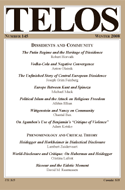 As the child of Russian immigrants who fled the Soviet Union just before it collapsed, I grew up in a unique time-warp. Not knowing the modern Russia, I was raised on Soviet songs, movies, and references. I thought it simply an amusing situation for a child to experience, but as Robert Horvath’s “The Putin Regime and the Heritage of Dissidence” makes clear, this sort of modern disconnect plays a strong, and damaging, part in contemporary Russian politics. Throughout the history of the Soviet Union, individuals of conviction found ways of subtly revolting against the oppressive Communist regime. Once that empire fell, however, these men began to feel the sting of obscurity. Sergei Kovalyov, “the most prominent former dissident in the State Duma,” Vladimir Voinovich, a Soviet satirist, and the most famous of the group, Alexander Solzhenitsyn, the long-bearded writer, all found themselves increasingly irrelevant in the new “democratic” Russia. The generation they belonged to had fallen away. As the child of Russian immigrants who fled the Soviet Union just before it collapsed, I grew up in a unique time-warp. Not knowing the modern Russia, I was raised on Soviet songs, movies, and references. I thought it simply an amusing situation for a child to experience, but as Robert Horvath’s “The Putin Regime and the Heritage of Dissidence” makes clear, this sort of modern disconnect plays a strong, and damaging, part in contemporary Russian politics. Throughout the history of the Soviet Union, individuals of conviction found ways of subtly revolting against the oppressive Communist regime. Once that empire fell, however, these men began to feel the sting of obscurity. Sergei Kovalyov, “the most prominent former dissident in the State Duma,” Vladimir Voinovich, a Soviet satirist, and the most famous of the group, Alexander Solzhenitsyn, the long-bearded writer, all found themselves increasingly irrelevant in the new “democratic” Russia. The generation they belonged to had fallen away.
Continue reading →
By Nicole Burgoyne · Tuesday, September 1, 2009 Welcome to the launch of TELOSthreads, a new website feature that showcases the online archive of Telos articles from the past decade. Each Tuesday in the TELOSscope blog, we will reach back into the archives and highlight an article whose critical insights continue to illuminate our thinking and challenge our assumptions. We’ve also set up an index of TELOSthreads topics, which will allow you to browse the archive thematically. For the first article in this series, we turn to Jorge Raventos’s 2001 interview with Paul Piccone, “From the New Left to Postmodern Populism: An Interview with Paul Piccone,” published in Telos 122 (Winter 2002).
In a 2001 interview with Paul Piccone, Telos‘s founding editor discussed the emergence of the journal within the context of the New Left of the 1960s. For Piccone, Telos existed as a kind of opposition within the opposition, a political force that drew critical strength from what was then a vibrant New Left, but which also largely took issue with the movement.
Continue reading →
By Jesse Gelburd-Meyers · Monday, August 10, 2009 Michael Marder’s essay “From the Concept of the Political to the Event of Politics” appears in Telos 147 (Summer 2009), a special issue on “Carl Schmitt and the Event” for which he is the guest editor. Jesse Gelburd-Meyers follows up with some questions.
Jesse Gelburd-Meyers: In a world in which liberal doctrine informs the partitioning off of every segment of society so as to minimize the reach of the political sphere and give an ever privileged role to the economic realm, it is essential that we keep a proper perspective as to just how elusive the political truly is. If there is no autonomous political “sphere,” then what does a constitution constitute? What legitimates the sovereign’s decision to declare an entity an enemy if his sovereignty itself is not made by previously created rules that demarcate who can legally make such decisions? Isn’t it inevitable that a nation that is not ruled by the mere force of man, and which peacefully transfers the reins of power from regime to regime, will have some rules that, at the very least, establish the preconditions for the political event by declaring the type of sovereign who is permitted to make such decisions?
Continue reading →
By Paul Gottfried · Sunday, August 2, 2009 Panajotis Kondylis, Machtfragen. Ausgewählte Beiträge zu Politik und Gesellschaft, ed. Volker Gerhart (Darmstadt: Wissenschaftliche Buchgesellschaft, 2006). Paul Piccone, Confronting the Crisis: Writings of Paul Piccone, ed. Gary Ulmen (New York: Telos Press, 2008).
There are two main reasons for pairing these posthumously published essays of Paul Piccone (1940–2004) with those of Panajotis Kondylis (1943–1998). One, both of these authors, who died in the last few years, were my friends, whose lives moved along much the same general trajectory as my own. None of us could be described as an academic luminary; although neither Paul, who mentored later successful professors, nor Panajotis, who called himself a “Privatgelehrter,” periodically associated with Heidelberg and the University of Athens, had as close an association as I’ve had with a long-term academic post. These brilliant social thinkers spent their lives on the edge of a university world that would have benefited greatly if they had been linked to it in appropriately high places.
Continue reading →
|
|