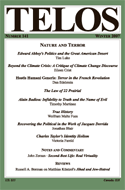
By Russell A. Berman · Saturday, December 29, 2007 Telos 141: Nature and Terror is available in our store.
 Classical figures of thought endure. A long-standing image of the health of nature contrasts the bucolic landscape with the corruption of the city, where violence abounds. The only security is a natural way of life, far from the brutal metropolis—until nature turns out to be a threat, and we succumb to the uncontrollable fear named for that destructive god: panic. The state of nature is the homeland of violence, its only law the law of the jungle, as we scurry back to the city to find security—until it morphs into the security state. Critical Theory described this dynamic as a sometimes too narrow narrative of domination: the human mastery of nature, in the interest of self-preservation, turns into the mastery of humanity by an encompassing machinery of control. This is an old story, but it comes to us anew in this political season, in which nature and terror—the anxieties about the environment and fear of terrorism, as well as the reaction to it—haunt us, in public and in private. Classical figures of thought endure. A long-standing image of the health of nature contrasts the bucolic landscape with the corruption of the city, where violence abounds. The only security is a natural way of life, far from the brutal metropolis—until nature turns out to be a threat, and we succumb to the uncontrollable fear named for that destructive god: panic. The state of nature is the homeland of violence, its only law the law of the jungle, as we scurry back to the city to find security—until it morphs into the security state. Critical Theory described this dynamic as a sometimes too narrow narrative of domination: the human mastery of nature, in the interest of self-preservation, turns into the mastery of humanity by an encompassing machinery of control. This is an old story, but it comes to us anew in this political season, in which nature and terror—the anxieties about the environment and fear of terrorism, as well as the reaction to it—haunt us, in public and in private.
Continue reading →
By Russell A. Berman · Sunday, December 9, 2007 Whether correctly or not, the National Intelligence Estimate has been read (or misread) and seized upon by the press as claiming that Iran no longer has nuclear ambitions. Happy Days are Here Again, and the pre-election season is spiced up with this one more seemingly incontrovertible evidence of the mendacity of the administration.
Or maybe not so incontrovertible. Neither the French nor the British seem inclined to back down from their hard line on sanctions, effectively dismissing the findings of the American “intelligence” community. On the contrary, they have reaffirmed their concerns about Iranian ambitions, and even Putin has strengthened his position on sanctions. It’s as if the NIE has no credibility outside of Pulitzered op-ed pages and the circles where those pages are avidly celebrated in Tehran.
Continue reading →
The release of Haleh Esfandiari, director of the Middle East Program of the Woodrow Wilson International Center for Scholars in Washington, from incarceration in Iran is an encouraging development. But the international community is still pondering what to do about Iran. Western leaders have not found a suitable means of responding to Iran’s nuclear program, support of insurgents in the Iraq war and Hezbollah in Lebanon. None of the alternatives now being publicly discussed seem promising. Either the West can use a military intervention to compel Iran to change its behavior or attempt to pressure Iran through diplomacy. But the West, and particularly the United States, appears to have little leverage with the current Iranian leadership—which has historically depended upon demonizing the West for legitimacy, while prohibiting internal dissent to guarantee stability. With the United States and NATO fully committed in Iraq and Afghanistan respectively, there is no military force capable of conquering and controlling Iran. Moreover, a military strike against Iran would prove that the hyperbolic rhetoric of President Mahmoud Ahmadinejad was correct, and his many critics would likely rally around his leadership in order to protect their nation. It would be, in fact, the worst possible decision.
Perhaps there is a strategy that the West could pursue toward Iran, akin to one that worked well in undermining the totalitarian government of Czechoslovakia: the example of Charter 77. Charter 77 was a human rights group founded by a politically diverse group of Czech and Slovak dissidents who openly signed a petition insisting that the communist government live up to its own legal and international obligations to protect human rights. Charter members, such as Václav Havel—who later became president of the country—maintained that Charter 77 was not—at least not overtly—a political opposition that formally challenged communist one-party rule. Rather, the Chartists defined themselves as a human rights movement that by its very existence helped to create a parallel polis—and widen social space for authentic existence outside to and independent of the dictates of the state. Despite its apolitical principles, the government actively prosecuted Charter 77, some of whom were given long jail sentences. Yet Charter 77 persisted and never collapsed. In 1989, when fortuitous circumstances allowed communism to unravel in Czechoslovakia, Charter 77, reborn as Civic Forum, became the nexus of an opposition, and later formed the first non-communist government, committed to establishing democratic institutions—including the rule of law, an independent judiciary, private ownership, and free and independent media. Thus the “parallel polis” of the communist era was to serve as a model for a functioning civil society in a healthy and consolidated democracy.
Could such a model of supporting a human rights opposition work in Iran? To fully answer that question we must consider what happened in Iraq, where no legitimate opposition was capable of taking the reigns of government when Saddam Hussein was overthrown. Evidently, U.S. policy makers expected that the prospect of “free and fair” elections would produce legitimate and capable rulers. But thirty years of ruthless dictatorship and an American intervention strategy based on a misguided belief that average Iraqis would see occupiers as liberators, robbed Iraqis of a legitimate home-grown opposition movement or nascent civil society. Amidst the violence of insurgency and counter-insurgency, social trust defaulted to tribal identity or sect. Only in Kurdistan, where an opposition leadership was able to develop under the protection of a U.N. mandate and American airpower, have civil institutions been established.
Continue reading →
By Kenneth Anderson · Sunday, November 18, 2007 Two weeks ago, on October 31, a court in Madrid handed down verdicts in the March 11, 2004, Atocha train station bombings that killed 191 people and wounded over 2,000 others. They were, on any standard of substantive justice, a major disappointment—three murder convictions out of 28 defendants, others convicted, barely, on far lesser charges, such as weapons possession, or minor conspiracies, or mere membership in a terrorist organization.
The court, it must be said, acted scrupulously within the confines of the Spanish criminal code. It excluded vast amounts of hearsay evidence, for example, collected from tapped telephone conversations in Italy, which was subject to much debate about Arabic translation, reliability, and provenance. The problem is that any outside observer, looking objectively at the pile of circumstantial evidence and not from the standpoint of that very special social game known as the criminal law, would have reasonably concluded that those being tapped, and many, indeed overwhelmingly likely nearly everyone on trial, had something culpable, big or small, to do with the terrorist plot.
We accept that freely, if not happily, in the case of ordinary criminality. Part of the reason we do so, however, is that we understand that the stakes are not as high in ordinary criminality as they are in the case of jihadist terrorists bent on suicide and mass murder. We accept—and should accept—a high standard of proof in order to protect the innocent in ordinary criminality, although a few minutes’ conversation with any public defender will suffice to show that in reality, there are relatively few genuinely innocent criminal defendants out there. They exist and deserve all the protections Western systems of justice offer—and, as the Duke lacrosse case demonstrates—in our ordinary justice system, the prosecutor has too much power and too much discretion.
Continue reading →
By Irene Lancaster · Tuesday, November 6, 2007 [The following review of Matthias Küntzel’s Jihad and Jew-Hatred, published by Telos Press, appeared on November 1, on the blog Irene Lancaster’s Diary. Reproduced here by permission.]
Today sees the publication by Telos Press of the English-language translation of Matthias Küntzel’s Jihad and Jew-Hatred. The publishers have asked me to review it to coincide with the publication date. And I am very pleased to do so. First, some background is needed.
I have spent my life in dialogue with Christians, Muslims and Buddhists. The longest chapter in my book on the Jewish mediaeval scholar Abraham ibn Ezra, Deconstructing the Bible, is entitled “Muslim Hermeneutics.” The first people to purchase the book were the Culture Departments of Iran and Lebanon. In my younger days I took part in Sufi turning sessions, and when I was growing up our family doctor was a Muslim.
Which is why, like a great many people who know something about the Holocaust (in my case first hand information from my parents, who were survivors and also from teaching courses on the subject and visiting areas in Europe where the Holocaust had been perpetrated), I was willing to dismiss Nazi links with people like the Mufti of Jerusalem as motivated purely by political considerations.
However, recent events in Britain have led many of us to believe that politics is never “pure” and is always motivated by psychology and often also by theology, or a “world-view.” It is impossible therefore not to find this book by a leading German scholar in the field thoroughly convincing.
Continue reading →
By Jürgen Habermas · Monday, November 5, 2007 [This is the third and final part of an address delivered by Jürgen Habermas at Stanford University on Friday, November 2, 2007. Part 1 is here, and part 2 is here. It is reproduced here by kind permission of the journal New Literary History, which will publish it in early 2008, in an issue devoted to Richard Rorty.]
Let me conclude our commemoration of Richard Rorty with one word each on the roles he so gloriously mastered, that of the philosopher, the writer, and the left cosmopolitan patriot.
First, the philosopher. In his profession, Richard Rorty exchanged the most sophisticated arguments with the most prominent of his colleagues. He debated the concept of truth with Donald Davidson, he argued about realism and rationality with Hilary Putnam, about the concept of the mental with Daniel Dennet, on intersubjectivity and objectivity with John McDowell, and with his master student Robert Brandom on the status of facts. [8] On the European continent, his work is as strongly in evidence as it is in the English-speaking world, if not possibly more influential than it is here. Rorty mastered the philosophical idioms of both worlds. Two of his three philosophical heroes were, after all, Europeans. With his interpretive skills he did great service for Foucault and Derrida, not only in the United States, but also in Germany. And it was also he via whom we in Europe indirectly communicated with one another when we found it hard to reach an understanding between the parties to the East and West of the river Rhine.
As to the writer, we have to acknowledge the fact that among those rare philosophers who can write flawless scholarly prose, Richard Rorty came closest to the spirit of poetry. His strategy of an eye-opening renovation of philosophical jargon laid the foundations for the affinity between what he achieved with his texts and the world-disclosing power of literature. Down through the decades, no other colleague surprised me with new ideas and exciting formulations the way he did. Rorty overwhelms his readers with mind-boggling rearrangements of conceptual constellations, he shocks them with thrilling binary oppositions. He often transforms complex chains of thoughts into seemingly barbaric simplifications, but at second glance such dense formulas prove to contain innovative interpretations. Rorty plays with his readers’ conventional expectations. With unusual series of names, he asks them to rethink connections. Sometimes it is only a matter of emphasis. If he names Donald Davidson, Daniel Dennett, Annette Baier, and Robert Brandom in a single breath, then the subliminal discrepancy that disconcerts the reader is the real message—in this case, the reference to Annette Baier’s great reconstruction of Hume’s moral philosophy, which Rorty wishes to emphasize as an “intellectual advance.”
Finally, in Rorty we encounter an old-fashioned sort of leftist intellectual who believes in education and social reform. What he finds most important about a democratic constitution is that it provides the oppressed and encumbered with instruments with which they “can defend themselves against the wealthy and the powerful.” The focus is on abolishing institutions that continue exploitation and degradation. And it is on promoting a tolerant society that keeps people together in solidarity despite growing diversity and recognizes no authority as binding that cannot be derived from deliberation and revisable agreements of all involved. Rorty terms himself a red diaper-anticommunist baby and a teenage Cold War liberal. But that past did not leave the slightest trace of resentment in him. He was completely free of the scars so typical of former radicals as well as of many of the older and some of the younger liberal hawks. If he gave a somewhat trenchant political response, then it was the one he directed against a cultural Left which he felt had bid farewell to the efforts of the arena: “Insofar as a Left becomes spectatorial and retrospective, it ceases to be a Left.”
Continue reading →
|
|