By Telos Press · Monday, November 16, 2020 Now available for pre-order: Screens of Power: Ideology, Domination, and Resistance in Informational Society, by Timothy W. Luke. Pre-order today in our online store and save 30% off the list price. Release date: December 1, 2020. Also save 30% on Luke’s Anthropocene Alerts: Critical Theory of the Contemporary as Ecocritique and on A Journal of No Illusions: Telos, Paul Piccone, and the Americanization of Critical Theory, edited by Tim Luke and Ben Agger.
Screens of Power
Ideology, Domination, and Resistance in Informational Society
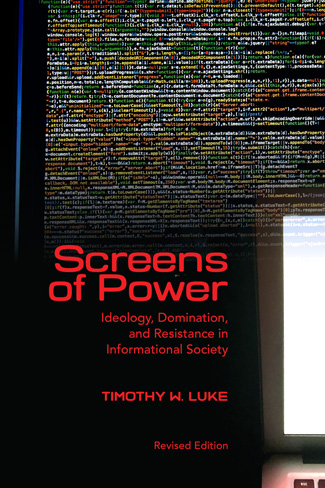 by Timothy W. Luke by Timothy W. Luke
With a Foreword by Ronald J. Deibert
Release date: December 1, 2020
This new edition of Screens of Power: Ideology, Domination, and Resistance in Informational Society, first published in 1989, reintroduces the innovative critique of informational culture, politics, and society outlined by Timothy W. Luke in Telos and other publications during the late 1970s and early 1980s. Much has changed, but far more has stayed the same, making this new edition useful for many readers, as digital images ground personal identity, informatics is geopolitics, grand history endlessly reruns as televisually formatted ritual, electronic electioneering never ends, tele-traditional cultures spin up the spirit of tele-ethnicity in new social movements, and digital divides continue crashing against cybernetic exchange.
On now countless screens of power, which are embedded in billions of smartphones, taxi seats, elevator panels, automobile dashboards, refrigerator doors, airport walls, work cubicles, skyscraper displays, exercise machines, and home video centers, a mix of disinformative mystifications exploits with vivid images of violence the unprecedented inequalities and inequities expressed in America’s bitter racial, gender, ethnic, and class conflicts. Their impact is sparking widespread popular resistance because many citizens feel oligarchy and demagoguery in both political parties are eclipsing democracy and opportunity.
Continue reading →
By Telos Press · Monday, October 19, 2020 Writing at the Wall Street Journal, Tunku Varadarajan profiles Fred Siegel, author of The Crisis of Liberalism: Prelude to Trump, now available from Telos Press Publishing. Order your copy in our online store and save 20% by using the coupon code BOOKS20 during checkout. Also available in Kindle ebook format from Amazon.com.
An excerpt:
 . . . Mr. Siegel traces the origins of the “present-day contempt” for the middle class back a century. He cites H.L. Mencken’s demeaning of the bourgeoisie, in the celebrated editor’s coinage of “booboisie.” Mr. Siegel has written extensively on Herbert Croly, the political philosopher and co-founder of the New Republic, as well as on the novelists H.G. Wells and Sinclair Lewis (who, in 1930, became the first American to win the Nobel Prize for Literature). These three men, Mr. Siegel says, laid the foundation for an elite revolt against the American middle class that endures to this day. . . . Mr. Siegel traces the origins of the “present-day contempt” for the middle class back a century. He cites H.L. Mencken’s demeaning of the bourgeoisie, in the celebrated editor’s coinage of “booboisie.” Mr. Siegel has written extensively on Herbert Croly, the political philosopher and co-founder of the New Republic, as well as on the novelists H.G. Wells and Sinclair Lewis (who, in 1930, became the first American to win the Nobel Prize for Literature). These three men, Mr. Siegel says, laid the foundation for an elite revolt against the American middle class that endures to this day.
“Croly’s idea was that the college-educated, the elite, should become a new aristocracy,” Mr. Siegel says. “Croly believed that the middle-class and their allies—latter-day Jeffersonians who advocated individual freedom and acted in their own self-interest—were impeding the path of the experts, who were ‘disinterested.'”
Wells and Lewis bolstered the view that the professional class was above the fray, giving the argument an almost aesthetic hue. “They thought the middle class was vulgar,” Mr. Siegel says. Mr. Siegel cites a passage in Lewis’s novel “Main Street” (1920), which he regards as “a sardonic sally at the small-town American middle class and its commercial culture.” In the passage, Carol Kennicott, a young woman from the big city trapped by marriage in small-town America, describes Americans as “a savorless people, gulping tasteless food, and sitting afterward, coatless and thoughtless, in rocking chairs . . . and viewing themselves as the greatest race in the world.” In a word, deplorables.
Croly has been largely forgotten, Mr. Siegel says, because liberalism has been largely eclipsed. “Wokeism is not liberalism,” he says. “I don’t want to be unfair to liberals. I was very critical of liberals, but they were in favor of debate; they were in favor of empiricism, of open argument.” Wokeism, by contrast, is a “new secular revealed religion,” which involves no “investigation or empirical study.”
Continue reading →
By Telos Press · Thursday, October 1, 2020 Now available from Telos Press Publishing: The Crisis of Liberalism: Prelude to Trump, by Fred Siegel. Order your copy today in our online store and save 20% off the list price. Also available in Kindle ebook format.
 The Crisis of Liberalism The Crisis of Liberalism
Prelude to Trump
by Fred Siegel
With a Foreword by Joel Kotkin
In The Crisis of Liberalism: Prelude to Trump, Fred Siegel leverages New York City to uncover the key political conflicts and social contradictions in American liberalism over the last century. This wide-ranging collection of essays critically recounts how passionate intellectual debates over how to realize “the good life” in the modern city emerged from the writings of early progressive “thought leaders,” who envisioned a new educated elite capable of enlightened democratic governance. The flaws in this approach, as Siegel shows, expressed themselves most floridly in John Lindsay’s New York, whose flashy limousine liberals were a preview of today’s politically correct gentry liberalism. Its cultural programs over the past half-century repeatedly failed the downtrodden underclass and alienated middle-class New Yorkers trapped in economic stagnation. By neglecting voters’ real concerns over illegal immigration and China’s emerging threats, globalist technocratic liberals ultimately set the stage for Donald Trump’s angry nationalist demand to put “America First.”
Continue reading →
By Telos Press · Tuesday, September 15, 2020 Now available for pre-order from Telos Press Publishing: The Crisis of Liberalism: Prelude to Trump, by Fred Siegel. Pre-order the paperback edition today in our online store and save 30% off the list price. Offer expires 9/30/20. Also available now in Kindle ebook format. Release dates: October 1, 2020 (paperback), September 15, 2020 (ebook).
The Crisis of Liberalism
Prelude to Trump
by Fred Siegel
With a Foreword by Joel Kotkin
In The Crisis of Liberalism: Prelude to Trump, Fred Siegel leverages New York City to uncover the key political conflicts and social contradictions in American liberalism over the last century. This wide-ranging collection of essays critically recounts how passionate intellectual debates over how to realize “the good life” in the modern city emerged from the writings of early progressive “thought leaders,” who envisioned a new educated elite capable of enlightened democratic governance. The flaws in this approach, as Siegel shows, expressed themselves most floridly in John Lindsay’s New York, whose flashy limousine liberals were a preview of today’s politically correct gentry liberalism. Its cultural programs over the past half-century repeatedly failed the downtrodden underclass and alienated middle-class New Yorkers trapped in economic stagnation. By neglecting voters’ real concerns over illegal immigration and China’s emerging threats, globalist technocratic liberals ultimately set the stage for Donald Trump’s angry nationalist demand to put “America First.”
Continue reading →
By Telos Press · Tuesday, September 15, 2020 In the inaugural episode of the Telos Press Podcast, David Pan and Russell Berman talk with Fred Siegel about his forthcoming book The Crisis of Liberalism: Prelude to Trump. Order your copy today in our online store and save 20% off the list price. In the podcast, Siegel discusses the growth of the administrative state, the similarities between former New York City mayor John Lindsay and Barack Obama, the Black Lives Matter movement, the echoes of the 1960s in today’s politics, and the rise of left-wing fascism.
Continue reading →
By Telos Press · Wednesday, August 26, 2020 The following interview was conducted by Moritz Schwarz and appeared in Junge Freiheit, on August 14, 2020. Published with permission. Translated by Russell A. Berman, who has written a separate note here.
Dr. Maaßen, the Mayor of Tübingen, Boris Palmer, has warned against a “world of prohibitions” in Germany, in which “moral condemnation” could follow the smallest mistake. This would “destroy liberal democracy.” Is he right?
Hans-Georg Maaßen: I am a jurist, out of passion, and that’s why I am frightened to have to agree with him in part. I am deeply concerned that our legal state—the rule of law—is being more and more undermined by the rule of morality.
Bärbel Bohley’s disappointed phrase is well known: “We wanted justice, but all we got is the rule of law.” Isn’t morality the better and ethically higher good?
Maaßen: No. It is true that the law only provides a moral minimum. Yet that is precisely the precondition of freedom.
Continue reading →
|
|