Germany and Iran by Matthias Küntzel

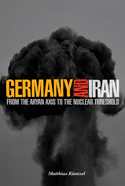
It’s a “special relationship.” But unlike the one embraced and enjoyed by the US and the UK, the nature of the relationship between Germany and Iran seems clandestine and sinister, and evokes strong feelings of suspicion and fear. In the new book, Germany and Iran: From the Aryan Axis to the Nuclear Threshold, respected political scientist and historian Matthias Küntzel examines the special connection between the “problem” countries of the past and present, and confronts the key issue of Iran’s achieving nuclear weapons capability and the real threat of danger that reality poses for Israel and the United States.

Continue reading →

More Scenes from the 2015 Telos Conference

Here are a few more photos from the 2015 Telos Conference, held last month in New York City. We will be posting conference papers and a few videos in the near future, so stay tuned. Special thanks to our photographer/videographer Gabe Miller for capturing the conference on film.

Continue reading →

Joel Kotkin on the New American Oligarchy

In an incisive and thoughtful review essay in Quadrant (March 2015), Peter Murphy examines Joel Kotkin’s The New Class Conflict and the prognosis for America in the “post-creative economy.” Read the full essay (subscription required) at Quadrant Online. Purchase your copy of The New Class Conflict in our online store.

Continue reading →

Scenes from the 2015 Telos Conference in New York

Here are just a few of the photos we took at last weekend’s Telos Conference in New York City. By all accounts the conference was a tremendous success, filled with lively conversation, thoughtful debate, delicious food, and our usual dose of February snow. We will be posting more media and writing from the conference shortly, so stay tuned!

Continue reading →

Amir Taheri on Matthias Küntzel’s Germany and Iran

Writing at the Gatestone Institute website, Amir Taheri reviews Matthias Küntzel’s Germany and Iran: From the Aryan Axis to the Nuclear Threshold, available now from Telos Press Publishing:

In the past 50 years or so, the “special relationship” between Iran and Germany has been highlighted in numerous ways. The first German industrial fair held in a foreign country after the Second World War was hosted by Tehran in 1960 with Economy Minister Ludwig Erhard leading a delegation of over 100 German businessmen. After that, all German Chancellors, starting with Konrad Adenauer, made a point of visiting Iran until the fall of the Shah. Even after the mullahs seized power, Germans pursued the special relationship through high-level visits, including that of Chancellor Gerhard Schroeder. The only time the German Federal parliament approved a law unanimously was when it enacted legislation to guarantee investments in Iran.

Continue reading →

Call for Papers: Special Issue on Korea

Telos seeks essays on the economic, political, cultural, literary, philosophical, and historical dimensions of Korea for a special issue. With its dramatic recovery from the devastating legacies of colonial rule and civil war, South Korea has emerged as one of the leading hubs of cutting-edge information technology and an epicenter of production in the realm of popular culture. Civil governance has taken bold steps forward over the past two decades, signaled by the advent of leaders who defy long-standing meritocratic and patriarchal conventions; meanwhile a multidimensional rethinking of the past is underway, ranging from ancient territorial boundaries to current disputes over national waters. In contrast, North Korea continues to enforce its lone doctrine of authoritarian rule, serving as a constant reminder of the precarious bind of ceasefire. Revenants of the past century’s ideological divide hang over the peninsula in the form of nuclear threat, while South Korea’s hasty march toward capitalist affluence has not benefited everyone equally. How can Critical Theory understand the South Korean path to modernization or the oppressiveness of the North Korean regime? How does Korea position itself as a nation, culture, and a system of values that inherit its past and inspire its future? How can we think South Korean economic dynamism together with/against its popular culture? Is there a (South) Korean model that can be evaluated in an international context and/or through the eyes of the Korean diaspora? This special issue invites critical analyses on these subjects from various disciplines, including but not limited to literature, sociology, anthropology, political science, philosophy, cultural studies, economics, and history. Please direct inquiries to Haerin Shin by email at haerin.shin@vanderbilt.edu. Manuscripts (7500 words) due by December 1, 2015.

Continue reading →