By Telos Press · Saturday, January 26, 2013 An excerpt from Carl Abrahamsson’s recent review of Ernst Jünger’s The Adventurous Heart, published by Telos Press. Read the full review here.
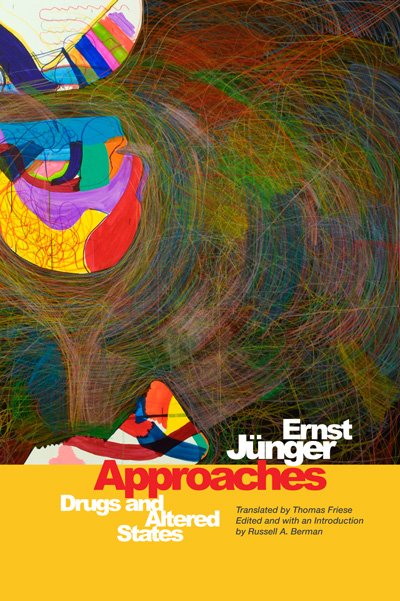
 The Adventurous Heart is a perfect title for the book. Once inside, each page is like an adventure and it does indeed belong more in the sphere of the heart than in the rational mind. Strolling through nature—both the chlorophyllic and the human—Jünger ponders phenomena as well as his own conclusions in an intuitive way. Aloof, yes, but always intriguing enough to keep you hooked. It’s an unpredictable mystery, very subtly designed, and which works over and over and over (try re-reading On the Marble Cliffs or this one and see how much new stuff actually appears. A literary tricking of memory or simply a living, sentient text?). . . . The Adventurous Heart is a perfect title for the book. Once inside, each page is like an adventure and it does indeed belong more in the sphere of the heart than in the rational mind. Strolling through nature—both the chlorophyllic and the human—Jünger ponders phenomena as well as his own conclusions in an intuitive way. Aloof, yes, but always intriguing enough to keep you hooked. It’s an unpredictable mystery, very subtly designed, and which works over and over and over (try re-reading On the Marble Cliffs or this one and see how much new stuff actually appears. A literary tricking of memory or simply a living, sentient text?). . . .
Continue reading →
By Telos Press · Wednesday, December 19, 2012 Gary Lachman reviews Ernst Jünger’s The Adventurous Heart for Reality Sandwich:
The Adventurous Heart is a collection of short essays, thoughts, stories, dreams, philosophical musings, and other unclassifiable writings on a number of experiences: nature, death, travel, sex, drugs, antique shops, museums, practically anything that caught Jünger’s ever inquisitive eye. It provides, as Jünger says, “small models of another way of seeing things.” This “other way” is what Jünger calls “stereoscopy,” the ability to see things in a dual aspect, perceiving their surface and depth simultaneously. . . . Jünger’s “stereoscopy” revealed to him the “secret correspondences existing between things,” and his reflections, written in an elegant, often lapidary style, trigger in the attentive reader a similar effect.
Continue reading →
By Telos Press · Monday, December 3, 2012 The following review of Ernst Jünger’s The Adventurous Heart: Figures and Capriccios appeared in the November edition of The Midwest Book Review‘s Small Press Bookwatch.
Psychology is the study of human thought and processes, and all around the world people have brought different perspectives together for a better and more complete understanding of it all. The Adventurous Heart: Figures and Capriccios is an English translation of the 1938 German psychological writer Ernst Jünger who wrote on his perspective of the mind and what we seek in life, touching on the nature of intuition. Revered throughout the literary and psychological international communities, The Adventurous Heart is a strong read for those who want a better understanding of the man who saw much in his time of turmoil.
Ernst Jünger’s The Adventurous Heart is available for purchase here.
Continue reading →
By Telos Press · Tuesday, October 23, 2012 The New York Times recently published a letter from Telos Editorial Associate Marcia Pally, who commends the paper for drawing attention to the work of “new evangelicals”:
Molly Worthen’s insightful review of “Moral Minority: The Evangelical Left in an Age of Conservatism,” by David R. Swartz (Sept. 30), is, I hope, the beginning of more coverage of the evangelicals who have left the right. Swartz’s fine scholarship illuminates a critical shift in our religio-political landscape: “new evangelical” activism in environmental protection, economic justice and immigration reform — a big change in where evangelical time and money are going. If we don’t read about changes like this, we accept old prejudices and remain blind to political realities.
Continue reading →
By Telos Press · Wednesday, September 19, 2012 Jens-Martin Eriksen, co-author (with Frederik Stjernfelt) of The Democratic Contradictions of Multiculturalism, recently appeared on The Agenda with Steve Paikin to discuss the rise of hatred in Western nations. Watch the video after the break.
Continue reading →
By Telos Press · Wednesday, August 22, 2012 Religion and Politics in a Post-Secular World
The Seventh Annual Telos Conference
February 16-17, 2013
New York City
The 21st century has been marked by both events and reflections that have explicitly challenged the long-standing liberal project of maintaining a separation between religion and politics. Not only have political conflicts become inseparable from theological and metaphysical considerations, but standard liberal claims of value-neutrality have been undermined by insights into the theological presuppositions of secular institutions. The goal of the 2013 Telos Conference will be to investigate the changing relationship between religion and politics. Possible topics include secularization and the “post-secular” turn; the theological foundations of political systems such as liberalism, socialism, and fascism; political theology; religion and the public sphere; separation of church and state; new civil forms of religious practice; the politics of religious pluralism; myth and sovereignty; theology and modernity; religion and political values; theocracy and religious law.
Please send short cv, paper title, and a 200-word abstract for a 15-minute presentation to David Pan (dtpan@uci.edu) with “2013 Telos Conference” in subject line by October 15, 2012.
|
|