By Matt Applegate · Tuesday, February 11, 2014 As an occasional feature on TELOSscope, we highlight a past Telos article whose critical insights continue to illuminate our thinking and challenge our assumptions. Today, Matt Applegate looks at André Gorz’s “The Tyranny of the Factory: Today and Tomorrow” from Telos 16 (Summer 1973).
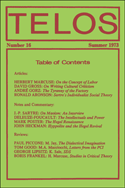 “There is a link between the crisis of School (school instruction) and the crisis of tyranny in the factory,” André Gorz proclaims in his 1973 article “The Tyranny of the Factory: Today and Tomorrow” (64). An Austrian-born social theorist, Gorz is known primarily for his interventions in political ecology and social analysis of capitalism. His focus on capital and education is not unrelated here, however. Substantively more than an abstract analysis of working conditions in the contemporary factory or a sweeping statement concerning the state of education in France, Gorz links the culture of factory labor to the imperatives of discipline and command in educational settings. The underlying claim here is that the logic of capitalism and the raison d’être of state-run education have become synonymous, resulting in both an auto-social response to capital’s hegemony in all forms of life and the elimination of pedagogical forms that inspire critical thought and practice. With this claim, at least three points of focus must be highlighted. “There is a link between the crisis of School (school instruction) and the crisis of tyranny in the factory,” André Gorz proclaims in his 1973 article “The Tyranny of the Factory: Today and Tomorrow” (64). An Austrian-born social theorist, Gorz is known primarily for his interventions in political ecology and social analysis of capitalism. His focus on capital and education is not unrelated here, however. Substantively more than an abstract analysis of working conditions in the contemporary factory or a sweeping statement concerning the state of education in France, Gorz links the culture of factory labor to the imperatives of discipline and command in educational settings. The underlying claim here is that the logic of capitalism and the raison d’être of state-run education have become synonymous, resulting in both an auto-social response to capital’s hegemony in all forms of life and the elimination of pedagogical forms that inspire critical thought and practice. With this claim, at least three points of focus must be highlighted.
Continue reading →
By Telos Press · Monday, February 10, 2014 Don’t forget: the Eighth Annual Telos Conference will be held this upcoming weekend, February 15–16, 2014, in New York City. Registration is now closed, but if you are still interested in attending the conference, please RSVP to deutscheshaus.rsvp@nyu.edu. Please note that some of the talks are limited to registered attendees only.
Additional details about the conference, as well as the complete conference program, are available at the Telos-Paul Piccone Institute website.
We look forward to seeing you this weekend!
Continue reading →
By Caroline Edwards · Thursday, February 6, 2014 Caroline Edwards’s “From Eros to Eschaton: Herbert Marcuse’s Liberation of Time” appears in Telos 165 (Winter 2013). Read the full version online at the Telos Online website, or purchase a print copy of the issue in our store.
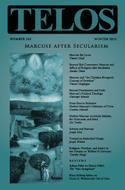 This article explores what Gershom Scholem has called Herbert Marcuse’s “unacknowledged ties to [his] Jewish heritage.” At the core of Marcuse’s vision of transformed, non-repressive social relations, I argue, is a struggle over time, which rests upon a distinctly Jewish approach to the twin questions of remembrance and redemption. One example of this approach is the temporal dialectic between alienated labor time and the timelessness of pleasure’s desire for eternity, which underpins Marcuse’s analysis in Eros and Civilization (1956). This dialectic rests upon Marcuse’s reading of the Freudian Eros-Todestrieb dualism, whose phylogenetic reading of patricide has been read by critics as reformulating the biblical rebellion against an authoritarian Yahweh. This article explores what Gershom Scholem has called Herbert Marcuse’s “unacknowledged ties to [his] Jewish heritage.” At the core of Marcuse’s vision of transformed, non-repressive social relations, I argue, is a struggle over time, which rests upon a distinctly Jewish approach to the twin questions of remembrance and redemption. One example of this approach is the temporal dialectic between alienated labor time and the timelessness of pleasure’s desire for eternity, which underpins Marcuse’s analysis in Eros and Civilization (1956). This dialectic rests upon Marcuse’s reading of the Freudian Eros-Todestrieb dualism, whose phylogenetic reading of patricide has been read by critics as reformulating the biblical rebellion against an authoritarian Yahweh.
Continue reading →
By Michael Millerman · Wednesday, February 5, 2014 As an occasional feature on TELOSscope, we highlight a past Telos article whose critical insights continue to illuminate our thinking and challenge our assumptions. Today, Michael Millerman looks at Carl Schmitt’s “Appropriation/Distribution/Production: Toward a Proper Formulation of Basic Questions of any Social and Economic Order” from Telos 95 (Spring 1993). Carl Schmitt’s The Nomos of the Earth in the International Law of the Jus Publicum Europaeum is available for purchase in our store.
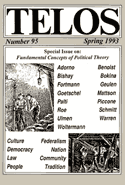 As indicated by its title, Carl Schmitt’s essay addresses to two problems: (1) what are the basic questions that we must raise about the social and the economic order? (2) how are those questions properly formulated? A moment’s reflection should reveal to us the great generality of these problems, which are designed—so Schmitt says—to answer a need for “comprehensive consideration” of social life in its unity (52). Whether we are asking about orders democratic, non-democratic, capitalist, or socialist; whether we inquire into totalitarianisms, fascisms, traditionalisms, ethno-nationalisms; whether we put the question to republics or princedoms, Schmitt is indicating that there are basic questions to ask, and he is suggesting that he has the key to their proper formulation. As indicated by its title, Carl Schmitt’s essay addresses to two problems: (1) what are the basic questions that we must raise about the social and the economic order? (2) how are those questions properly formulated? A moment’s reflection should reveal to us the great generality of these problems, which are designed—so Schmitt says—to answer a need for “comprehensive consideration” of social life in its unity (52). Whether we are asking about orders democratic, non-democratic, capitalist, or socialist; whether we inquire into totalitarianisms, fascisms, traditionalisms, ethno-nationalisms; whether we put the question to republics or princedoms, Schmitt is indicating that there are basic questions to ask, and he is suggesting that he has the key to their proper formulation.
Continue reading →
By Zvi Tauber · Thursday, January 30, 2014 Zvi Tauber’s “Herbert Marcuse on Jewish Identity, the Holocaust, and Israel” appears in Telos 165 (Winter 2013). Read the full version online at the Telos Online website, or purchase a print copy of the issue in our store.
The article focuses at three themes of Herbert Marcuse’s approach, views, and attitudes concerning Judaism, Jewish history and the State of Israel. Marcuse, whose research and philosophy only marginally addressed the “Jewish question,” never denied his Jewish origins, but at the same time he never used this objective fact as an exclusive or decisive argument to affect his views on various issues, not even regarding world-historical matters of particular relevance to the Jews. Even if generally, positively, Marcuse endeavored to constitute the Marxian Realm of Freedom, or at least strove to fathom scientifically why in the course of modern history, an authentic revolution for the liberation of man has failed repeatedly, his major, immediate, intellectual and socio-political concern was the struggle against the reemergence of an oppressive reign of horror, including a struggle against the possible recurrence of a genocide.
Continue reading →
By Linas Jokubaitis · Tuesday, January 28, 2014 As an occasional feature on TELOSscope, we highlight a past Telos article whose critical insights continue to illuminate our thinking and challenge our assumptions. Today, Linas Jokubaitis looks at Carl Schmitt’s “The Legal World Revolution” from Telos 72 (Summer 1987).
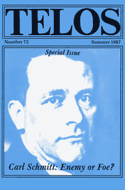 Carl Schmitt wrote “The Legal World Revolution” when he was ninety years old, and it turned out to have been his last publication. New political developments had forced him to restate some of his old positions, the most important of which was the relationship between legitimacy, legality, and super-legality. The guiding theme of Schmitt’s final publication was the one that had been of the highest importance during his whole career. It is best summarized in notes posthumously published as Glossarium, in a passage entitled “The Diagnostic and Prognostic of Max Weber,” where Schmitt quoted from Weber’s “Sociology of Law”: “As a result of technical and economic development, it is inevitable that current law is destined to be conceived more and more as a rational technical mechanism which can be modified at any time for functional purposes, and is lacking in any kind of sacred content. The destiny may be hidden by the suppleness of belief of the current law, but cannot be truly avoided.” Carl Schmitt wrote “The Legal World Revolution” when he was ninety years old, and it turned out to have been his last publication. New political developments had forced him to restate some of his old positions, the most important of which was the relationship between legitimacy, legality, and super-legality. The guiding theme of Schmitt’s final publication was the one that had been of the highest importance during his whole career. It is best summarized in notes posthumously published as Glossarium, in a passage entitled “The Diagnostic and Prognostic of Max Weber,” where Schmitt quoted from Weber’s “Sociology of Law”: “As a result of technical and economic development, it is inevitable that current law is destined to be conceived more and more as a rational technical mechanism which can be modified at any time for functional purposes, and is lacking in any kind of sacred content. The destiny may be hidden by the suppleness of belief of the current law, but cannot be truly avoided.”
Continue reading →
|
|