By Russell A. Berman · Monday, October 26, 2020 From the beginning of Donald Trump’s campaign for the presidency and throughout his administration, the most consistent point of orientation in his politics has been the priority of the nation. It informed the slogan “Make America Great Again,” which initially shocked political sensibilities, since it implied the accusation that previous bipartisan political leadership had stood by during a decline or even facilitated a loss of greatness. The priority of the nation similarly underpinned the formula of “America First,” as the designation of a foreign policy that would give greater attention to national interest and therefore break with established patterns of multilateralism. Trump himself has embraced the term “nationalist,” and this marks his difference from both the free trade internationalism that used to define the neoliberal Republicans as well as from the multiculturalism that dominates the identity-political Democrats.
Between those two alternatives, globalism and fragmentation, Trump has opted for the nation. With that choice, he put his finger on the forgotten category—class—in an era of growing inequality. “Nation” serves as the organizing principle for programs purporting to achieve vertical integration, the “whole nation,” i.e., a promise—whether fulfilled or not—of an inclusive nationalism. Trump’s nationalism therefore is better described as a national populism. This aspiration for inclusion outweighs a simultaneous function of exclusionary nationalism, the differentiation from other nations, although that aspect clearly plays a role as well, especially in immigration policies.
Continue reading →
By Mark G. E. Kelly · Friday, October 23, 2020 As we near the denouement of the 2020 U.S. general election, the actual in-person one-day ballot—which will surely be less decisive this year than previously, due to the relative prevalence of early voting—Donald J. Trump’s presidency looks doomed. Polling resolutely predicts his demise. Of course, pollsters are cautious this year after almost equally decisive predictions in 2016 proved misguided, and indeed there is still reason to think that Trump might nonetheless triumph (see in particular Isaac Lopez’s recent prediction to this effect in this very blog in his “Why Trump Will Win”).
Trump’s defeat would in a way provide a logical end point to a consistent wailing for his blood from the most vocal sectors of the American public sphere, which began well before he became president. The consistency of the discourse against Trump is nothing short of uncanny—indeed, in some ways it seems unchanged, fossilized, left over from when it was intended to prevent the unthinkable election of Trump from ever taking place. We might read in this determined carrying-on of the rhetorical electioneering of 2016 over the entirety of Trump’s term a kind of denial that Trump’s election ever happened. Indeed, Trump’s election was for urbane liberals so unthinkable that their capitalized “Resistance” to Trump has not been so much a political resistance movement as a reaction of psychological resistance to the very existence of his presidency. From such a perspective, Trump’s defeat might seem to offer a return to sanity and normality, one that will allow “Resisters” to pretend his presidency never happened.
Continue reading →
By Norbert Bolz · Thursday, October 22, 2020 The art of scandalizing is inexhaustible. In Kant’s Anthropology, there are a few remarks familiar to anyone who has studied Kant. According to the standards of the spirit our time, one could characterize those as racist. That media attention can be sparked from this today is known since the leveling of similar accusations at Shakespeare and Mark Twain. Hegel praised war, Nietzsche proclaimed the necessity of slavery, the hypersensitive Walter Benjamin made use of the word “gypsy.” One could endlessly extend the proscription list of scandalous thinkers. For the block warden of thought, there is really not a single great mind before 1968 with whom some racist, militaristic, or misogynistic remark could not be substantiated.
Continue reading →
By Mark G. E. Kelly · Tuesday, October 20, 2020 Mark G. E. Kelly’s “Is Fascism the Main Danger Today? Trump and Techno-Neoliberalism” appears in Telos 192 (Fall 2020): Truth and Power. Read the full article at the Telos Online website, or purchase a print copy of the issue in our online store. Individual subscriptions to Telos are available in both print and online formats.
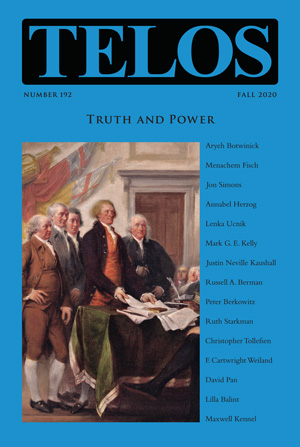 In this article, I argue against the prevalent tendency, both in popular and scholarly discourse, to understand the Trump presidency as representing an incipient American fascism. I point out that Trump’s actual administration has shown no features distinctive of fascism, and that all alleged fascist policies of Trump are deeply in continuity with the pattern of liberal U.S. politics. I further argue that the most extraordinary aspect of Trump’s presidency, his strident rhetoric, while representing a deviation from U.S. politics as usual, is nonetheless not distinctively fascist. Lastly, I point out that, while Trump’s rhetoric and policies have drawn him support from literal fascists, he has little real connection with them and has largely disappointed rather than encouraged them. Instead, I suggest that Trump’s presidency represents the opposite of robust use of state power we associate with fascism, namely, a further decline in federal executive power in favor of the power of corporations. I conclude by suggesting that the increase of the censorious power of Big Tech in particular represents a far greater threat to democracy than Trump, and that the left’s monomaniacal focus on opposing Trump has allowed this tendency to go unchecked. In this article, I argue against the prevalent tendency, both in popular and scholarly discourse, to understand the Trump presidency as representing an incipient American fascism. I point out that Trump’s actual administration has shown no features distinctive of fascism, and that all alleged fascist policies of Trump are deeply in continuity with the pattern of liberal U.S. politics. I further argue that the most extraordinary aspect of Trump’s presidency, his strident rhetoric, while representing a deviation from U.S. politics as usual, is nonetheless not distinctively fascist. Lastly, I point out that, while Trump’s rhetoric and policies have drawn him support from literal fascists, he has little real connection with them and has largely disappointed rather than encouraged them. Instead, I suggest that Trump’s presidency represents the opposite of robust use of state power we associate with fascism, namely, a further decline in federal executive power in favor of the power of corporations. I conclude by suggesting that the increase of the censorious power of Big Tech in particular represents a far greater threat to democracy than Trump, and that the left’s monomaniacal focus on opposing Trump has allowed this tendency to go unchecked.
Continue reading →
By Telos Press · Monday, October 19, 2020 Writing at the Wall Street Journal, Tunku Varadarajan profiles Fred Siegel, author of The Crisis of Liberalism: Prelude to Trump, now available from Telos Press Publishing. Order your copy in our online store and save 20% by using the coupon code BOOKS20 during checkout. Also available in Kindle ebook format from Amazon.com.
An excerpt:
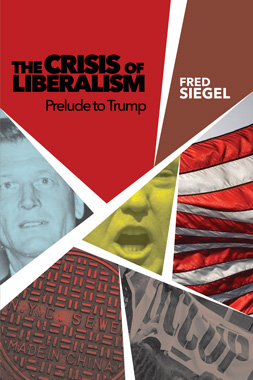 . . . Mr. Siegel traces the origins of the “present-day contempt” for the middle class back a century. He cites H.L. Mencken’s demeaning of the bourgeoisie, in the celebrated editor’s coinage of “booboisie.” Mr. Siegel has written extensively on Herbert Croly, the political philosopher and co-founder of the New Republic, as well as on the novelists H.G. Wells and Sinclair Lewis (who, in 1930, became the first American to win the Nobel Prize for Literature). These three men, Mr. Siegel says, laid the foundation for an elite revolt against the American middle class that endures to this day. . . . Mr. Siegel traces the origins of the “present-day contempt” for the middle class back a century. He cites H.L. Mencken’s demeaning of the bourgeoisie, in the celebrated editor’s coinage of “booboisie.” Mr. Siegel has written extensively on Herbert Croly, the political philosopher and co-founder of the New Republic, as well as on the novelists H.G. Wells and Sinclair Lewis (who, in 1930, became the first American to win the Nobel Prize for Literature). These three men, Mr. Siegel says, laid the foundation for an elite revolt against the American middle class that endures to this day.
“Croly’s idea was that the college-educated, the elite, should become a new aristocracy,” Mr. Siegel says. “Croly believed that the middle-class and their allies—latter-day Jeffersonians who advocated individual freedom and acted in their own self-interest—were impeding the path of the experts, who were ‘disinterested.'”
Wells and Lewis bolstered the view that the professional class was above the fray, giving the argument an almost aesthetic hue. “They thought the middle class was vulgar,” Mr. Siegel says. Mr. Siegel cites a passage in Lewis’s novel “Main Street” (1920), which he regards as “a sardonic sally at the small-town American middle class and its commercial culture.” In the passage, Carol Kennicott, a young woman from the big city trapped by marriage in small-town America, describes Americans as “a savorless people, gulping tasteless food, and sitting afterward, coatless and thoughtless, in rocking chairs . . . and viewing themselves as the greatest race in the world.” In a word, deplorables.
Croly has been largely forgotten, Mr. Siegel says, because liberalism has been largely eclipsed. “Wokeism is not liberalism,” he says. “I don’t want to be unfair to liberals. I was very critical of liberals, but they were in favor of debate; they were in favor of empiricism, of open argument.” Wokeism, by contrast, is a “new secular revealed religion,” which involves no “investigation or empirical study.”
Continue reading →
By Jon Simons · Friday, October 16, 2020 Jon Simons’s “Divine Violence, Profane Peace: Walter Benjamin, Rabbis for Human Rights, and Peace in Israel–Palestine” appears in Telos 192 (Fall 2020): Truth and Power. Read the full article at the Telos Online website, or purchase a print copy of the issue in our online store. Individual subscriptions to Telos are available in both print and online formats.
One of the reasons for disaffection toward peace among Jewish Israelis may be a “Judaic deficit” in the secular, liberal conceptions of peace implicit in both official peace processes and peace activism. I address this deficit by bringing the Judaically inflected but nonreligious work of Walter Benjamin into conversation with the thought and practice of Rabbis for Human Rights, who combine Judaism with liberal, universal rights. Benjamin’s essay “Critique of Violence” counters the legally enforced violence of liberal peace with a conjugation of divine violence and nonviolent conflict resolution. Interpreting his essay with particular attention to his reading of the Biblical story of Korah leads to a theologico-political notion of peace as agonistic, human wrestling with divine violence and power. Rabbis for Human Rights embody such peace to some degree in their simultaneous interpretation of divine law and “small acts” of nonviolent opposition to Occupation.
Continue reading →
|
|