By Erik Pomrenke · Wednesday, January 3, 2018 As an occasional feature on TELOSscope, we highlight a past Telos article whose critical insights continue to illuminate our thinking and challenge our assumptions. Today, Erik Pomrenke looks at Andrew J. Mitchell’s “Entering the World of Pain: Heidegger” from Telos 150 (Spring 2010).
Heidegger’s thinking of pain allows for a positive revaluation of pain as openness, not closure, to the world. Andrew J. Mitchell contends in his “Entering the World of Pain: Heidegger,” that “pain is the surest sign that we wholly belong to this world; in fact, pain is nothing other than our contact with the world and our ‘openness’ to it.” Mitchell situates Heidegger against two popular accounts of pain: Freudian psychoanalysis and the humanist interpretation of pain as articulated by Elaine Scarry in her book The Body in Pain. Both models oppose pain and openness to the world and therefore see pain as a withdrawal from meaning. Within psychoanalysis, this takes place in the disengagement of cathexis—divestment of libido from love objects. Within the broadly humanist account, world and body are opposed. When the body demands attention, it necessitates a withdrawal from and contraction of the world. Scarry’s thought is structured by such binary oppositions as pain and meaning, interiority and exteriority, and it will be the task of Heidegger’s thinking of pain to reconfigure these oppositions by holding up pain and language as co-original phenomena—a task that Mitchell illustrates by reading Trakl.
Continue reading →
By Cary Nelson · Wednesday, December 20, 2017 The large room at the Marriott Wardman Park was filled to overflowing on Sunday afternoon for a special session billed as “Thinking Palestine Intersectionally.” The seats were occupied and scores of others stood along the walls, sat on the floor in front of the stage, and spilled out into the hallway. For many it was clearly the highlight of The Middle East Studies Association’s November 2017 annual meeting of faculty and graduate students, held in Washington, DC. Perhaps 500 people were present to hear Noura Erakat, Judith Butler, Samera Esmeir, and Angela Davis be hailed as symbolic conquerors of the Jewish state. “The peace process is over,” Erakat began, and then affirmed “the entwinement of our liberation,” offering her own take on intersectionality. The real reason the United States blocked the “Zionism is racism” framework, she declared was “to prevent itself from having to pay reparations for slavery,” a claim that would have surprised the very people who fought against the 1975 UN resolution. The days of progressive advocacy “except for Palestine are over,” she concluded. It is time “to bar supporters of Israel from feminist movements.” Even this last agenda item, a call to cast out the female devils in our midst, met with loud applause.
Continue reading →
By Russell A. Berman · Wednesday, December 13, 2017 Telos 181 (Winter 2017): War and Civil War is now available for purchase in our store.
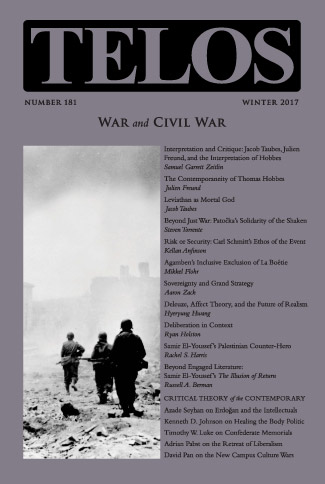 Consider the question: has American political life ever been as polarized as it is today? If the most appropriate answer is: yes, of course, in 1861, then the problem has been named and we are left with little comfort. The evaporation of anything like a bipartisan consensus in the political class leaves us staring at a battlefield, with few common bonds or shared attachments. Politics has become the internalization of war by other means. This is our version of the crisis of parliamentary democracy that Schmitt described in the Weimar years. Congressional Democrats are unwilling to cross the aisle to find room for compromise in the Trump era, but this only repeats the animosity among Republicans toward the Obama agenda eight years ago. Each party seeks its own advantage, which exclusively means the other party’s disadvantage, as the national good slips beneath the horizon. Each party focuses on mobilizing its base for votes and fund-raising, which means that each has an irresistible incentive to avoid solving those problems that are the most effective vehicles for rallying their supporters: when they held the majority, the Democrats preferred to keep the “dreamers” vulnerable, so as to be able to recycle them in future campaigns, just as the Republicans chose to punt on health care. Each issue is too successful in attracting voters, too valuable to give up. Consider the question: has American political life ever been as polarized as it is today? If the most appropriate answer is: yes, of course, in 1861, then the problem has been named and we are left with little comfort. The evaporation of anything like a bipartisan consensus in the political class leaves us staring at a battlefield, with few common bonds or shared attachments. Politics has become the internalization of war by other means. This is our version of the crisis of parliamentary democracy that Schmitt described in the Weimar years. Congressional Democrats are unwilling to cross the aisle to find room for compromise in the Trump era, but this only repeats the animosity among Republicans toward the Obama agenda eight years ago. Each party seeks its own advantage, which exclusively means the other party’s disadvantage, as the national good slips beneath the horizon. Each party focuses on mobilizing its base for votes and fund-raising, which means that each has an irresistible incentive to avoid solving those problems that are the most effective vehicles for rallying their supporters: when they held the majority, the Democrats preferred to keep the “dreamers” vulnerable, so as to be able to recycle them in future campaigns, just as the Republicans chose to punt on health care. Each issue is too successful in attracting voters, too valuable to give up.
Continue reading →
By David Pan · Friday, November 10, 2017 David Pan’s “Cosmopolitanism, Tianxia, and Walter Benjamin’s ‘The Task of the Translator'” appears in Telos 180 (Fall 2017), a special issue on Cosmopolitanism and China. Read the full article at the Telos Online website, or purchase a print copy of the issue in our online store. Individual subscriptions to Telos are now available in both print and online formats.
As a term, cosmopolitanism defies simple understanding. Already in its earliest formulation, attributed to the ancient Greek Cynic Diogenes, the merging of cosmos and polite to mean “citizen of the world” had a paradoxical meaning, imagining both local belonging as a citizen and lack of a specific place in the world. If the Cynics’ notion of cosmopolitanism arises out of a rejection of conventions in general rather than the embracing of a world system, they were left in an empty space between locality and universality. This tension between belonging and universality continues into the current discussion of cosmopolitanism as a term that spans political and cultural discussions. While the modern cosmopolitan political project seeks to lay out a common institutional framework for human society, the accompanying cultural project in fact works against such unity by seeking to promote the recognition and toleration of cultural differences.
Continue reading →
By Yifeng Sun · Wednesday, November 1, 2017 Yifeng Sun’s “Cosmopolitan Translation and Cross-Cultural Paradigms: A Chinese Perspective” appears in Telos 180 (Fall 2017), a special issue on Cosmopolitanism and China. Read the full article at the Telos Online website, or purchase a print copy of the issue in our online store. Individual subscriptions to Telos are now available in both print and online formats.
This paper proposes to investigate the shifting cross-cultural paradigms in response to cosmopolitan thinking and consciousness as well as the nature of cultural translation in relation to cosmopolitanism. The perception of cosmopolitan translation, referring primarily to cultural translation situated fully within the cosmopolitan constellation, is closely linked to cognitive, social, and cultural change in a global and globalizing context. The rapid development of globalization raises questions about nationalism, cultural identity, and, above all, translation itself.
Continue reading →
By Mark Wegierski · Thursday, October 26, 2017 The following paper was presented at the conference “After the End of Revolution: Constitutional Order amid the Crisis of Democracy,” co-organized by the Telos-Paul Piccone Institute and the National Research University Higher School of Economics, September 1–2, 2017, Moscow. For additional details about the conference as well as other upcoming events, please visit the Telos-Paul Piccone Institute website.
This presentation compares two societies, which, although both claim to be “Western” as well as vibrant liberal democracies, are in many aspects quite different. Those societies have been shaped by their history and political culture to evolve in quite different directions. Nevertheless, they can both be seen as “post-revolutionary” societies.
Poland has had a very checkered history, from being a Great Power, to disappearing from the map of Europe, which has contributed to a strongly “erotic” sense of belonging among the Poles. Poland after 1989—the so-called Third Republic—has been in the difficult process of attempting a restoration of a more traditional Polish society, whose organic evolution and development had been so cruelly interrupted since 1939.
Continue reading →
|
|