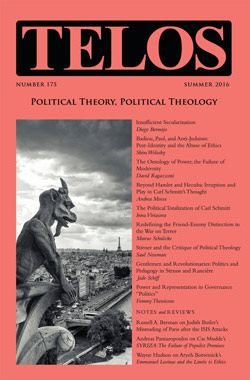
 Critical theory inherited the mission of philosophy to know the world and to pursue the good life. Careful examination should shed light on the cosmos and our place within it and contribute to a beneficial ordering of human concerns, when wisdom informs governance. Yet that aspiration to know the world encountered the limits of intelligibility, beyond which reason could not proceed. Meanwhile, the efforts to remake the world in the spirit of reason elicited processes of rationalization, as deleterious to the world around us, the natural environment, as to the world within us, the ongoing cultural crisis of modernity and its social corollaries. That is Horkheimer and Adorno’s dialectic of enlightenment at the foundation of the critical theoretical tradition that continues to provide a framework with which to articulate a critique of the contemporary in its many heterogeneous facets: the disruption of all forms of solidarity, the pressures on family structures, the erosion of educational opportunities, the growing gap between rich and poor. Add to this the ominous shifts in the international order, including the breakdown of state structures from North Africa through the Middle East, the strains on the European Union, and the return of a repressive semi-dictatorship in Russia, while—at this point in the presidential election season—the United States seems to be tumbling dangerously toward Weimar conditions.
|
In “On the Political: Schmitt contra Schmitt,” Benjamin Arditi is occupied with the task of revitalizing Carl Schmitt, to open or retrace various interpretative paths that allow us to use Schmitt in trajectories that he did not envisage or did not pursue. Arditi takes his reader by the hand into an exploration of a series of issues arising from Schmitt’s theory: disputes regarding the bellicose nature of the political, the identification of politics in the political, the charge of formalism, and the normative dimension of order. Mina Ahadi is an Iranian exile, living in Germany. She opposed the Shah as well as Khomeini. In 1990 she fled to the West. An adamant secularist, critical of all religion and therefore an opponent of Islamist politics, she does not appear to distinguish between “Islamic” and “Islamist” in her prose. She identifies herself as a communist, she is a leader in the “Central Committee of Former Muslims,” and she is a principled defender of human rights. In two recent open letters, she stakes out positions that not only provide insight into contemporary German political discussions but that are directly relevant to U.S. debates as well. Writing at the Jerusalem Center for Public Affairs website, Joseph S. Spoerl reviews Matthias Küntzel’s Germany and Iran: From the Aryan Axis to the Nuclear Threshold, published by Telos Press Publishing. “Küntzel’s book,” writes Spoerl, “demonstrates a deeply disturbing truth, namely, that if Iran should acquire nuclear weapons and use them to commit a second Holocaust against the six million Jews of Israel, then Germany—the nation that committed the first Holocaust—will have played a central role in paving the way for the Iranian perpetrators.” Save 20% on your purchase of Germany and Iran, as well as other Telos Press books, by using the coupon code BOOKS20 in our online store. This is the fourth in a series of posts that introduce the thought of historian Martin J. Sklar, as a prelude to a print symposium on his life and work in a future issue of Telos. Earlier excerpts of Sklar’s writing appear in the first, second, and third posts. For a fuller introduction, refer to the head note to the first TELOSscope post. As a researcher, Sklar was a historian of the United States, including its role in the world, particularly (from the late nineteenth century) as a promoter and guarantor (on balance) of a global system of expanding economic and political freedom. As a reader and informed commentator on international affairs, he was also deeply interested in broader issues in world history, particularly insofar as they shaped contemporary global conflicts. (Among the several dozen of Sklar’s books that I inherited are heavily marked and annotated copies of the following: John Yoo, War by Other Means: An Insider’s Account of the War on Terror; Philip Bobbitt, Terror and Consent; Bernard Lewis, The Middle East: A Brief History of 2,000 Years; and Niall Ferguson, Colossus: The Rise and Fall of the American Empire.) The following excerpts from a letter to John Yoo reflect Sklar’s evolving understanding of what he understood as an ongoing U.S. (and Western) war against Islamic imperialism. Of particular interest is his conceptualization of various sectarian, and even nominally secular, movements as sometimes-competing branches of an expansive, totalitarian movement. |
   |
|||
|
Privacy Policy · Data Protection Copyright © 2026 Telos Press Publishing · All Rights Reserved |
||||