By Timothy W. Luke · Monday, September 14, 2015 Telos 172 (Fall 2015) is now available for purchase in our store.
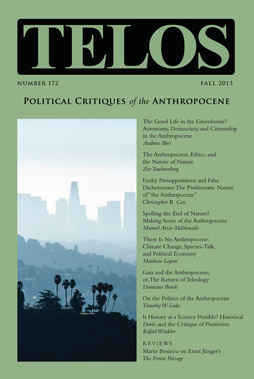 Rapid climate change today is attributed to the profligate use of fossil fuels, and this consumption of hydrocarbon energy has worldwide, albeit uneven and discontinuous, cultural and economic patterns to it. Nonetheless, it is more than plausible to spin up the frameworks for a universal history of humanity based upon modern society’s increasing combustion of the planet’s biotic prehistory as fossil fuel energy. As the carbon of antediluvian plant matter is burned to light homes, run factories, and propel vehicles, the history of the present becomes materially universalized as the exhausted energy of the distant past released along with its soot, smog, and smoke. Rapid climate change today is attributed to the profligate use of fossil fuels, and this consumption of hydrocarbon energy has worldwide, albeit uneven and discontinuous, cultural and economic patterns to it. Nonetheless, it is more than plausible to spin up the frameworks for a universal history of humanity based upon modern society’s increasing combustion of the planet’s biotic prehistory as fossil fuel energy. As the carbon of antediluvian plant matter is burned to light homes, run factories, and propel vehicles, the history of the present becomes materially universalized as the exhausted energy of the distant past released along with its soot, smog, and smoke.
Thus, noxious by-products of production and consumption ironically become the crown of commodified creation at the end of history, whose ultimate historical ends, as Fukuyama reaffirms, are tied to the “endless accumulation” of wealth. Little did he know, this outcome also would entail nonstop increases in greenhouse gases and rapid climate change; but, environmentalists, historians, sociologists, and technologists are more than willing now to seize upon this curious outcome for the crisis narratives of a universal history framed by the concept of “the Anthropocene.”
Continue reading →
By Telos Press · Monday, September 14, 2015 The following is an open letter from Heshmat Tabarzadi, Iran’s leading pro-democracy activist, to leaders of Western governments. The original Persian version is available at the Iran Democratic Front website. Translated by Banafsheh Zand.
Continue reading →
By Lukas Szrot · Wednesday, September 9, 2015 Anthony M. Matteo’s “In Defense of Moral Realism” offers a fascinating argument. He begins with the seemingly innocuous premise that philosophy, and by extension theorizing of any stripe, should be linked to what people actually do. Philosophy of science is his analogue, the obtuse, jargon-laden pages of such work often seeming to generate little useful insight for the practitioners of science. An account of morality, by analogy, should be useful to practicing moral agents.
Continue reading →
By Telos Press · Tuesday, September 8, 2015 Writing at The Tower website, Ben Cohen examines Ali Khamenei’s eliminationist rhetoric toward Israel, as well as the responses of Western politicians in the wake of the Iran nuclear deal. Cohen’s article “Global Anti-Semitism Has a New Leader” draws on the historical research recently introduced by Matthias Küntzel in his book Germany and Iran: From the Aryan Axis to the Nuclear Threshold, now available in our online store.
Continue reading →
By Telos Press · Tuesday, September 1, 2015 Telos Press Publishing is pleased to announce that Ernst Jünger’s Eumeswil is now available for purchase. Order your copy today in our online store.
Eumeswil
by Ernst Jünger
Translated by Joachim Neugroschel
Edited and with an Introduction by Russell A. Berman
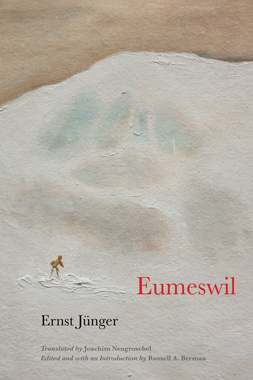 Eumeswil, ostensibly a post-apocalyptic science fiction novel, is effectively a comprehensive synthesis of Ernst Jünger’s mature thought, with a particular focus on new and achievable forms of individual freedom in a technologically monitored and managed postmodern world. Here Jünger first fully develops his figure of the anarch, the inwardly liberated and outwardly pragmatic individual, who lives peacefully in the heart of Leviathan and is yet able to preserve his individuality and freedom. Composed of a series of short passages and fragments, Eumeswil follows the reflections of Martin Venator, a historian living in a futuristic city-state ruled by a dictator known as the Condor. Through Venator, the prototypical anarch, Jünger offers a broad and uniquely insightful analysis of history from the post-historic perspective and, at the same time, presents a vision of future technological developments, including astonishingly prescient descriptions of today’s internet (the luminar), smartphone (the phonophore), and genetic engineering. At once a study of accommodation to tyranny and a libertarian vision of individual freedom, Eumeswil continues to speak to the contradictions and possibilities inherent in our twenty-first-century condition. Eumeswil, ostensibly a post-apocalyptic science fiction novel, is effectively a comprehensive synthesis of Ernst Jünger’s mature thought, with a particular focus on new and achievable forms of individual freedom in a technologically monitored and managed postmodern world. Here Jünger first fully develops his figure of the anarch, the inwardly liberated and outwardly pragmatic individual, who lives peacefully in the heart of Leviathan and is yet able to preserve his individuality and freedom. Composed of a series of short passages and fragments, Eumeswil follows the reflections of Martin Venator, a historian living in a futuristic city-state ruled by a dictator known as the Condor. Through Venator, the prototypical anarch, Jünger offers a broad and uniquely insightful analysis of history from the post-historic perspective and, at the same time, presents a vision of future technological developments, including astonishingly prescient descriptions of today’s internet (the luminar), smartphone (the phonophore), and genetic engineering. At once a study of accommodation to tyranny and a libertarian vision of individual freedom, Eumeswil continues to speak to the contradictions and possibilities inherent in our twenty-first-century condition.
Continue reading →
By Telos Press · Thursday, August 27, 2015 In a new interview with Karmel Melamed in the Jewish Journal, Matthias Küntzel discusses the history of antisemitism in Iran, a topic he explores in detail in his new book Germany and Iran: From the Aryan Axis to the Nuclear Threshold. Purchase your copy of the book in our online store.
Continue reading →
|
|