It seems that a young internet highflier who calls himself “the Argonaut,” whose idée fixe is the future of the European Union, has become the champion of a possible Federalist European Union and is bombarding the network with a number of miracles that, according to him, are being achieved in Brussels and Strasbourg. He claims that Europe’s political unification is fully realized, that the ECB has extended quantitative easing to all European banks, that the Greek problem, he happily announces, is solved thanks to a giant issue of fifty-year Greek government real estate bonds, which are sending the international financial market agog. The EU Commission, the Argonaut dreams, has decided to support the British suggestion that the EU MPs should work inside various 28 national parliaments, thus integrating the European institutions, and not in Strasbourg; he moreover says that the Frontex Immigrant Agency in Warsaw, duly instructed by Germany, has accepted enthusiastically to coordinate the Mediterranean immigrants distribution among the EU member states who heartedly agree. His most fantastic declaration is that five EU defense ministers of Germany, France, Italy, Spain, and Great Britain, based on articles 28, 42, and 43 of the Lisbon Treaty, have created the EEF, an European Expeditionary Force, which will be based in Sardinia and near Cracow. Special arrangements, he candidly assures the social network, have already been signed with NATO.
|
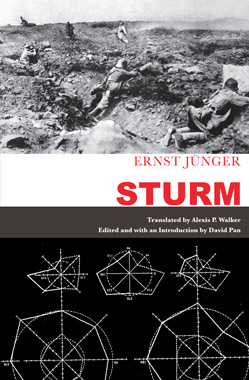
At the Great War Fiction blog, George Simmers reviews Ernst Jünger’s Sturm, now available from Telos Press. You can purchase your copy in our online store, and save 20% with the coupon code BOOKS20. “I believe we have committed heinous and horrific crimes. We were involved with espionage, treason, and disobedience. Our crimes are too grave, so much so that the Islamic Republic of Iran should mete out the severest and heaviest punishment upon us who are responsible for all these transgressions.” This quote is taken from the televised confession of Dr. Noureddin Kianouri in 1981. Kianouri was the General Secretary of the Toudeh party, Iran’s communist party, from 1979 to 1984. While he appeared ragged, fragile, devastated, and impatient, and could hardly compose complete sentences in Farsi, clearly due to tough and cruel torture, he was displayed on national television in order to tarnish his record and the image of the Toudeh party at large. The once prominent politician was shattered by this forced interview in which he, next to other leaders of Toudeh, was forced into reciting and restating whatever their interrogators and torturers put in front of them. Telos Press Publishing is pleased to announce that Ernst Jünger’s Sturm is now available for purchase. Order your copy today in our online store.
Translated by Alexis P. Walker Set in 1916 in the days before the Somme offensive, Ernst Jünger’s Sturm provides a vivid portrait of the front-line experiences of four German infantry officers and their company. A highly cultivated man and an acute observer of his era, the eponymous Lieutenant Sturm entertains his friends during lulls in the action with readings from his literary sketches. The text’s forays into philosophical and social commentary address many of the themes of Jünger’s early work, such as the nature of war, death, heroism, the phenomenon of Rausch, and mass society. Originally published in installments in the Hannoverscher Kurier in 1923, Sturm fell into obscurity until 1960, when it was re-discovered and subsequently re-published by Hans Peter des Coudres, a scholar of Jünger’s work. This translation—the first to be published in English—brings to the English-speaking world a work of literature of interest not only to students of Jünger’s work and of World War I, but to any reader in search of a powerful story of war and its effects on the lives of the men who endure it. Coming on October 1st from Telos Press Publishing: Ernst Jünger’s Sturm. Pre-order your copy today, and we will ship it as soon as it is available. Sturm
Translated by Alexis P. Walker Set in 1916 in the days before the Somme offensive, Ernst Jünger’s Sturm provides a vivid portrait of the front-line experiences of four German infantry officers and their company. A highly cultivated man and an acute observer of his era, the eponymous Lieutenant Sturm entertains his friends during lulls in the action with readings from his literary sketches. The text’s forays into philosophical and social commentary address many of the themes of Jünger’s early work, such as the nature of war, death, heroism, the phenomenon of Rausch, and mass society. Originally published in installments in the Hannoverscher Kurier in 1923, Sturm fell into obscurity until 1960, when it was re-discovered and subsequently re-published by Hans Peter des Coudres, a scholar of Jünger’s work. This translation—the first to be published in English—brings to the English-speaking world a work of literature of interest not only to students of Jünger’s work and of World War I, but to any reader in search of a powerful story of war and its effects on the lives of the men who endure it. “What appears to be a new Iran”: the ABC News host takes us inside Iran with these words, while the ABC News reporter in Iran is ready to match him with the following: “We needed a permit, but once we got it, the city opens up to all kinds of surprises.”[1] Meanwhile, the reporter spills the end of her report reassuring us that changes are on their way but not overnight, and a new Iran is embracing pop music, iPhones, Steven Jobs, and most importantly, nose jobs so that Iranians can look more Western. This overtly Orientalist narrative presents Iran as a new and young country, in contrast to an ancient, old, mystic, and mysterious Iran that has captured and mesmerized the Western unconscious for centuries. The reporter finishes her report by conditioning these changes on the nuclear deal that will facilitate all these sweeping shifts and alterations. Not everybody shares this Orientalist narrative, but the promising economic market in the near future of Iran is what focuses many analysts’ ample attention. Richard Javad Heidarian, a specialist in geopolitical and political affairs, unveils another aspect of this ubiquitous hope: “And similar to the case of China, an Iran–West rapprochement holds the promise of unlocking one of the world’s most promising markets, with broad implications for the global economy.” Regardless of all these cost-benefit driven analyses, the deal generated two opposing queues of political observations, rotating around a simple “yes” or” no” response to the deal. John Bell, the director of the Middle East program at the Toledo International Peace Centre in Madrid, provides us with a snapshot of all the debates over the deal: “The debate over the Iran nuclear agreement has been vibrant and will continue all the way up to the American Congressional vote. Progressives have lined up with the deal, as has most of the world. However, there are many voices in the U.S., Israel, and the region lined up against it.” |
   |
|||
|
Privacy Policy · Data Protection Copyright © 2026 Telos Press Publishing · All Rights Reserved |
||||