By Telos Press · Monday, April 27, 2026 CALL FOR PAPERS
War and Time: Russia’s Invasion of Ukraine and the Eclipse of Peace
Coedited by Michael Marder and Denys Sultanhaliiev
In what appears to be a peculiar paradox of our time, the Russo-Ukrainian war—initially a profound rupture in the European political imagination—has gradually receded into the background noise of global media circulation. Saturated coverage has not yielded conceptual clarity. On the contrary, despite the overwhelming volume of commentary, there remains a striking absence of sustained theoretical engagement with the war’s implications for political thought. Rather than catalyzing new frameworks, the conflict has too often been instrumentalized as confirmatory evidence for already established positions.
This special issue of Telos seeks to address this philosophical void.
Continue reading →
By David Pan · Monday, October 24, 2022 Volodymyr Zelensky has virtually single-handedly demonstrated the world-historical importance of sovereignty and its mechanisms. Before his courageous insistence on Ukrainian sovereignty, the world—including the United States, with its offer of a helicopter ride for Zelensky out of Kyiv—was already treating the Russian subjugation of Ukraine as a fait accompli and the continuation of business as usual. Russia was using in Ukraine the methods that it had already successfully practiced in Chechnya, Syria, and Belarus while the rest of the world stood by to allow such methods to become normalized. By taking his stand in Kyiv, Zelensky was declaring to the Ukrainian people and the rest of the world that Russia’s invasion was in fact not a normal action that had to be accepted. Suddenly, Russia’s years-long undermining of the idea of popular sovereignty in different parts of the world had been called out as a transgression, leading to global insights about recent history and our role in its development. The nations of Europe above all, but also the United States, have had to face the extent to which their energy policies were contributing to Russia’s reshaping of global norms. Zelensky has forced us to take a stand one way or the other in deciding the political shape of the world for the foreseeable future.
Continue reading →
By Gábor T. Rittersporn · Tuesday, March 8, 2022 I was completely wrong when I opined on February 9 that the Russians would not invade Ukraine. I mistakenly took them for more rational than they turned out to be. Mea maxima culpa. For the rest, I was not mistaken at all when I enumerated the reasons that militated against a martial adventure. The course the war took shows that the Russian leadership neglected them or, what is worse, does not read the Telos blog. Here are some obstacles to a successful operation I indicated and the consequences we can see today.
With the exception of the inhabitants of the separatist regions, no one greeted the Russians as liberators. The invaders crossed the border at provinces with a sizable Russian population, at regions where a significant proportion of people claim Russian as their mother tongue, no matter the ethnic group their ancestry happened to belong to. At the 2019 elections, all these regions voted overwhelmingly for current president Volodydmyr Zelensky, who is of Jewish origin, not necessarily an advantage in Eastern Europe. The comedian-turned-war-leader won more than 73 percent of the voices against his rival, billionaire and outgoing president Petro Poroshenko, who can boast Ukrainian forefathers. The Kremlin bosses apparently believed that only ethnic, religious, and linguistic affinities define political allegiances in Ukraine, or they simply did not take the trouble to have a look at the relevant statistics.
Continue reading →
By Gábor T. Rittersporn · Wednesday, February 9, 2022 The Western ballyhoo about the danger of Russian occupation of Ukraine is preposterous. We can sleep soundly, the Russians will not attack. They did not abandon their obsession with reconquering as much as they can of the defunct Soviet empire. But they cannot expect any gain from an adventure in Ukraine.
It is not simple to overrun a country nearly as large as France with a population of more than 40 million people. Granted, the invaders can mobilize pretty girls in national costumes who would greet them with flowers and (according to East Slavic tradition) with bread and salt. In the worst of cases, they can import the girls from Russia. They can also find collaborators but hardly enough to run the administration and the economy. Especially, they cannot find collaborators among leading politicians whose reputation and popularity would secure broad support. Also, they can do nothing to placate citizens through raising poor living standards, finishing with omnipresent corruption, and proving that they offer a brighter future than the establishment they would defeat.
Continue reading →
By Fabrice Balanche · Wednesday, December 8, 2021 Fabrice Balanche is a geographer at the University of Lyon who focuses on the Middle East. This interview appeared in Le Figaro on August 19, 2021, and is translated with permission by Russell A. Berman, whose comments are here.
Q: What are the geographic specificities of Afghanistan?
Fabrice Balanche: Afghanistan is a country of mountains and deep valleys, with passes connecting one region to another. It is a compartmentalized country. This obviously poses problems to all powers that want to penetrate it. It is a territory very difficult to control.
This physical fragmentation has human and social corollaries. The country includes different ethnicities living in the valleys: Pashtoons, Uzbeks, Tajiks. These ethnicities are further divided into clans and tribes that compete with each other. Even the central authority in Kabul, during the time of the monarchy, never succeeded in achieving direct control of the population.
This physical reality and the ethnic diversity are essential elements for any understanding of the country. They are furthermore linked to each other: the tribes maintain their specific identities thanks to the physical geography of the territory. One can be the master of one’s valley. Let us be precise that the field of geography has two topics: the physical question and the human and cultural specificity of a country. Western leaders did not want to see or understand these points, and this is what has led to the fiasco.
Continue reading →
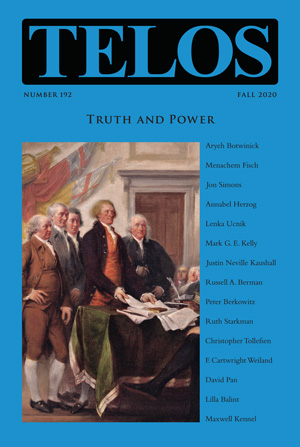
By Aryeh Botwinick · Friday, November 13, 2020 Aryeh Botwinick’s “Negative Theology, Power, and the Israeli–Palestinian Conflict” appears in Telos 192 (Fall 2020): Truth and Power. Read the full article at the Telos Online website, or purchase a print copy of the issue in our online store. Individual subscriptions to Telos are available in both print and online formats.
 From a Machiavellian perspective, peace is war by other means. You can have a much greater watchful vigilance of your former (or future) opponent in times of peace than in a time of war. Israel as a sponsor (or co-sponsor) of a kind of Middle East Marshall Plan: Rebuilding your enemy so that he becomes your ally and friend. Enemies must learn to use each other’s weapons. The weakness of the Palestinians has to be matched by the deliberate, self-consciously generated weakness of the Israelis in the form of benevolence and generosity in order for both sides to emerge as triumphant. If this approach is pursued, the Israeli–Palestinian conflict harbors the prospect of turning into a sum-sum conflict, where both sides stand equally to gain by pursuing peace. From a Machiavellian perspective, peace is war by other means. You can have a much greater watchful vigilance of your former (or future) opponent in times of peace than in a time of war. Israel as a sponsor (or co-sponsor) of a kind of Middle East Marshall Plan: Rebuilding your enemy so that he becomes your ally and friend. Enemies must learn to use each other’s weapons. The weakness of the Palestinians has to be matched by the deliberate, self-consciously generated weakness of the Israelis in the form of benevolence and generosity in order for both sides to emerge as triumphant. If this approach is pursued, the Israeli–Palestinian conflict harbors the prospect of turning into a sum-sum conflict, where both sides stand equally to gain by pursuing peace.
Continue reading →
|
|