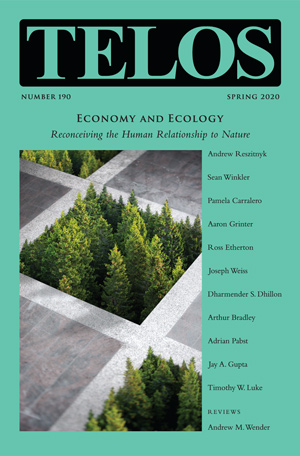
By Ross Etherton · Wednesday, April 29, 2020 Ross Etherton’s “Reading against the Gun: The Machine Gun and Sturm” appears in Telos 190 (Spring 2020): Economy and Ecology: Reconceiving the Human Relationship to Nature. Read the full article at the Telos Online website, or purchase a print copy of the issue in our online store. Individual subscriptions to Telos are available in both print and online formats. Ernst Jünger’s Sturm, published in English translation by Telos Press, is also available in our store.
 This essay examines the role of the machine gun in Ernst Jünger’s 1923 serially published novella Sturm, arguing that an examination of the novella’s key technological actant is at least as beneficial as an examination of the text’s human protagonists. It posits that reading Sturm in light of the machine gun and in the context of the material and cultural conditions of its original serial publication allows for a different understanding of the novella’s treatment of reading and writing under the conditions of modern mechanized warfare. The essay not only links the technical process at the heart of the gun (continuity derived from explosive interruption) to the explosive interruptions within the novella; it also links this interruptive continuity to the arbitrary, irregular breaks in its original serial publication. This technical-literary approach connects the literary scholarship on Sturm (primarily by Peter Uwe Hohendahl and David Pan) with one indebted to philosopher Gilbert Simondon, who sought to redress humanity’s profound alienation from technology and technical objects. The essay first outlines its approach to Sturm, and then provides readers with an overview of Sturm‘s publication history, contextualizing it within Jünger’s early works. It then examines the explosively interruptive moments of the novella, tying them to the machine gun and to nineteenth- and early twentieth-century scientific, philosophical, and poetological discourses. It closes by gesturing toward the importance that the gun and the concepts embedded in it would have for Jünger in the decade following Sturm. This essay examines the role of the machine gun in Ernst Jünger’s 1923 serially published novella Sturm, arguing that an examination of the novella’s key technological actant is at least as beneficial as an examination of the text’s human protagonists. It posits that reading Sturm in light of the machine gun and in the context of the material and cultural conditions of its original serial publication allows for a different understanding of the novella’s treatment of reading and writing under the conditions of modern mechanized warfare. The essay not only links the technical process at the heart of the gun (continuity derived from explosive interruption) to the explosive interruptions within the novella; it also links this interruptive continuity to the arbitrary, irregular breaks in its original serial publication. This technical-literary approach connects the literary scholarship on Sturm (primarily by Peter Uwe Hohendahl and David Pan) with one indebted to philosopher Gilbert Simondon, who sought to redress humanity’s profound alienation from technology and technical objects. The essay first outlines its approach to Sturm, and then provides readers with an overview of Sturm‘s publication history, contextualizing it within Jünger’s early works. It then examines the explosively interruptive moments of the novella, tying them to the machine gun and to nineteenth- and early twentieth-century scientific, philosophical, and poetological discourses. It closes by gesturing toward the importance that the gun and the concepts embedded in it would have for Jünger in the decade following Sturm.
Continue reading →
By Timothy W. Luke · Thursday, May 11, 2017 Assessing asymmetric wars in the abstract is a problematic task, even though most are “small wars” fought by “big nations.” Armed conflicts with these characteristics brim with persistent, undeclared, and low-intensity violence. It rarely is extinguished, and the lingering injuries sustain even more violence on the same scale. Many of these small wars began in Asia, Africa, Latin America, or the Middle East during, or not long after, World War II. Armed resistance there never completely ended; instead it intensified with decolonization and/or postcolonial state failure. Now virtually institutionalized in many violent wild zones around the world, low-intensity wars also flare up as asymmetric conflicts between rich countries and poor peoples, Westernized nations and anti-Western movements, liberal democratic states and illiberal theocratic insurgents after 1989.
Continue reading →
By Marcia Pally · Thursday, April 27, 2017 The thoughts below were first presented at the 2017 Telos Paul Piccone Institute conference, “Asymmetrical Warfare: The Centrality of the Political to the Strategic.” On the perhaps naïve presumption that politics are grounded in ideals, norms, and values that guide (if not govern) societal conduct, I have extended the title to “Asymmetrical Warfare: The Centrality of the Ethical to Politics and the Strategic.” Since the writing of these remarks, Donald Trump has taken the office of president, promised a vast build-up of the U.S. military, and proposed large increases in the military budget alongside substantial decreases in humanitarian aid programs. He has detonated in Afghanistan the largest non-nuclear bomb in U.S. military history, he is saber-rattling with North Korea, and he has bombed Syria—all in his first 100 days, indicating a certain unconsidered readiness to use military force.
Continue reading →
By Andrew M. Wender · Wednesday, March 8, 2017 If the phrase “asymmetrical warfare” is taken to connote scenarios where “one side is possessed of overwhelming power with respect to its adversary,” together with manifold embodiments “of asymmetry in media representations, ideology, religion, sub- and supra-national actors, the environment and even psychology,” then there would appear little doubt that today’s world is pervaded by such conflict. Necessarily, the unique historical conditions of the present, globalizing era—with its fragmenting as well as revanchist states, and its dizzying technological accelerations—are evoked by “new wars” that embroil a proliferation of non-state actors, along with states who believe that they should rightly monopolize (or be immune from, as the case may be) such asymmetrical modalities as nuclear arsenals, mercenary forces, drones, cyberattacks, and propaganda innovations.
Continue reading →
By Martin Bolle · Tuesday, February 28, 2017 The definition of asymmetry in asymmetrical warfare could, it seems, contribute to illuminating the link between war and politics, or war and peace. For Clausewitz, “War is a simple continuation of politics by other means.” Now, we could ask: what is the politics of asymmetrical warfare? Still following Clausewitz, war is “a wide-scale duel” and, as a duel or fight, war “takes two distinct forms: attack and defense.” Additionally, for Clausewitz, politics would be a form of “wide-scale commerce” between states. In his book Drone Theory, the French philosopher Grégoire Chamayou defines asymmetrical warfare as cynegetic (in other words, a form of hunt). He uses as an illustration the name of a recent model of unmanned vehicle: “the Predator,” le prédateur. But how can asymmetrical warfare be considered as war if the fight dynamic is absent? And if asymmetrical warfare is a manhunt, how could politics as commerce be possible?
Continue reading →
By Beau Mullen · Friday, February 24, 2017
This paper focuses on the modern practice of using law, both national and international, to achieve policy goals and political ends that usually are the result of tactical military action. Lawfare, as this practice is referred to, is now a crucial tactic in the modern era of international relations, where war is largely carried out in a far from traditional manner. Lawfare, then, is a unique form of irregular warfare that can be employed by nations against one another and against insurgents in asymmetrical conflicts at home and abroad. This new reliance on irregular and asymmetrical warfare generally and lawfare specifically is reflective of Hegel’s view of the end of history, particularly as articulated by Alexandre Kojève. Basically, that as individuals gain equal recognition, the mode of satisfying desire will necessarily take the form of law and bureaucracy.
Continue reading →
|
|