By Telos Press · Monday, April 27, 2026 CALL FOR PAPERS
War and Time: Russia’s Invasion of Ukraine and the Eclipse of Peace
Coedited by Michael Marder and Denys Sultanhaliiev
In what appears to be a peculiar paradox of our time, the Russo-Ukrainian war—initially a profound rupture in the European political imagination—has gradually receded into the background noise of global media circulation. Saturated coverage has not yielded conceptual clarity. On the contrary, despite the overwhelming volume of commentary, there remains a striking absence of sustained theoretical engagement with the war’s implications for political thought. Rather than catalyzing new frameworks, the conflict has too often been instrumentalized as confirmatory evidence for already established positions.
This special issue of Telos seeks to address this philosophical void.
Continue reading →
By David Pan · Monday, February 12, 2024 
As much as war has become automated and mechanized, the subjective experience of the horror of war remains central to its meaning today. Russia, through its intentional bombing of civilians, and Hamas, with its massacres, have both sought to manipulate personal experience by terrorizing their enemies to achieve their war aims. Such tactics have also become the basis of their rule, in which they use fear to intimidate domestic political opponents to maintain their power. While they seek to create fear, the response of Ukrainians and Israelis alike has been to respond to subjective horror with the courage to maintain resistance while also affirming their values. War continues to be grounded in the way in which the participants’ most personal experiences can create a unified political will.
Continue reading →
By David Pan · Friday, January 12, 2024 Telos 205 (Winter 2023): Forms of War is now available for purchase in our store. Individual subscriptions to Telos are also available in both print and online formats.
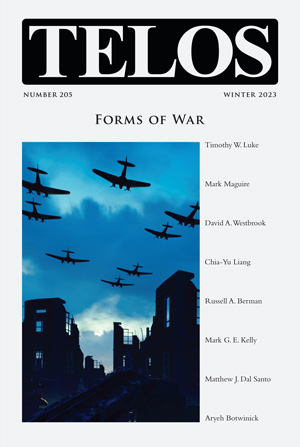 One of the most challenging aspects of the wars in Ukraine and Israel is the way in which the conflicts have been constantly shifting in form. In the first place, there is a conventional ground war between Russia and Ukraine, in which the identity and will of the two peoples are at stake. Yet Russia has used weapons supplied by Iran and North Korea, and Ukraine relies on NATO for its own supplies, indicating that this war depends on the maintenance and expansion of alliances. The stability of these alliances in turn depends on a combination of Realpolitik and shared values as the glue that holds them together. This logic of alliances motivates the energy war that Russia is waging with Europe, revealing that, unbeknownst to Europe, Russian energy policy over the last decade was an early form of the war. Similarly, the threat of nuclear war also tests the resolve of NATO, forcing it to consider the values at stake in the conflict. Is the war about Ukraine’s sovereignty or the principle of nation-state sovereignty itself? Is it about human rights for Ukrainians or the entire human rights project? For Russia, is it about self-defense or a pan-Slavic identity? Is it about the protection of Russian minorities in Ukraine or the threat of Western secularization? The answers to these questions will determine the will to fight on each side and thus the length and ferocity of the war. One of the most challenging aspects of the wars in Ukraine and Israel is the way in which the conflicts have been constantly shifting in form. In the first place, there is a conventional ground war between Russia and Ukraine, in which the identity and will of the two peoples are at stake. Yet Russia has used weapons supplied by Iran and North Korea, and Ukraine relies on NATO for its own supplies, indicating that this war depends on the maintenance and expansion of alliances. The stability of these alliances in turn depends on a combination of Realpolitik and shared values as the glue that holds them together. This logic of alliances motivates the energy war that Russia is waging with Europe, revealing that, unbeknownst to Europe, Russian energy policy over the last decade was an early form of the war. Similarly, the threat of nuclear war also tests the resolve of NATO, forcing it to consider the values at stake in the conflict. Is the war about Ukraine’s sovereignty or the principle of nation-state sovereignty itself? Is it about human rights for Ukrainians or the entire human rights project? For Russia, is it about self-defense or a pan-Slavic identity? Is it about the protection of Russian minorities in Ukraine or the threat of Western secularization? The answers to these questions will determine the will to fight on each side and thus the length and ferocity of the war.
Similarly, the war between Israel and Hamas began with Hamas’s use of terror and rape as instruments of war. The idea was to provoke Israel into attacking Hamas and causing civilian casualties. Because the terrain of war extends to public opinion in the West, Hamas’s use of Israeli hostages and Palestinian human shields becomes part of its strategy of increasing civilian casualties in the war. Even though Hamas is the ultimate cause of such casualties, Hamas is able to pressure Israel by placing civilians in the path of Israel’s war effort. The conflict on the ground in Gaza is thus overshadowed by the struggle for hearts and minds across the globe.
Continue reading →
By Telos Press · Friday, December 22, 2023 Now available: Shards and Specters of the New World Order, by Timothy W. Luke. Order the paperback edition today in our online store and save 20% by using the coupon code BOOKS20. Also available in Kindle ebook format at Amazon.com.
Shards and Specters of the New World Order: Casting Soviet and Post-Soviet Studies as Critique
by Timothy W. Luke
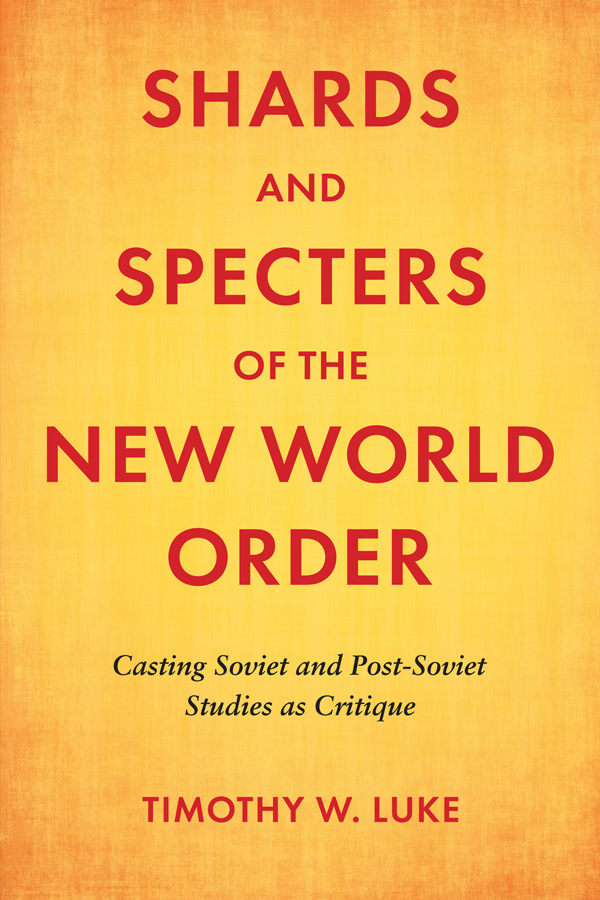 From ideological dynamics in revolutionary Russia, cultural stagnation in the USSR, and ineffective Soviet governance in the 1980s to the USSR’s institutional collapse in 1991, the emergence of the Russian Federation under Boris Yeltsin, and Vladimir Putin’s wars in Ukraine since 2014, Timothy W. Luke’s Shards and Specters of the New World Order investigates how the geopolitical clout of the United States has worked to contain, but at other times sustain, the Soviet Union and later the Russian Federation. Luke’s critical studies also examine how Moscow’s strategies provoked radical Islamic resistance movements in Afghanistan and aided anti-Western client states, like Iraq and Syria, that threatened the New World Order envisioned in Washington after 1991. From ideological dynamics in revolutionary Russia, cultural stagnation in the USSR, and ineffective Soviet governance in the 1980s to the USSR’s institutional collapse in 1991, the emergence of the Russian Federation under Boris Yeltsin, and Vladimir Putin’s wars in Ukraine since 2014, Timothy W. Luke’s Shards and Specters of the New World Order investigates how the geopolitical clout of the United States has worked to contain, but at other times sustain, the Soviet Union and later the Russian Federation. Luke’s critical studies also examine how Moscow’s strategies provoked radical Islamic resistance movements in Afghanistan and aided anti-Western client states, like Iraq and Syria, that threatened the New World Order envisioned in Washington after 1991.
Continue reading →
By Telos Press · Wednesday, May 3, 2023 In today’s episode of the Telos Press Podcast, David Pan talks with Matthew Dal Santo about his article “Russia, the Ukraine War, and the West’s Empire of Secularization,” from Telos 201 (Winter 2022). An excerpt of the article appears here. In their conversation they discuss Augusto Del Noce’s view of twentieth-century secularization as the unfolding of the philosophy of atheism; how Del Noce understood secularization; why, if Marxism is atheistic, Del Noce sees the West as more atheistic than the Soviet Union; why the alliance between the United States and Ukraine is a secularist one; why it is necessary to link religion and politics to avoid secularization; how the idea of the Holy Rus’ presents a politics that realizes a religious project rather than one that replaces a religious project with a nationalist political one, and how we might differentiate between the two possibilities; the distinction between the causality of (or immediate reasons for) the war in Ukraine and its meaning (or higher causality); and how to make sense of a contradiction between the two in the case of the Russian invasion of Ukraine. If your university has an online subscription to Telos, you can read the full article at the Telos Online website. For non-subscribers, learn how your university can begin a subscription to Telos at our library recommendation page. Print copies of Telos 201 are available for purchase in our online store.
Continue reading →
By David Pan · Friday, February 24, 2023 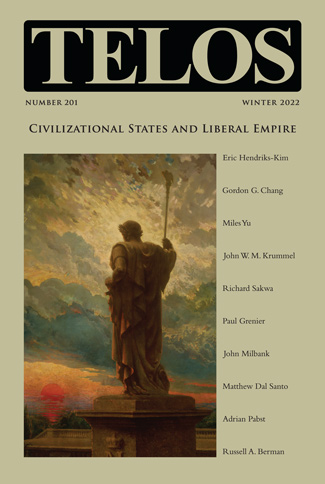 On the anniversary of the Russian invasion of Ukraine, the continuing war indicates that the foundations of a rules-based global order are not just the rules themselves but also the structure of sovereignty that supports those rules. Sovereignty includes both the use of power and the establishment of a legitimating vision of order. The challenges to the Westphalian system of global order consequently come not just from the Russian invasion but also from the Russian idea of its civilizational mission against Western secularism as well as China’s idea of a “shared humanity for mankind.” Telos 201 provides analyses of both of these alternative visions for global order. Matthew Dal Santo, for example, describes Russia’s stance as a defense of a spiritual rather than a secular conception of the basis of order. Gordon Chang analyzes the way in which China has been promoting its tianxia model of unified global governance against the chaos and conflict of separate sovereign nation-states. The frame within which to view these alternative visions is not the struggle between spirituality and secularism or between China and the West, but the global development of nationalism. On the anniversary of the Russian invasion of Ukraine, the continuing war indicates that the foundations of a rules-based global order are not just the rules themselves but also the structure of sovereignty that supports those rules. Sovereignty includes both the use of power and the establishment of a legitimating vision of order. The challenges to the Westphalian system of global order consequently come not just from the Russian invasion but also from the Russian idea of its civilizational mission against Western secularism as well as China’s idea of a “shared humanity for mankind.” Telos 201 provides analyses of both of these alternative visions for global order. Matthew Dal Santo, for example, describes Russia’s stance as a defense of a spiritual rather than a secular conception of the basis of order. Gordon Chang analyzes the way in which China has been promoting its tianxia model of unified global governance against the chaos and conflict of separate sovereign nation-states. The frame within which to view these alternative visions is not the struggle between spirituality and secularism or between China and the West, but the global development of nationalism.
Continue reading →
|
|