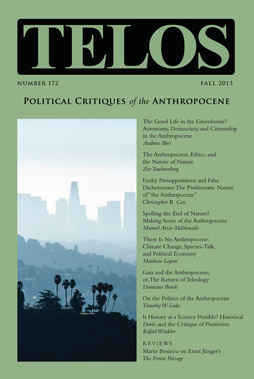
 Critiques of the Anthropocene abound, but few adequately challenge the argument’s historical weaknesses. This essay is meant to engage them. The Anthropocene argument relies deeply upon the false dichotomy that human reality is not geological reality; that individual and collective human behaviors are of more importance than the systems in which those behaviors are manifested. The violent ontological notion that humans are extra-natural and nature is extra-human, the human/nature divide, set the stage long ago for the systemic exploitation and appropriation of nature. Unlimited accumulation of capital is a holographic-like reality, only plausible if humans are seen as the beneficiaries of nature’s “bounty,” and extra-human nature as the beneficiary of humanity’s waste. My argument unfolds in three pieces: First, these problematic ontologies are laid out and retreated with historical relationality. Second, I utilize some key theses from the work of Jason W. Moore to take seriously the notion that “nature” is not in fact ontologically divided from the human, but is always already co-constitutive of both the human and the extra-human. This framing allows us to see that carbon intensive social engines are only possible under specific organizational regimes of power. Capital, not the Anthropos, is at the heart of what the Anthropocene is most concerned about, carbon, and therefore the Anthropocene is a misnomer. It is in this sense that I argue, in solidarity with Moore and others, that this new epoch we have entered is more aptly called the Capitalocene.
|
“I believe we have committed heinous and horrific crimes. We were involved with espionage, treason, and disobedience. Our crimes are too grave, so much so that the Islamic Republic of Iran should mete out the severest and heaviest punishment upon us who are responsible for all these transgressions.” This quote is taken from the televised confession of Dr. Noureddin Kianouri in 1981. Kianouri was the General Secretary of the Toudeh party, Iran’s communist party, from 1979 to 1984. While he appeared ragged, fragile, devastated, and impatient, and could hardly compose complete sentences in Farsi, clearly due to tough and cruel torture, he was displayed on national television in order to tarnish his record and the image of the Toudeh party at large. The once prominent politician was shattered by this forced interview in which he, next to other leaders of Toudeh, was forced into reciting and restating whatever their interrogators and torturers put in front of them. Writing in the Washington Post, George Will discusses Joel Kotkin’s The New Class Conflict (recently published by Telos Press) and the reasons why today’s government serves the wealthy and powerful. At the 2014 Telos in Europe Conference in L’Aquila, Italy, sociologist Dan Krier talked about his experiences at the conference as well as what distinguished the Telos conference from more discipline-specific academic gatherings. For anyone interested in participating in the upcoming 2015 Telos Conference in New York, abstracts will be accepted through October 20. For complete details and the full call for papers, please visit the Telos-Paul Piccone Institute website. We hope to see you there! |
   |
|||
|
Privacy Policy · Data Protection Copyright © 2026 Telos Press Publishing · All Rights Reserved |
||||
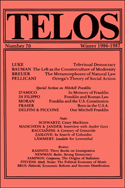 Premised on the Left’s fundamental inability to dissociate itself from the ideals of the bourgeois revolution, Zygmunt Bauman’s “The Left as the Counter-Culture of Modernity” introduces the notion of reconstituting “the Left as the counter-culture of modernism,” rather than as the “counter-culture of capitalism.” Bauman makes the case for this repositioning because, in his view, there is no historical agent to carry out an anti-capitalist program. However, by continuing to defend and maintain the Left’s core values of individual autonomy and political democracy, Bauman believes that the Left can identify the barriers preventing their realization in the present neoliberal paradigm. Bauman recounts the Left’s courtship with various strategies, namely, the heterodox critique of capitalist practice and professed affinity with the industrial working class, and the recent flirtation with postmodern theory. By examining each as it addresses the present historical paradigm, he emphasizes the need to rehabilitate the values of the Leftist program and search for alternative strategies to realize them.
 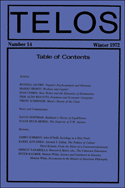 Mario Tronti’s postscript to the second edition of his publication Operai e Capitale, published in Telos in 1972 as “Workers and Capital,” provides the reader with a summation of his thought on the development of the “mass worker,” presented through an analysis of notable labor struggles across the Western world. Tronti’s methodology, which he briefly explicates at the beginning of the piece, delineates certain historical workers’ struggles in order to examine “macroscopic groups of facts yet untouched by the critical consciousness of labor thought” (25). His purpose is to yield “an historical model, a privileged period of research” (25) so as to better analyze the emergence of the autonomy of the working class engaged in a dialectical struggle with capital.