By Telos Press · Monday, December 1, 2025 Now available: Knowledge, What Is It Good For? Italian/American Leadership in the Twenty-First Century, by Anthony Julian Tamburri. Order the paperback edition today in our online store and save 20% by using the coupon code BOOKS20.
Knowledge, What Is It Good For? Italian/American Leadership in the Twenty-First Century
by Anthony Julian Tamburri
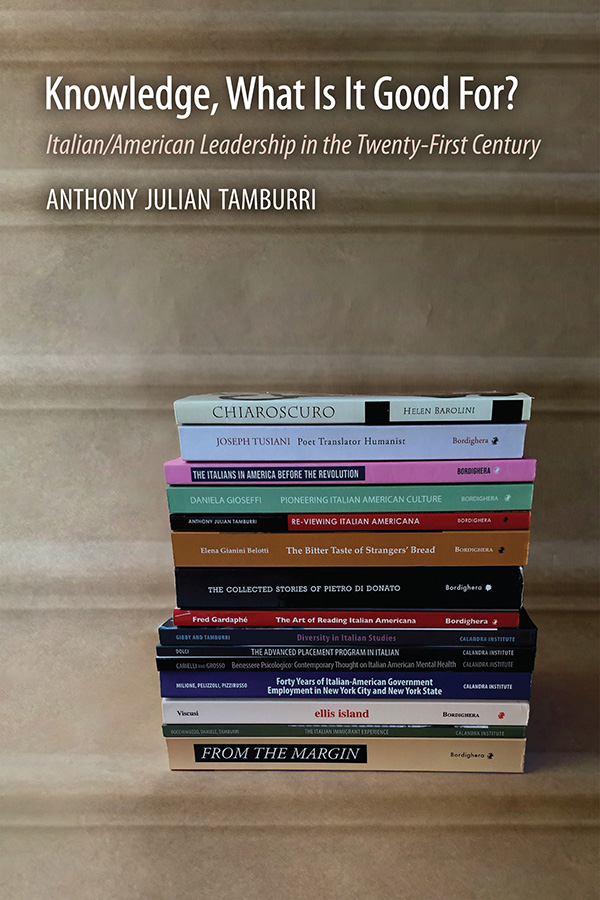 Anthony Julian Tamburri’s Knowledge, What Is It Good For? provides a detailed and systematic examination of Italian/American leadership today, whether that leadership arose through consensus or self-appointment. The various chapters describe the key issues at hand, which overall reflect a lack of knowledge about the history of Italians and their descendants in the United States. Through the critique of these issues, Tamburri emphasizes the need for solutions to remedy these gaps. This book is a follow-up to Tamburri’s A Politics of [Self‑]Omission: The Italian/American Challenge in a Post-George Floyd Age (2022), which offered a first look at influential individuals and leaders of non-scholarly Italian/American organizations. Anthony Julian Tamburri’s Knowledge, What Is It Good For? provides a detailed and systematic examination of Italian/American leadership today, whether that leadership arose through consensus or self-appointment. The various chapters describe the key issues at hand, which overall reflect a lack of knowledge about the history of Italians and their descendants in the United States. Through the critique of these issues, Tamburri emphasizes the need for solutions to remedy these gaps. This book is a follow-up to Tamburri’s A Politics of [Self‑]Omission: The Italian/American Challenge in a Post-George Floyd Age (2022), which offered a first look at influential individuals and leaders of non-scholarly Italian/American organizations.
Continue reading →
By Arno Tausch · Tuesday, April 14, 2020 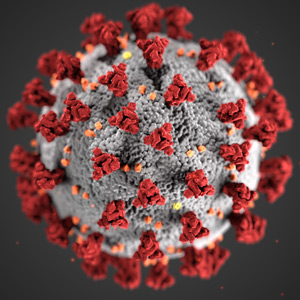 The global fallout from the miserable phytosanitary conditions at the Huanan Market in Wuhan, China, will change the fortunes of the twenty-first century. The countries at the center of the global economy, especially the eurozone, are now heading not only toward being at the receiving end of the worst pandemic since the Spanish flu of 1918–20, but also toward the abyss of an unprecedented economic recession. Amidst all this, in March 2020, the core of the European Union’s neoliberal fiscal policy framework, the Maastricht criteria, were put out of action. But what will follow next? The global fallout from the miserable phytosanitary conditions at the Huanan Market in Wuhan, China, will change the fortunes of the twenty-first century. The countries at the center of the global economy, especially the eurozone, are now heading not only toward being at the receiving end of the worst pandemic since the Spanish flu of 1918–20, but also toward the abyss of an unprecedented economic recession. Amidst all this, in March 2020, the core of the European Union’s neoliberal fiscal policy framework, the Maastricht criteria, were put out of action. But what will follow next?
Italian Prime Minister Giuseppe Conte has already called, with good reason, for special “corona bonds” to help EU states finance desperately needed health spending and economic rescue programs. With 20,465 coronavirus deaths as of April 14, 2020, Italy has ample reason to call for such “corona bonds.” The same applies to the other most seriously affected EU countries, Spain (18,056 deaths) and France (14,967 deaths). The idea is also welcomed by a growing number of leading global economists—but not by Austrian Federal Chancellor Sebastian Kurz, one of the European leaders whose country and whose banks, like those of Germany and the Netherlands, were among the absolute winners in the eurozone redistribution of wealth since the 2008 crisis, to the detriment of the European South. Kurz, in many ways now the absolute trendsetter of center-right politics in Europe (at the pace that Germany’s Angela Merkel, by her perennial indecisiveness, leaves an ever bigger vacuum), was very quick to refer the suffering in Italy back to the same old European Stability Mechanism (ESM) that already caused so much stagnation in the European South since 2008.
Continue reading →
By Flaminia Incecchi · Thursday, January 11, 2018 As an occasional feature on TELOSscope, we highlight a past Telos article whose critical insights continue to illuminate our thinking and challenge our assumptions. Today, Flaminia Incecchi looks at Giuseppe Parlato’s “Giovanni Gentile: From the Risorgimento to Fascism” from Telos 133 (Winter 2005).
Giovanni Gentile is one of many important philosophers that have been eclipsed by shifting fashions in modern academia. In becoming overshadowed, he now often is forgotten and to some extent shunned. After all, most philosophy departments have become increasingly polarized as their orthodoxies crystallize in the analytic or the continental camp, leaving them, in most cases, without much hope for dialogue. It seems useful to ask: Who should look at Gentile? Which philosophy department should engage with his thought? On paper, it seems that Gentile does not have much to offer to one sect or the other. This misfit quality is worsened and to some degree excused by the various ideological shadows that precede Gentile. At that point, Gentile’s ideological predispositions provide an indisputable alibi for the silence surrounding his thought. Most of his works have not been translated from the Italian, which limits his prospective audiences significantly. Of course, Gentile also is not at the center of academic disputes today in Italy.
Continue reading →
By Telos Press · Monday, March 7, 2016 A panel on Renzo De Felice’s The Jews in Fascist Italy: An Historical Appraisal was held at the Calandra Institute on January 28, 2016. The panel included Frank Adler, Telos Editorial Associate and editor of Telos 164 (Fall 2013): Italian Jews and Fascism. Copies of Telos 164 can be purchased in our online store. Panelists explored the genesis of De Felice’s book and its place in contemporary historiography. Commissioned by the Union of the Italian Jewish Communities and published in 1961, it was the first study of the anti-Jewish persecution in Italy to reach a general audience. It was also a young historian’s first book on the Fascist era. This glance into a chapter of national history, that Italy had been quick to bury, set De Felice on a path to become one of the leading and most controversial scholars of Fascism. How was his attempt to capture an unsettling past received at the time of the book’s publication? What place does this book have in the current scholarship when many of its conclusions have been overturned after five decades of research on Italian state-sponsored anti-Semitism? And to which degree have the studies of Fascism and of the persecution of the Jews shed light on one another?
Continue reading →
By Telos Press · Tuesday, January 26, 2016 Telos readers in the New York City area may be interested in an upcoming event at the John D. Calandra Italian American Institute:
On the occasion of the paperback reprint of Renzo De Felice’s The Jews in Fascist Italy, this panel will explore the genesis of the book and its place in contemporary historiography.
Commissioned by the Union of the Italian Jewish Communities and published in 1961, it was the first study of the anti-Jewish persecution in Italy to reach a general audience. It was also a young historian’s first book on the Fascist era. This glance into a chapter of national history, that Italy had been quick to bury, set De Felice on a path to become one of the leading and most controversial scholars of Fascism.
Continue reading →
By Telos Press · Thursday, October 9, 2014 Whether you attended or not, you’ll want to see this wonderful collection of photos from the recent Telos in Europe Conference, held in L’Aquila, Italy, in early September. Below is a sample, but you can view the full set over at our Facebook page. And just a reminder, there’s still time to submit your abstract for the upcoming 2015 Telos Conference in New York. For complete details, visit the Telos-Paul Piccone Institute website.
Continue reading →
|
|