By Telos Press · Monday, December 1, 2025 Now available: Knowledge, What Is It Good For? Italian/American Leadership in the Twenty-First Century, by Anthony Julian Tamburri. Order the paperback edition today in our online store and save 20% by using the coupon code BOOKS20.
Knowledge, What Is It Good For? Italian/American Leadership in the Twenty-First Century
by Anthony Julian Tamburri
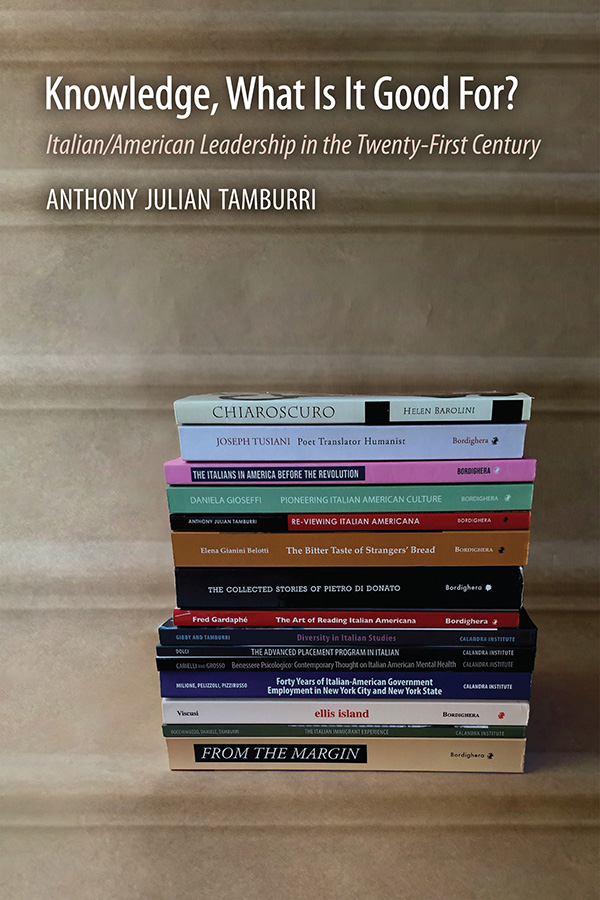 Anthony Julian Tamburri’s Knowledge, What Is It Good For? provides a detailed and systematic examination of Italian/American leadership today, whether that leadership arose through consensus or self-appointment. The various chapters describe the key issues at hand, which overall reflect a lack of knowledge about the history of Italians and their descendants in the United States. Through the critique of these issues, Tamburri emphasizes the need for solutions to remedy these gaps. This book is a follow-up to Tamburri’s A Politics of [Self‑]Omission: The Italian/American Challenge in a Post-George Floyd Age (2022), which offered a first look at influential individuals and leaders of non-scholarly Italian/American organizations. Anthony Julian Tamburri’s Knowledge, What Is It Good For? provides a detailed and systematic examination of Italian/American leadership today, whether that leadership arose through consensus or self-appointment. The various chapters describe the key issues at hand, which overall reflect a lack of knowledge about the history of Italians and their descendants in the United States. Through the critique of these issues, Tamburri emphasizes the need for solutions to remedy these gaps. This book is a follow-up to Tamburri’s A Politics of [Self‑]Omission: The Italian/American Challenge in a Post-George Floyd Age (2022), which offered a first look at influential individuals and leaders of non-scholarly Italian/American organizations.
Continue reading →
By Rufus Burrow, Jr. · Monday, April 23, 2018 Rufus Burrow, Jr.’s “Martin Luther King, Jr., and Ethical Leadership” appears in Telos 182 (Spring 2018), a special issue commemorating the life and thought of Martin Luther King, Jr. Read the full article at the Telos Online website, or purchase a print copy of the issue in our online store. Individual subscriptions to Telos are now available in both print and online formats.
James MacGregor Burns, a pioneer in leadership theory, was certain that many people lack clarity about the meaning and place of leadership. “The confusion,” he said, “will continue as long as we fail to distinguish leadership from brute power, leadership from propaganda, leadership from manipulation, leadership from pandering, leadership from coercion.” What we have seen during and after the 2016 presidential election cycle in the United States is evidence of this ambiguity and confusion. In addition, political operatives and other presumed leaders fail to exhibit integrity, character, civility, courage, and a sense of obligation to the highest and best values. Instead, what we see persistently, particularly in the Donald J. Trump presidency, are efforts to cater to the worst in citizens, especially uneducated, unemployed, and underemployed white working-class people. For a long time I have wondered whether a study of Martin Luther King, Jr., (1929–1968) might reveal important lessons about the nature and meaning of leadership, leadership that reasonable people eagerly follow. This essay seeks to clarify how King understood leadership.
Continue reading →
By Philip Roscoe · Monday, July 18, 2016 Sacrifice, or at least the discourse of sacrifice, is a recognizable aspect of popular management discourse and management scholarship of the “post-bureaucratic” variety, especially popular in America from the 1980s to the 2000s. The absence of bureaucratic structures of command necessitates other forms of authority, and notions of sacrifice form part of the symbolic armory of the post-bureaucratic chief executive—though, of course, post-bureaucracy is itself a symbolic myth more than a practical solution. In this talk I will set out some aspects and suggest, playfully, that there are crypto-theologies at work in management discourse and scholarship; I will finish by connecting these to the sacrifice and excess inherent in neoliberal forms of organization.
Continue reading →
|
|