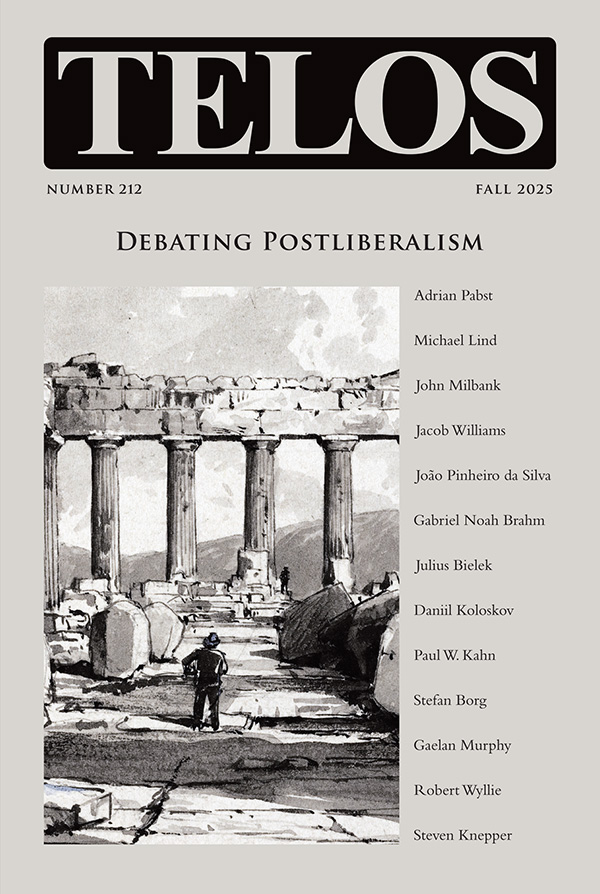
 In today’s episode of the Telos Press Podcast, Adrian Pabst talks with Michael Lind and John Milbank about postliberalism, the topic of the current issue of Telos, “Debating Postliberalism.” Adrian Pabst’s “The New Era: What Comes After the Self-Erosion of Liberalism,” Michael Lind’s “After Liberalism,” and John Milbank’s “The Politics of Virtue” all appear in the issue. We have made the articles by Pabst and Lind available as open access publications, and they can be read for free at our website. To purchase a copy of the issue or to subscribe to Telos, visit our online store.
|
Telos 212 (Fall 2025): Debating Postliberalism is now available for purchase in our store. Individual subscriptions to Telos are also available in both print and online formats.
Some political and policy differences notwithstanding, the mainstream left and right—in the United States, Europe, and other Western countries such as Japan, South Korea, Australia, and New Zealand—took a progressive turn and embraced untrammeled markets, hyper-individualism, and foreign military adventures. The ruling elites felt vindicated by the “end of history” utopia of a global convergence toward liberal market democracy and the inevitable forward march of globalization. Both liberal interventionists and neoconservative crusaders advanced the vision of America as a liberal Leviathan that secures the social contract at home and U.S. supremacy abroad. |
   |
|||
|
Privacy Policy · Data Protection Copyright © 2026 Telos Press Publishing · All Rights Reserved |
||||