By Nassim Benchaabane · Monday, August 20, 2012 As an occasional feature on TELOSscope, we highlight a past Telos article whose critical insights continue to illuminate our thinking and challenge our assumptions. Today, Nassim Benchaabane looks at James V. Schall’s “On Choosing Not to See” from Telos 136 (Fall 2006).
 Two tourists happen upon a waterfall on the order of Niagara. One describes it as “sublime,” the other as “pretty,” but “pretty” is the wrong description. This scenario, from a passage in C.S. Lewis’s The Abolition of Man, is not merely about the proper use of words. It poses a more serious question, a question of objective reality, and it weighs heavily not only on philosophical studies such as epistemology, metaphysics, and ontology, but also on life in general. This is the powerful question at the heart of James V. Shall’s “On Choosing Not to See,” a profound and expertly written article that carries a controversial declaration: modern society, often a constructed alternate to the truth of what is, is gripped by our power to choose “not to see.” Two tourists happen upon a waterfall on the order of Niagara. One describes it as “sublime,” the other as “pretty,” but “pretty” is the wrong description. This scenario, from a passage in C.S. Lewis’s The Abolition of Man, is not merely about the proper use of words. It poses a more serious question, a question of objective reality, and it weighs heavily not only on philosophical studies such as epistemology, metaphysics, and ontology, but also on life in general. This is the powerful question at the heart of James V. Shall’s “On Choosing Not to See,” a profound and expertly written article that carries a controversial declaration: modern society, often a constructed alternate to the truth of what is, is gripped by our power to choose “not to see.”
Continue reading →
By Frederick H. Pitts · Monday, August 13, 2012 As an occasional feature on TELOSscope, we highlight a past Telos article whose critical insights continue to illuminate our thinking and challenge our assumptions. Today, Frederick H. Pitts looks at Mario Tronti’s “Social Capital” in Telos 17 (Fall 1973). An earlier post on Tronti’s critique of trade unionism appeared on Friday.
 In a previous post, I discussed Tronti’s critique of trade unionism. Here I investigate the suggestions Tronti offers as to how the complete integration of organized labor within the capitalist system can be surpassed in order to erect an effective working-class challenge against capitalist domination. Tronti begins his piece “Social Capital” by outlining the way in which fully developed capitalism witnesses the all-encompassing socialization of the class relation. The unorthodox and controversial appeal of Tronti’s text consists precisely in the way in which he treats class struggle not as some external hazard facing capitalism, but as an integral part of its operation as a system. The class struggle, far from posing a threat to capital, becomes a constitutive part of its reproduction, maintaining the collective capitalist and collective workers as clearly demarcated and, crucially, organized participants in the continuing success of the system. Trade unions, for Tronti, perform the valuable role of organizing workers as a working class so that they can assume their position in capitalist production. In a previous post, I discussed Tronti’s critique of trade unionism. Here I investigate the suggestions Tronti offers as to how the complete integration of organized labor within the capitalist system can be surpassed in order to erect an effective working-class challenge against capitalist domination. Tronti begins his piece “Social Capital” by outlining the way in which fully developed capitalism witnesses the all-encompassing socialization of the class relation. The unorthodox and controversial appeal of Tronti’s text consists precisely in the way in which he treats class struggle not as some external hazard facing capitalism, but as an integral part of its operation as a system. The class struggle, far from posing a threat to capital, becomes a constitutive part of its reproduction, maintaining the collective capitalist and collective workers as clearly demarcated and, crucially, organized participants in the continuing success of the system. Trade unions, for Tronti, perform the valuable role of organizing workers as a working class so that they can assume their position in capitalist production.
Continue reading →
By Frederick H. Pitts · Friday, August 10, 2012 As an occasional feature on TELOSscope, we highlight a past Telos article whose critical insights continue to illuminate our thinking and challenge our assumptions. Today, Frederick H. Pitts looks at Mario Tronti’s “Social Capital” in Telos 17 (Fall 1973). A second post on Tronti’s article will follow on Monday.
The labor movement is in crisis, with trade union density falling and its political parties increasingly discredited by their complicity with capitalist austerity programs. New fronts of anti-capitalist activity have been opened, away from the traditional structures of socialism and working-class organization, including the trade unions and the parties of labor. Mario Tronti’s article “Social Capital,” from 1973, presents a critique of trade unionism that possesses significant contemporary relevance in the light of these developments. Tronti presents trade unions as a central element in the capitalist regulation and organization of workers. The fatally compromised nature of trade unions under capital points the way toward different means of building struggles based not upon the maintenance of a status within society as “workers” but along alternative matrices of identity. An example is the Occupy movement’s clarion call of the 99% stacked against capital.
Continue reading →
By James Santucci · Thursday, August 9, 2012 As an occasional feature on TELOSscope, we highlight a past Telos article whose critical insights continue to illuminate our thinking and challenge our assumptions. Today, James Santucci looks at Paul Piccone’s “Towards a Socio-Historical Interpretation of the Scientific Revolution” in Telos 1 (Spring 1968). This essay was also republished as part of the anthology Confronting the Crisis: Writings of Paul Piccone, available from Telos Press.
Paul Piccone begins this essay with a word of caution for anyone looking back at the scientific revolution:
The scientific revolution of the 16th century is popularly thought of as having freed mankind from superstition and myth. This account, however, runs into difficulties when it is realized that superstition and myth are still with us and, furthermore, that institutionalized irrationality is a predominant feature of 20th century society.
 The popularly held view that Piccone mentions doesn’t just arrive at different conclusions about what happened in history; it requires a completely different view of how history happens. History, in this view, has been continuously building toward modernity, and the triumph of rationalism and science in the sixteenth century were culture’s first steps toward the superior ways of being and thinking that we have today. The signal that our ways of being and thinking today are superior, of course, is that we have them today, and what could possibly be more modern? The popularly held view that Piccone mentions doesn’t just arrive at different conclusions about what happened in history; it requires a completely different view of how history happens. History, in this view, has been continuously building toward modernity, and the triumph of rationalism and science in the sixteenth century were culture’s first steps toward the superior ways of being and thinking that we have today. The signal that our ways of being and thinking today are superior, of course, is that we have them today, and what could possibly be more modern?
Continue reading →
By Juan Carlos Donado · Wednesday, August 8, 2012 As an occasional feature on TELOSscope, we highlight a past Telos article whose critical insights continue to illuminate our thinking and challenge our assumptions. Today, Juan Carlos Donado looks at Heidegger’s 1933 letter to Carl Schmitt, published under the title “Heidegger and Schmitt: The Bottom Line” in Telos 72 (Summer 1987).
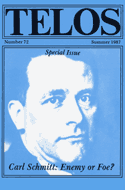 The date was August 22, 1933. Only ten days before, Winston Churchill had spoken publicly for the first time about the dangers of German re-armament. Almost exactly two months later, Germany would withdraw from the League of Nations. During that same year, Martin Heidegger would controversially speak in public about Hitler’s referendum, stating: “The National Socialist revolution is not merely the taking over of a present-at-hand power in the state by another power that has grown sufficiently [strong] for it, but rather this revolution brings the complete overturning [Umwälzung] of our German Dasein.” The date was August 22, 1933. Only ten days before, Winston Churchill had spoken publicly for the first time about the dangers of German re-armament. Almost exactly two months later, Germany would withdraw from the League of Nations. During that same year, Martin Heidegger would controversially speak in public about Hitler’s referendum, stating: “The National Socialist revolution is not merely the taking over of a present-at-hand power in the state by another power that has grown sufficiently [strong] for it, but rather this revolution brings the complete overturning [Umwälzung] of our German Dasein.”
Continue reading →
By Brendan O'Connor · Monday, July 30, 2012 As an occasional feature on TELOSscope, we highlight a past Telos article whose critical insights continue to illuminate our thinking and challenge our assumptions. Today, Brendan O’Connor looks at Joseph Ferrandino’s “Joyce and Phenomenology,” from Telos 2 (Fall 1968).
 In “Joyce and Phenomenology,” Joseph Ferrandino proposes a “phenomenological reading” of James Joyce’s Ulysses, and while he admits that much of the epic eludes such sweeping, categorical interpretations, he maintains that “in terms of aims and methods, Ulysses can only be seen as a concrete application of what Husserl means by phenomenology” (84). Ferrandino provides an excellent gloss on Husserl and his notoriously difficult philosophy before he delves into the equally difficult Joyce. Ferrandino explains that the aim of Husserl’s phenomenology is “to get back to the ‘things themselves.’ This is done by suspending judgment . . . reducing the immediate experience to the operations of the life-world (the phenomenological reduction), and then constituting again the whole in its proper subjective sense” (87). Joyce, in objectifying individual experience so deftly, enables us, as readers, to consider our own experience from a sort of literary remove. Ferrandino understands this to be analogous, even equivalent, to the work of the phenomenologist: “It is from this viewpoint that the reader can come to grasp the proper meaning of the experience, just as the phenomenologist who has performed the reduction can view the bracketed experience and its correct sense” (91). The reader’s experience of Ulysses, Ferrandino argues, is a reflexive one, and by bringing us into an awareness of ourselves as readers the text also aligns us with Joyce as the author: “We, as readers, have access to the same viewpoint that Joyce has. We are not Stephen walking on the strand contemplating philosophical problems. The philosophical is not the object of our act of awareness. It is Stephen’s object. Our object is Stephen’s act of awareness and its object” (90). In “Joyce and Phenomenology,” Joseph Ferrandino proposes a “phenomenological reading” of James Joyce’s Ulysses, and while he admits that much of the epic eludes such sweeping, categorical interpretations, he maintains that “in terms of aims and methods, Ulysses can only be seen as a concrete application of what Husserl means by phenomenology” (84). Ferrandino provides an excellent gloss on Husserl and his notoriously difficult philosophy before he delves into the equally difficult Joyce. Ferrandino explains that the aim of Husserl’s phenomenology is “to get back to the ‘things themselves.’ This is done by suspending judgment . . . reducing the immediate experience to the operations of the life-world (the phenomenological reduction), and then constituting again the whole in its proper subjective sense” (87). Joyce, in objectifying individual experience so deftly, enables us, as readers, to consider our own experience from a sort of literary remove. Ferrandino understands this to be analogous, even equivalent, to the work of the phenomenologist: “It is from this viewpoint that the reader can come to grasp the proper meaning of the experience, just as the phenomenologist who has performed the reduction can view the bracketed experience and its correct sense” (91). The reader’s experience of Ulysses, Ferrandino argues, is a reflexive one, and by bringing us into an awareness of ourselves as readers the text also aligns us with Joyce as the author: “We, as readers, have access to the same viewpoint that Joyce has. We are not Stephen walking on the strand contemplating philosophical problems. The philosophical is not the object of our act of awareness. It is Stephen’s object. Our object is Stephen’s act of awareness and its object” (90).
Continue reading →
|
|