By Francisco Unger · Tuesday, December 15, 2009 Each Tuesday in the TELOSscope blog, we reach back into the archives and highlight an article whose critical insights continue to illuminate our thinking and challenge our assumptions. Today, Francisco Unger looks at Michael Marder’s article “Carl Schmitt’s ‘Cosmopolitan Restaurant’: Culture, Multiculturalism, and Complexio Oppositorum,” from Telos 142 (Spring 2008).
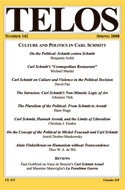 Michael Marder’s essay on Carl Schmitt’s concept of complexio oppositorum, a term elaborated in Schmitt’s Roman Catholicism and Political Form (1923), takes up this “complex of opposites” as a framework for understanding culture. Marder makes the provocative argument that what is normally a decorative centerpiece in the mantle of depoliticized liberalism, “multiculturalism,” can be rescued on Schmittian grounds in order to militate against the somnolence of its former master. When it is understood as the recognition of a charged plurality, or a complex of opposite cultures, multiculturalism satisfies the need for a living politics. Cultures are not paying mere lip service to a common framework of socially entrenched goals, or to the proselytizers of universalism by day (political players by night), but now cultures are seen as vehicles for a people’s political particularity. For Marder, novels, films, languages, manners, etc., can become political weapons by which a disempowered group shatters the fiction of an all-inclusive consensus, and intrudes on the atmosphere of sterility that often accompanies liberalism’s claim to “universality.” Michael Marder’s essay on Carl Schmitt’s concept of complexio oppositorum, a term elaborated in Schmitt’s Roman Catholicism and Political Form (1923), takes up this “complex of opposites” as a framework for understanding culture. Marder makes the provocative argument that what is normally a decorative centerpiece in the mantle of depoliticized liberalism, “multiculturalism,” can be rescued on Schmittian grounds in order to militate against the somnolence of its former master. When it is understood as the recognition of a charged plurality, or a complex of opposite cultures, multiculturalism satisfies the need for a living politics. Cultures are not paying mere lip service to a common framework of socially entrenched goals, or to the proselytizers of universalism by day (political players by night), but now cultures are seen as vehicles for a people’s political particularity. For Marder, novels, films, languages, manners, etc., can become political weapons by which a disempowered group shatters the fiction of an all-inclusive consensus, and intrudes on the atmosphere of sterility that often accompanies liberalism’s claim to “universality.”
Continue reading →
By Nicole Burgoyne · Wednesday, December 9, 2009 Carl Schmitt’s Hamlet or Hecuba: The Intrusion of the Time into the Play is now available in English translation from Telos Press. Nicole Burgoyne recently discussed some of the book’s central arguments with translator David Pan.
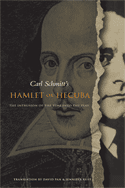 Nicole Burgoyne: Hamlet or Hecuba: The Intrusion of the Time into the Play represents a bit of a departure from Schmitt’s usual juristic theoretical work. At the beginning of the book he makes quite clear that he means to appeal to the literary lover of Shakespeare and to provide a new understanding of the text. How important was literature to Schmitt? Is literature simply another vehicle to explore Schmitt’s other key concepts, such as his definition of the sovereign, the exception, the friend/enemy dichotomy, etc.? Nicole Burgoyne: Hamlet or Hecuba: The Intrusion of the Time into the Play represents a bit of a departure from Schmitt’s usual juristic theoretical work. At the beginning of the book he makes quite clear that he means to appeal to the literary lover of Shakespeare and to provide a new understanding of the text. How important was literature to Schmitt? Is literature simply another vehicle to explore Schmitt’s other key concepts, such as his definition of the sovereign, the exception, the friend/enemy dichotomy, etc.?
David Pan: Literature was important to Schmitt from very early in his career; one of his first publications was a book of literary criticism on the Expressionist poem Nordlicht, by Theodor Däubler. This interest was linked to his political theory to the extent that this theory began with the assumption that politics was based in theology. Though his Roman Catholicism and Political Form theorizes this link in terms of the Catholic Church, his nationalist attitudes brought his interest in theology back to an engagement with the kinds of literary texts, such as Hamlet for England, that make up a national culture.
Continue reading →
By Nicole Burgoyne · Tuesday, December 8, 2009 Each Tuesday in the TELOSscope blog, we reach back into the archives and highlight an article whose critical insights continue to illuminate our thinking and challenge our assumptions. Today, Nicole Burgoyne looks at Donald W. Livingston’s “Lincoln Symbols,” a review of Barry Schwartz’s Abraham Lincoln and the Forge of National Memory, from Telos 122 (Winter 2002).
 In his 2002 review of Abraham Lincoln and the Forge of National Memory, Donald W. Livingston praises author Barry Schwartz for grappling with the theory of commemorative national memory and images, but then proceeds to tear the substance of Schwartz’s argument to bloody bits. The issue of “truth” proves to be Livingston’s main point of contention in this article, which not only points out the discrepancies between Lincoln myth and reality, but poses a polemical alternative to the ideals that Lincoln is meant to represent. In his 2002 review of Abraham Lincoln and the Forge of National Memory, Donald W. Livingston praises author Barry Schwartz for grappling with the theory of commemorative national memory and images, but then proceeds to tear the substance of Schwartz’s argument to bloody bits. The issue of “truth” proves to be Livingston’s main point of contention in this article, which not only points out the discrepancies between Lincoln myth and reality, but poses a polemical alternative to the ideals that Lincoln is meant to represent.
Continue reading →
By Etel Sverdlov · Tuesday, November 24, 2009 Each Tuesday in the TELOSscope blog, we reach back into the archives and highlight an article whose critical insights continue to illuminate our thinking and challenge our assumptions. Today, Etel Sverdlov looks at Elena Aga Rossi and Giovanni Orsina’s article “The United States According to the Italian Communist Press (1945–1953),” from Telos 127 (Spring 2004).
 I wonder at times whether the Internet provides people around the world with greater access to the “truth.” Possibly as a result of the widespread availability of almost any information, propaganda today must become more subtle and broad generalizations, or even bold lies, more covert. Such distortions—some deliberate, some unintentional—once permeated Italian communist publications. In their article “The United States According to the Italian Communist Press (1945–1953),” Elena Aga Rossi and Giovanni Orsina trace the rhetoric with which the Italian communists attacked the United States. What stands out most within their analysis is the striking similarity between the charges that the communists and capitalists hurled at each other. I wonder at times whether the Internet provides people around the world with greater access to the “truth.” Possibly as a result of the widespread availability of almost any information, propaganda today must become more subtle and broad generalizations, or even bold lies, more covert. Such distortions—some deliberate, some unintentional—once permeated Italian communist publications. In their article “The United States According to the Italian Communist Press (1945–1953),” Elena Aga Rossi and Giovanni Orsina trace the rhetoric with which the Italian communists attacked the United States. What stands out most within their analysis is the striking similarity between the charges that the communists and capitalists hurled at each other.
Continue reading →
By Marcus Michelsen · Tuesday, November 17, 2009 Each Tuesday in the TELOSscope blog, we reach back into the archives and highlight an article whose critical insights continue to illuminate our thinking and challenge our assumptions. Today, Marcus Michelsen looks at Todd Samuel Presner’s “Heidegger, Arendt, and the Modernity of Mass Death,” from Telos 135 (Summer 2006).
 We are all going to die. Of course, this is a platitude. Is death a social or a personal event? It is a strange point of intersection where an inexpressibly personal experience gives expression to meaning for the group. A meaning that is enjoyed or suffered by people who, in a very clear sense, are not taking part in the very event that serves as its point of origin. Whose event, then, is my death? This question becomes irrelevant in the face of mass death, because, here, my death ceases to be a singular event. It is buried in a crowd, innumerable through the multiplication of the killed—my life and my death are both stolen from me. How are we to think of this other kind of death? We are all going to die. Of course, this is a platitude. Is death a social or a personal event? It is a strange point of intersection where an inexpressibly personal experience gives expression to meaning for the group. A meaning that is enjoyed or suffered by people who, in a very clear sense, are not taking part in the very event that serves as its point of origin. Whose event, then, is my death? This question becomes irrelevant in the face of mass death, because, here, my death ceases to be a singular event. It is buried in a crowd, innumerable through the multiplication of the killed—my life and my death are both stolen from me. How are we to think of this other kind of death?
Continue reading →
By Philip Crone · Tuesday, November 10, 2009 Each Tuesday in the TELOSscope blog, we reach back into the archives and highlight an article whose critical insights continue to illuminate our thinking and challenge our assumptions. Today, Philip Crone looks two articles about the Frankfurt School: Ben Morgan’s “The Project of the Frankfurt School,” from Telos 119 (Spring 2001), and James Gordon Finlayson’s “Morality and Critical Theory: On the Normative Problem of Frankfurt School Social Criticisms,”from Telos 146 (Spring 2009).
In an earlier post on the TELOSscope blog, Nicole Burgoyne highlighted a 2001 interview with Paul Piccone in which he discussed the appearance of Telos in the 1960s. Piccone listed a number of ideological currents that played major formative roles in the early years of Telos, including Frankfurt School critical theory. Forty years after the first issue of Telos was published the journal is still going strong, but can the same be said of the critical theory of the Frankfurt School? The Frankfurt School itself long predates Telos; the beginnings of its program can be traced to the 1920s when the Institute for Social Research was founded by Carl Grünberg. The Frankfurt School, or at least what is known as its “first generation,” reached its apex with the publication of the second edition of Max Horkheimer and Theodor Adorno’s Dialectic of Enlightenment in 1947. While thinkers influenced by this first generation continue to exert enormous intellectual influence, the ideas of the original group itself have waned.
Continue reading →
|
|