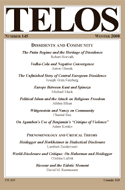
Each Tuesday in the TELOSscope blog, we reach back into the archives and highlight an article whose critical insights continue to illuminate our thinking and challenge our assumptions. Today, Etel Sverdlov looks at Robert Hovarth’s “The Putin Regime and the Heritage of Dissidence” published in Telos 145 (Winter 2008), a special issue on “Dissidents and Community.”
 As the child of Russian immigrants who fled the Soviet Union just before it collapsed, I grew up in a unique time-warp. Not knowing the modern Russia, I was raised on Soviet songs, movies, and references. I thought it simply an amusing situation for a child to experience, but as Robert Horvath’s “The Putin Regime and the Heritage of Dissidence” makes clear, this sort of modern disconnect plays a strong, and damaging, part in contemporary Russian politics. Throughout the history of the Soviet Union, individuals of conviction found ways of subtly revolting against the oppressive Communist regime. Once that empire fell, however, these men began to feel the sting of obscurity. Sergei Kovalyov, “the most prominent former dissident in the State Duma,” Vladimir Voinovich, a Soviet satirist, and the most famous of the group, Alexander Solzhenitsyn, the long-bearded writer, all found themselves increasingly irrelevant in the new “democratic” Russia. The generation they belonged to had fallen away.