By Matt Applegate · Tuesday, May 6, 2014 As an occasional feature on TELOSscope, we highlight a past Telos article whose critical insights continue to illuminate our thinking and challenge our assumptions. Today, Matt Applegate looks at Arshi Pipa’s “Gramsci as a (Non) Literary Critic” from Telos 57 (Fall 1983).
 Arshi Pipa’s “Gramsci as a (Non) Literary Critic” is more than a short biography and description of Antonio Gramsci’s inquiries into literary criticism. It also provokes the reader to meditate on the political conditions of literary criticism as an intellectual practice. Gramsci is a controversial figure in the history of literary criticism for at least two reasons, according to Pipa. First, his political work remains more prominent than his literary criticism. When one thinks of Gramsci as a writer and historical figure, his literary criticism might not even register, given his political writing and influence. Second, Gramsci’s politics serve as the impetus for his intellectual projects, thus also providing potential grounds to dismiss or ignore his aesthetic analyses. To be sure, Gramsci is a controversial political figure. In 1921 Gramsci co-founded and led the Communist Party of Italy in opposition to fascism, and was later arrested by fascist police under Mussolini, ultimately dying in prison in 1937. Perhaps his most famous collection of writings, Prison Notebooks, was completed while he was incarcerated between 1926 and 1937. Yet, it is precisely Gramsci’s controversial style and political will that draw Pipa to his work and allow him to question literary criticism as an enduring intellectual practice. Arshi Pipa’s “Gramsci as a (Non) Literary Critic” is more than a short biography and description of Antonio Gramsci’s inquiries into literary criticism. It also provokes the reader to meditate on the political conditions of literary criticism as an intellectual practice. Gramsci is a controversial figure in the history of literary criticism for at least two reasons, according to Pipa. First, his political work remains more prominent than his literary criticism. When one thinks of Gramsci as a writer and historical figure, his literary criticism might not even register, given his political writing and influence. Second, Gramsci’s politics serve as the impetus for his intellectual projects, thus also providing potential grounds to dismiss or ignore his aesthetic analyses. To be sure, Gramsci is a controversial political figure. In 1921 Gramsci co-founded and led the Communist Party of Italy in opposition to fascism, and was later arrested by fascist police under Mussolini, ultimately dying in prison in 1937. Perhaps his most famous collection of writings, Prison Notebooks, was completed while he was incarcerated between 1926 and 1937. Yet, it is precisely Gramsci’s controversial style and political will that draw Pipa to his work and allow him to question literary criticism as an enduring intellectual practice.
Continue reading →
By Matthew Bagot · Monday, May 5, 2014 The following paper was originally prepared for the Eighth Annual Telos Conference, held on February 15–16, 2014, in New York City.
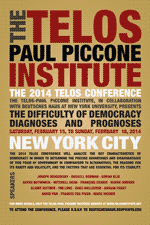 In this paper, I will try to show the positive potential of religion for democracy in light of some theoretical and practical considerations. At the theoretical level, a debate on the proper relation of religion to politics has taken place between certain “liberal” political theorists who are suspicious of religion for good historical reasons and a number of Christian authors who argue that religion can enrich our public life.[1] One such author, David Hollenbach, S.J., bases his argument on an approach to the common good—defined in Catholic teaching as “the sum of those conditions of social life which allow social groups and their individual members relatively thorough and ready access to their own fulfillment”[2]—that he discerns at the Second Vatican Council (1962–65) and calls “dialogic universalism.”[3] In this paper, I will try to show the positive potential of religion for democracy in light of some theoretical and practical considerations. At the theoretical level, a debate on the proper relation of religion to politics has taken place between certain “liberal” political theorists who are suspicious of religion for good historical reasons and a number of Christian authors who argue that religion can enrich our public life.[1] One such author, David Hollenbach, S.J., bases his argument on an approach to the common good—defined in Catholic teaching as “the sum of those conditions of social life which allow social groups and their individual members relatively thorough and ready access to their own fulfillment”[2]—that he discerns at the Second Vatican Council (1962–65) and calls “dialogic universalism.”[3]
Continue reading →
By Jacob Dreyer · Friday, May 2, 2014  For the outsider, the metropolis—a visual, tangible representation of the economic activities that it sites—appears to be endlessly seductive, complicated, and enthralling. And yet, for the urbanites themselves, both the skyline and the economy that it harbors inspire tedium; when will these games terminate, these spectacles that bring us no closer to a utopian community but merely run down the clock prior to the moment of judgment? What appears superficially to be busyness (e.g., business) is in fact a gigantic conspiracy for the wasting of everybody’s time, resources, and cognitive ability. At least, that is the way that it appeared to the revolutionary urban intellectuals of East Asia’s 1930s, both those from Tokyo as well as those from Shanghai; the former group, motivated by a critique of capitalism, would be involved in the creation of much of the built structure of an East Asian modern, while the latter became architects of the Chinese Communist Revolution. The revolutionary impulse of the Japanese progressives in Manchuria was realized as technocracy; however, deeper insecurities about the nature of capitalist modernity haunted the thoughts and work of the men who, while articulating a system of modern infrastructure across the Great Northern Wasteland, simultaneously brooded upon the limited and constricting nature of the society within which they existed. For the outsider, the metropolis—a visual, tangible representation of the economic activities that it sites—appears to be endlessly seductive, complicated, and enthralling. And yet, for the urbanites themselves, both the skyline and the economy that it harbors inspire tedium; when will these games terminate, these spectacles that bring us no closer to a utopian community but merely run down the clock prior to the moment of judgment? What appears superficially to be busyness (e.g., business) is in fact a gigantic conspiracy for the wasting of everybody’s time, resources, and cognitive ability. At least, that is the way that it appeared to the revolutionary urban intellectuals of East Asia’s 1930s, both those from Tokyo as well as those from Shanghai; the former group, motivated by a critique of capitalism, would be involved in the creation of much of the built structure of an East Asian modern, while the latter became architects of the Chinese Communist Revolution. The revolutionary impulse of the Japanese progressives in Manchuria was realized as technocracy; however, deeper insecurities about the nature of capitalist modernity haunted the thoughts and work of the men who, while articulating a system of modern infrastructure across the Great Northern Wasteland, simultaneously brooded upon the limited and constricting nature of the society within which they existed.
Continue reading →
By Nicholas W. Drummond · Thursday, May 1, 2014 Nicholas W. Drummond’s “Immigration and the Therapeutic Managerial Government” appears in Telos 166 (Spring 2014). Read the full version online at the Telos Online website, or purchase a print copy of the issue in our store.
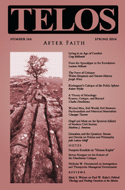 Multiculturalism as state policy in the Western World has functioned without serious complications because an unequivocal division existed between the oppressive culture group and the culture groups requiring protection. Recent evidence suggests this distinction may be fading and the consequences are likely to be significant. Managerial governments traditionally accommodating towards diverse cultures are beginning to critically evaluate immigrant communities feared to be afflicted with objectionable pathologies like the tendency of some Islamic groups to promote gender inequality, homophobia, and Sharia law. Multiculturalism as state policy in the Western World has functioned without serious complications because an unequivocal division existed between the oppressive culture group and the culture groups requiring protection. Recent evidence suggests this distinction may be fading and the consequences are likely to be significant. Managerial governments traditionally accommodating towards diverse cultures are beginning to critically evaluate immigrant communities feared to be afflicted with objectionable pathologies like the tendency of some Islamic groups to promote gender inequality, homophobia, and Sharia law.
Continue reading →
By Telos Press · Wednesday, April 30, 2014 Gary Lachman, writing at the Daily Grail, has just posted a new review of Ernst Jünger’s The Forest Passage. Here’s an excerpt.
Continue reading →
By Richard R. Weiner · Friday, April 25, 2014 The following paper was presented at the Eighth Annual Telos Conference, held on February 15–16, 2014, in New York City. It develops ideas that the author previously explored in “The Changing Forms of Contracting in a Society of Transnational Networks,” a paper delivered at the 2011 Telos Conference.
Can Critical Theory—rooted in the observation and dialectical understanding of the tensions and contradictions within the totality of interactions—bind itself like Odysseus in studying neoliberal social forms, so as to learn from them? And in so doing, discern in a Durkheimian manner emergent practices of self-binding and mutual bonds? Without foundering on neoliberalism’s reefs and rocks of sovereignty? Without falling prey to the collective addictions of the self-destructive financialized manipulations some neoliberal thinking spawns?
Continue reading →
|
|