By Telos Press · Wednesday, April 30, 2014 Gary Lachman, writing at the Daily Grail, has just posted a new review of Ernst Jünger’s The Forest Passage. Here’s an excerpt.
Continue reading →
By Richard R. Weiner · Friday, April 25, 2014 The following paper was presented at the Eighth Annual Telos Conference, held on February 15–16, 2014, in New York City. It develops ideas that the author previously explored in “The Changing Forms of Contracting in a Society of Transnational Networks,” a paper delivered at the 2011 Telos Conference.
Can Critical Theory—rooted in the observation and dialectical understanding of the tensions and contradictions within the totality of interactions—bind itself like Odysseus in studying neoliberal social forms, so as to learn from them? And in so doing, discern in a Durkheimian manner emergent practices of self-binding and mutual bonds? Without foundering on neoliberalism’s reefs and rocks of sovereignty? Without falling prey to the collective addictions of the self-destructive financialized manipulations some neoliberal thinking spawns?
Continue reading →
By Giuseppe Tassone · Thursday, April 24, 2014 Giuseppe Tassone’s “Wicked Men, Evil World: Evil between Psychoanalysis and Historical Materialism” appears in Telos 166 (Spring 2014). Read the full version online at the Telos Online website, or purchase a print copy of the issue in our store.
 Slavoj Žižek and Terry Eagleton have recently deployed the neo-Lacanian appropriation of Kant’s notion of radical evil in favor of an emancipatory politics of terror. For Žižek, there is a “progressive” passion for the Real that is aimed at universal justice. Similarly, Eagleton insists that there is a “good” will to nothingness that, if embodied by the wretched of the earth—that is, the victims of global capitalism—can lead to a radical transformation of society. In this article, I argue that Žižek’s and Eagleton’s accounts of terror are problematic as long as they are based on the assumption that there is a fundamental ontological flaw in human will to which the most intractable horrors of history are to be traced down. Following Adorno, I contend that evil is a social category or, in Adornian terms, an expression of the oppressive totality of which individuals as such are not responsible, and that, in the rationalized society of late capitalism, evil individuals such as Iago and Richard III have become impossible. Slavoj Žižek and Terry Eagleton have recently deployed the neo-Lacanian appropriation of Kant’s notion of radical evil in favor of an emancipatory politics of terror. For Žižek, there is a “progressive” passion for the Real that is aimed at universal justice. Similarly, Eagleton insists that there is a “good” will to nothingness that, if embodied by the wretched of the earth—that is, the victims of global capitalism—can lead to a radical transformation of society. In this article, I argue that Žižek’s and Eagleton’s accounts of terror are problematic as long as they are based on the assumption that there is a fundamental ontological flaw in human will to which the most intractable horrors of history are to be traced down. Following Adorno, I contend that evil is a social category or, in Adornian terms, an expression of the oppressive totality of which individuals as such are not responsible, and that, in the rationalized society of late capitalism, evil individuals such as Iago and Richard III have become impossible.
Continue reading →
By Aaron Bell · Wednesday, April 23, 2014 As an occasional feature on TELOSscope, we highlight a past Telos article whose critical insights continue to illuminate our thinking and challenge our assumptions. Today, Aaron Bell looks at Theodor W. Adorno’s “Resignation” from Telos 35 (Spring 1978).
 Reading “Resignation” today, it is immediately clear that the historical context is necessary to fully grasp the significance of Adorno’s words. Originally delivered as a radio address in 1968, “Resignation” is, among other things, an important entry in the Marxist theory-praxis debate and a primary document in the history of Adorno’s troubled relationship with the radical student movements of postwar Germany. Adorno, responding directly to the Frankfurt School’s critics of the radical left, defends his refusal to translate Critical Theory into a program for political action. Against the charge of apolitical “resignation,” Adorno articulates a defiant vision of critical thought beholden to no master. This vision of critical thought remains vital today, despite the dated trappings of the theory-praxis debate and the limited interest in Adorno’s biography and the politics of postwar Germany. Reading “Resignation” today, it is immediately clear that the historical context is necessary to fully grasp the significance of Adorno’s words. Originally delivered as a radio address in 1968, “Resignation” is, among other things, an important entry in the Marxist theory-praxis debate and a primary document in the history of Adorno’s troubled relationship with the radical student movements of postwar Germany. Adorno, responding directly to the Frankfurt School’s critics of the radical left, defends his refusal to translate Critical Theory into a program for political action. Against the charge of apolitical “resignation,” Adorno articulates a defiant vision of critical thought beholden to no master. This vision of critical thought remains vital today, despite the dated trappings of the theory-praxis debate and the limited interest in Adorno’s biography and the politics of postwar Germany.
Continue reading →
By Telos Press · Tuesday, April 22, 2014 At the recent 2014 Telos Conference in New York City, we sat down with Marcia Pally, Professor at NYU, and Ulrike Kistner, Professor at University of Pretoria in South Africa, to discuss the importance of Telos conferences to their work. Here’s what they had to say.
Continue reading →
By Jacob Dreyer · Monday, April 21, 2014 In this series of entries, Jacob Dreyer investigates the spatial forms of modernity in China, notably that of the Metropolis (e.g., Shanghai) and the Wasteland (e.g., Heilongjiang). In his last piece, he read the two regions through Schmitt’s dialectic of land and sea; here, he reads Shanghai through Dostoyevsky’s vision of the Crystal Palace; the next piece will subject the exterior, the “Great Northern Wasteland,” to a similar analysis.
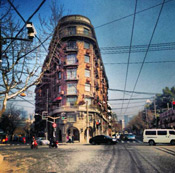 If the goal of the project of modernity in China is ultimately the integration of the entire territory of PRC China into an urbanized “interior,” with no useless or wild zones, of universalizing the social practices of the metropolis, then an investigation into the unique spatial forms that did not emerge until modernity—and their shadow in consciousness, visible in the work of philosophers, writers, and architects—is necessary. As discussed in my previous post, Chinese literati have been exploring the territory since the beginning of civilization in Asia. In fact, it would not be inaccurate to say that the beginning of civilization is created by the initial architectural division between “inside” and “outside,”[1] created by architecture—physical edifices, no doubt, but also the structures of thought and language which tend to divide the world into two zones, interior and exterior. If the goal of the project of modernity in China is ultimately the integration of the entire territory of PRC China into an urbanized “interior,” with no useless or wild zones, of universalizing the social practices of the metropolis, then an investigation into the unique spatial forms that did not emerge until modernity—and their shadow in consciousness, visible in the work of philosophers, writers, and architects—is necessary. As discussed in my previous post, Chinese literati have been exploring the territory since the beginning of civilization in Asia. In fact, it would not be inaccurate to say that the beginning of civilization is created by the initial architectural division between “inside” and “outside,”[1] created by architecture—physical edifices, no doubt, but also the structures of thought and language which tend to divide the world into two zones, interior and exterior.
Continue reading →
|
|