By Mark S. Weiner · Thursday, April 10, 2014 The following paper was presented at the Eighth Annual Telos Conference, held on February 15–16, 2014, in New York City.
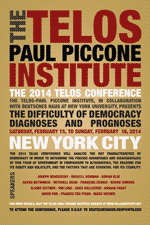 As the final speaker after a fascinating day of talks, I’ll keep my comments brief. I’ll be addressing two questions about democracy raised by our conference description: first, “the reasons for its rarity and volatility”; and, second, “the factors that are essential for its stability.” For each question, I’ll try to provide a concise, mildly provocative answer from my perspective as a writer and scholar about constitutional law and comparative legal history. As the final speaker after a fascinating day of talks, I’ll keep my comments brief. I’ll be addressing two questions about democracy raised by our conference description: first, “the reasons for its rarity and volatility”; and, second, “the factors that are essential for its stability.” For each question, I’ll try to provide a concise, mildly provocative answer from my perspective as a writer and scholar about constitutional law and comparative legal history.
So why is democracy so rare and volatile? I think one answer we could give to this question is that democracy is volatile because the modern self is a legal achievement. There is nothing outside of law, including individual subjectivity. Instead, the modern self that lies at the center of liberal democratic practice developed only after a long historical process of dialectical negation and synthesis. In that process, a handful of societies, beginning in western Europe, transcended what in my most recent book I call the “rule of the clan.”
Continue reading →
By Jacob Dreyer · Friday, April 4, 2014 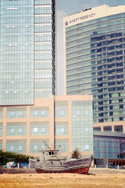 The shadow of geography in modern Chinese thought is profound, for the understanding of a modern China above all relies on the interpretation of what China is. A population? A geography? A continental form of knowledge, modulated as cultural system? The interrogation of China’s two modern cities—Harbin and Shanghai[1]—reveals certain disparities in the approach toward geography and landscape, and the resultant subject position. Shanghai, whose name literally means “up against the sea,” and the soil of which is nearly entirely all the eroded dust from the banks of the Yangtze in the Chinese interior,[2] is the heir to the watery tradition of Jiangnan, the Yangtze region of water towns; Harbin, the frozen Siberian capital, was founded as an outpost in the middle of the “Great Northern Wasteland,” which has been tamed by the successive generations of labor fanning out from the transportation network of which Harbin is the center. Shanghai, then, has never been sufficiently solid or stable to be a capital; it errs on the avant-garde of flow, a slippery Atlantis. Harbin, with its gruff dialect, with its ripe and aged neighborhoods, with the earnest and clean faces glimpsed on the boulevards, is a city in which the earth has come to life. The shadow of geography in modern Chinese thought is profound, for the understanding of a modern China above all relies on the interpretation of what China is. A population? A geography? A continental form of knowledge, modulated as cultural system? The interrogation of China’s two modern cities—Harbin and Shanghai[1]—reveals certain disparities in the approach toward geography and landscape, and the resultant subject position. Shanghai, whose name literally means “up against the sea,” and the soil of which is nearly entirely all the eroded dust from the banks of the Yangtze in the Chinese interior,[2] is the heir to the watery tradition of Jiangnan, the Yangtze region of water towns; Harbin, the frozen Siberian capital, was founded as an outpost in the middle of the “Great Northern Wasteland,” which has been tamed by the successive generations of labor fanning out from the transportation network of which Harbin is the center. Shanghai, then, has never been sufficiently solid or stable to be a capital; it errs on the avant-garde of flow, a slippery Atlantis. Harbin, with its gruff dialect, with its ripe and aged neighborhoods, with the earnest and clean faces glimpsed on the boulevards, is a city in which the earth has come to life.
Continue reading →
By Telos Press · Wednesday, April 2, 2014 At this year’s Telos Conference in New York City, Telos Associate Editor Adrian Pabst outlined the theme of the upcoming Telos in Europe Conference, which will be held on September 5–8, in L’Aquila, Italy. This conference will focus on “The Idea of Europe,” and will offer speakers and attendees an opportunity to discuss Europe’s current crisis of identity. For complete details about the conference, as well as the full call for papers, please visit the conference page on the Telos Paul Piccone Institute website, located here.
Continue reading →
By Robert Wyllie · Thursday, March 27, 2014 The following paper was presented at the Eighth Annual Telos Conference, held on February 15–16, 2014, in New York City.
Kierkegaard is the first to call modern Christians “pagans.” If Augustine’s critique of the Physicalists in the City of God was the last critique of ancient pagan time, Kierkegaard’s critique of our present “abstract infinity” is the first critique of modern pagan time. Augustine and Kierkegaard are like bookends on the complex sacred time of the Middle Ages.
Continue reading →
By Telos Press · Monday, March 24, 2014 At the recent Telos Conference in New York City, Telos Editor Russell A. Berman discussed the themes of the upcoming issues of the journal. Telos 166 (Spring 2014), which is now available, is entitled “After Faith” and addresses the endurance of religion despite the movement toward secularization. Telos 167, coming this summer, takes the related question “Are We Post-Secular” as its theme, and brings together a variety of contributions from around the world.
Continue reading →
By Telos Press · Friday, March 21, 2014 Telos Editorial Associate Jay Gupta recently spoke with C.S. Soong on Pacifica Radio’s Against the Grain, a show about politics, society, and ideas. Their conversation turned to ethics, objective vs. subjective truth, and the manner in which war is reported in the media. Listen the full interview at the Against the Grain website here.
Continue reading →
|
|