By Johannes Grow · Tuesday, November 19, 2013 As an occasional feature on TELOSscope, we highlight a past Telos article whose critical insights continue to illuminate our thinking and challenge our assumptions. Today, Johannes Grow looks at Russell A. Berman’s “Saddam and Hitler: Rethinking Totalitarianism” from Telos 125 (Fall 2002).
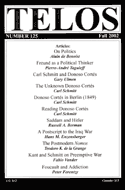 In “Saddam and Hitler: Rethinking Totalitarianism,” Russell A. Berman examines the limits of current efforts to understand totalitarianism in light of the juxtaposition of Nazi Germany and Baathist Iraq. He questions the “cultural approaches” often implemented when approaching the study of the Nazi years. Berman doubts whether the German people, under the increasingly violent and fanatical Nazi regime, were truly a Volksgemeinschaft, a happy population believing in every word of the leader, be it true or false, or as the Baathist regime in Iraq demonstrated, a regime of violence, with the party and the leader as the center node propagating terror throughout the state. The author examines three problems present in contemporary discussions of the Nazi regime that may be further elucidated through a juxtaposition of Hitler’s “movement” with the old Saddam regime. The first involves the futility of defining these regimes as either “Left” or “Right.” These types of distinctions do not allow for a full exploration of the effects of these regimes. The second problem is the aligning of Nazism with a sort of “cultural hegemony” rather than with an environment of coercion, violence, and politics. The third concern involves limiting the question of totalitarianism to a certain period history rather than examining its effects on the present. In “Saddam and Hitler: Rethinking Totalitarianism,” Russell A. Berman examines the limits of current efforts to understand totalitarianism in light of the juxtaposition of Nazi Germany and Baathist Iraq. He questions the “cultural approaches” often implemented when approaching the study of the Nazi years. Berman doubts whether the German people, under the increasingly violent and fanatical Nazi regime, were truly a Volksgemeinschaft, a happy population believing in every word of the leader, be it true or false, or as the Baathist regime in Iraq demonstrated, a regime of violence, with the party and the leader as the center node propagating terror throughout the state. The author examines three problems present in contemporary discussions of the Nazi regime that may be further elucidated through a juxtaposition of Hitler’s “movement” with the old Saddam regime. The first involves the futility of defining these regimes as either “Left” or “Right.” These types of distinctions do not allow for a full exploration of the effects of these regimes. The second problem is the aligning of Nazism with a sort of “cultural hegemony” rather than with an environment of coercion, violence, and politics. The third concern involves limiting the question of totalitarianism to a certain period history rather than examining its effects on the present.
Continue reading →
By Telos Press · Thursday, November 14, 2013 
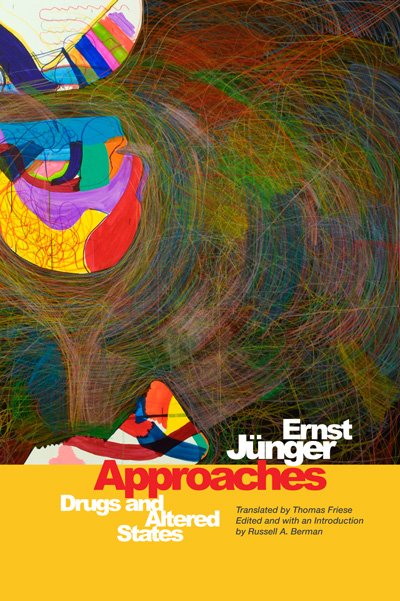
Ernst Jünger’s The Forest Passage explores the possibility of resistance: how the independent thinker can withstand and oppose the power of the omnipresent state. No matter how extensive the technologies of surveillance become, the forest can shelter the rebel, and the rebel can strike back against tyranny. Jünger’s manifesto is a defense of freedom against the pressure to conform to political manipulation and artificial consensus. A response to the European experience under Nazism, Fascism, and Communism, The Forest Passage has lessons equally relevant for today, wherever an imposed uniformity threatens to stifle liberty
Continue reading →
By Telos Press · Monday, November 4, 2013 We’re pleased to announce that Matthias Küntzel’s Jihad and Jew-Hatred: Islamism, Nazism, and the Roots of 9/11 is now available for purchase as a Kindle eBook. To purchase the eBook, visit the Amazon.com product page or buy it from within your Kindle reader or mobile Kindle app.
Continue reading →
By Johanna K. Schenner · Thursday, October 31, 2013 As an occasional feature on TELOSscope, we highlight a past Telos article whose critical insights continue to illuminate our thinking and challenge our assumptions. Today, Johanna Schenner looks at Simon Clarke’s “The Crisis of Fordism or the Crisis of Social Democracy?” from Telos 83 (Spring 1990).
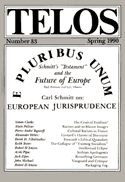 Simon Clarke’s “The Crisis of Fordism or the Crisis of Social Democracy?” deals with the need to develop different economic strategies as the interventionist welfare state underwent many challenges and crises in the 1980s. The crumbling of communism further supported the idea that weak state interventionism often could not reach its stipulated economic goals. In comparison to the socialist critique of the state, the political right put forward measures and tools such as privatization to support its critique of the state by the following means: first, by focusing on the selective redistribution of income; and second, by bringing about a particular kind of Keynesian economic policy featuring military characteristics (73). The economic growth came to an end in 1987 when a global panic about the massive credit boom begun under Reagan and Thatcher broke wide open. Still, the right’s policies reached a new height with the waves of radical liberalization in the former communist countries as well as in the Third World. Clarke, however, expresses severe doubts about this strategy being the solution to neoliberalism’s economic strategy crisis (79). Simon Clarke’s “The Crisis of Fordism or the Crisis of Social Democracy?” deals with the need to develop different economic strategies as the interventionist welfare state underwent many challenges and crises in the 1980s. The crumbling of communism further supported the idea that weak state interventionism often could not reach its stipulated economic goals. In comparison to the socialist critique of the state, the political right put forward measures and tools such as privatization to support its critique of the state by the following means: first, by focusing on the selective redistribution of income; and second, by bringing about a particular kind of Keynesian economic policy featuring military characteristics (73). The economic growth came to an end in 1987 when a global panic about the massive credit boom begun under Reagan and Thatcher broke wide open. Still, the right’s policies reached a new height with the waves of radical liberalization in the former communist countries as well as in the Third World. Clarke, however, expresses severe doubts about this strategy being the solution to neoliberalism’s economic strategy crisis (79).
Continue reading →
By Robert Wyllie · Tuesday, October 22, 2013 As an occasional feature on TELOSscope, we highlight a past Telos article whose critical insights continue to illuminate our thinking and challenge our assumptions. Today, Robert Wyllie looks at Alain Manville’s “Hegel and Metaphysics,” from Telos 42 (Winter 1979).
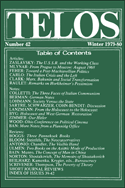 In “Hegel and Metaphysics,” Alain Manville joins the echelon of French theorists who attempt to focalize Hegelianism around one core concept. In the vanguard, Jean Wahl turned unhappy consciousness into an organizing principle for reading Hegel. More famously, Alexandre Kojève pared Hegelianism down to the core master-slave dialectic. Manville focuses upon the annihilation of metaphysics in Hegel’s speculative recognition that being equals nothingness. Speculative thought transcends the understanding (Vernunft), which sees only an ontological contradiction. Hegel dismisses Vernunft and metaphysics, Manville argues, to grasp concrete reality in a postmetaphysical sense. In “Hegel and Metaphysics,” Alain Manville joins the echelon of French theorists who attempt to focalize Hegelianism around one core concept. In the vanguard, Jean Wahl turned unhappy consciousness into an organizing principle for reading Hegel. More famously, Alexandre Kojève pared Hegelianism down to the core master-slave dialectic. Manville focuses upon the annihilation of metaphysics in Hegel’s speculative recognition that being equals nothingness. Speculative thought transcends the understanding (Vernunft), which sees only an ontological contradiction. Hegel dismisses Vernunft and metaphysics, Manville argues, to grasp concrete reality in a postmetaphysical sense.
Continue reading →
By Telos Press · Monday, October 21, 2013 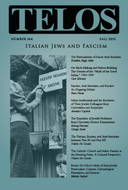 On Saturday, October 26, the Telos-Paul Piccone Institute and the Centro Primo Levi will host a panel discussion on Telos 164: Italian Jews and Fascism. The discussion will be held at Casa Italiana Zerilli Marimò, 24 West 12th Street, in New York City, from 1 pm to 4pm. Following the discussion, there will be a cocktail reception that will include Maria Piccone’s delicious “amaretti” cookies, in honor of Telos‘s 45th Anniversary. We hope to see you there! On Saturday, October 26, the Telos-Paul Piccone Institute and the Centro Primo Levi will host a panel discussion on Telos 164: Italian Jews and Fascism. The discussion will be held at Casa Italiana Zerilli Marimò, 24 West 12th Street, in New York City, from 1 pm to 4pm. Following the discussion, there will be a cocktail reception that will include Maria Piccone’s delicious “amaretti” cookies, in honor of Telos‘s 45th Anniversary. We hope to see you there!
Continue reading →
|
|