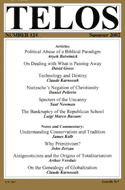
By Maja Sidzinska · Thursday, October 17, 2013 As an occasional feature on TELOSscope, we highlight a past Telos article whose critical insights continue to illuminate our thinking and challenge our assumptions. Today, Maja Sidzinska looks at James Kalb’s “Understanding Conservatism and Tradition,” from Telos 124 (Summer 2002).
 Let’s start with the punch-line: James Kalb informs us, in his article “Understanding Conservatism and Tradition,” that “the modern emphasis is too much on technology, on breaking things down to their simplest parts and reconstructing them in accord with human will. The problem with applying that approach to human life as a whole is that one can make sense of one’s actions only by reference to standards and realities one does not create” (164). In Kalb’s view, tradition creates these standards and realities, and is irreplaceable in this role. He compares the role of tradition to the roles of bureaucracy and markets, and he holds these three operative approaches as constitutive of politics, public policy, and life more generally. Let’s start with the punch-line: James Kalb informs us, in his article “Understanding Conservatism and Tradition,” that “the modern emphasis is too much on technology, on breaking things down to their simplest parts and reconstructing them in accord with human will. The problem with applying that approach to human life as a whole is that one can make sense of one’s actions only by reference to standards and realities one does not create” (164). In Kalb’s view, tradition creates these standards and realities, and is irreplaceable in this role. He compares the role of tradition to the roles of bureaucracy and markets, and he holds these three operative approaches as constitutive of politics, public policy, and life more generally.
Continue reading →
By Telos Press · Monday, October 14, 2013 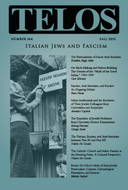 On Saturday, October 26, the Telos-Paul Piccone Institute and the Centro Primo Levi will host a panel discussion on Telos 164: Italian Jews and Fascism. The discussion will be held at Casa Italiana Zerilli Marimò, 24 West 12th Street, in New York City, from 1 pm to 4pm. We hope to see you there On Saturday, October 26, the Telos-Paul Piccone Institute and the Centro Primo Levi will host a panel discussion on Telos 164: Italian Jews and Fascism. The discussion will be held at Casa Italiana Zerilli Marimò, 24 West 12th Street, in New York City, from 1 pm to 4pm. We hope to see you there
Continue reading →
By Johanna K. Schenner · Tuesday, October 8, 2013 As an occasional feature on TELOSscope, we highlight a past Telos article whose critical insights continue to illuminate our thinking and challenge our assumptions. Today, Johanna Schenner looks at Alain de Benoist’s “The End of the Left-Right Dichotomy: The French Case,” from Telos 102 (Winter 1995).
 In his article “The End of the Left-Right Dichotomy: The French Case,” Alain de Benoist points to the gradual disappearance of traditional political ideologies in both socialist and conservative parties. In fact, Sofres Polls support this statement: in March 1981, 33% of the population viewed this delineation as outdated; in February 1986, 45% of the population shared this view; in March 1988, this proportion reached a new record level of 48%; and eventually in November 1989, more than half of the French population deemed this ideological antagonism as obsolete (73). In his article “The End of the Left-Right Dichotomy: The French Case,” Alain de Benoist points to the gradual disappearance of traditional political ideologies in both socialist and conservative parties. In fact, Sofres Polls support this statement: in March 1981, 33% of the population viewed this delineation as outdated; in February 1986, 45% of the population shared this view; in March 1988, this proportion reached a new record level of 48%; and eventually in November 1989, more than half of the French population deemed this ideological antagonism as obsolete (73).
Continue reading →
By Linas Jokubaitis · Thursday, September 26, 2013 As an occasional feature on TELOSscope, we highlight a past Telos article whose critical insights continue to illuminate our thinking and challenge our assumptions. Today, Linas Jokubaitis looks at Paul Piccone’s “Lukács’s History and Class Consciousness Half a Century Later,” from Telos 4 (Fall 1969).
 In 1969, when Paul Piccone wrote “Lukács’s History and Class Consciousness Half a Century Later,” almost fifty years had passed since the publication of Georg Lukács’s magnum opus. Piccone wrote this essay to mark that anniversary, and he argued that this work was an “underground classic.” Moreover, he asserted that this book was essential for any analysis of modern thought. According to Piccone, everyone attempting to understand and overcome the ideological crisis of Marxism would be wise to consult this book. In 1969, when Paul Piccone wrote “Lukács’s History and Class Consciousness Half a Century Later,” almost fifty years had passed since the publication of Georg Lukács’s magnum opus. Piccone wrote this essay to mark that anniversary, and he argued that this work was an “underground classic.” Moreover, he asserted that this book was essential for any analysis of modern thought. According to Piccone, everyone attempting to understand and overcome the ideological crisis of Marxism would be wise to consult this book.
Continue reading →
By Franklin Hugh Adler · Monday, September 23, 2013 Telos 164 (Summer 2013) is now available for purchase in our store.
When we examine European anti-Semitism during the 1930s, and especially the Shoah, the case of Germany looms so large that the Nazi regime immediately appears as the paradigmatic form of fascism and the manifold policies directed against European Jewry during the 1930s little more than German racial policy writ large. Without in any way trivializing or, worse, relativizing in an ethical sense the German case, one might nevertheless suggest that it occupies too much conceptual space and occludes a more precise comparative understanding of other European cases where anti-Semitic policies had been autonomously generated, relatively independent of direct Nazi pressure. In this sense, decentering the German case might be a necessary first step toward a less encumbered perspective on what happened elsewhere.
Continue reading →
By Telos Press · Monday, September 16, 2013 Karel Kosík and Dialectics of the Concrete Prague, June 4–6, 2014
A conference organised by the Department for the Study of Modern Czech Philosophy, Institute of Philosophy, Academy of Sciences of the Czech Republic.
In 1963 Karel Kosík published his path-breaking book Dialectics of the Concrete. It made an impact on both Marxist and non-Marxist thinkers, in Czechoslovakia and throughout the world. In this work Kosík set for himself an ambitious task—to re-think the basic concepts of the Marxist philosophical tradition and to employ them in the analysis of social reality. In the course of his analysis he touched on a wide array of issues that are still relevant today, including the problem of mystification or the “pseudo-concrete,” the social role of art, the conception of reality as a concrete totality, the conception of the human being as an onto-formative being, the systematic connection between labour and temporality, the relationship between praxis and labour, and the explanatory power of the dialectical method.
Continue reading →
|
|