By Paolo Morisi · Friday, August 30, 2013 Paolo Morisi’s “Twentieth-Century British Christian Democratic Movements: The Search for a Political Space” appears in Telos 163 (Summer 2013). Read the full version online at the Telos Online website, or purchase a print copy of the issue in our store.
 One of the major British political anomalies vis-à-vis Europe is the lack of a Christian Democratic political party. In most European countries these parties are part of the political fabric of the nation, but in Britain Christian Democracy never developed into a party. Research has shown that during the twentieth century there were British groups that inspired by Catholic social thought were the closest approximation to Christian Democracy. They not only sought to influence the parties, but also introduced into domestic politics typical Christian Democratic concerns. Thus, this essay seeks to address the following questions: What were their aims and policies? How and in what ways did they influence the parties? What was their ideological outlook? Finally, were there ideological differences among these groups? One of the major British political anomalies vis-à-vis Europe is the lack of a Christian Democratic political party. In most European countries these parties are part of the political fabric of the nation, but in Britain Christian Democracy never developed into a party. Research has shown that during the twentieth century there were British groups that inspired by Catholic social thought were the closest approximation to Christian Democracy. They not only sought to influence the parties, but also introduced into domestic politics typical Christian Democratic concerns. Thus, this essay seeks to address the following questions: What were their aims and policies? How and in what ways did they influence the parties? What was their ideological outlook? Finally, were there ideological differences among these groups?
Continue reading →
By Johannes Grow · Tuesday, August 27, 2013 As an occasional feature on TELOSscope, we highlight a past Telos article whose critical insights continue to illuminate our thinking and challenge our assumptions. Today, Johannes Grow looks at Pierluigi Mennitti’s “Germany in Decline,” from Telos 127 (Spring 2004).
 In “Germany in Decline,” from Telos 127 (Spring 2004), Pierluigi Mennitti addresses Berlin’s inability to enact “true” reforms, which has subsequently led to a decline in its economic, geopolitical, and cultural influence. Through an examination of a contemporaneous Der Spiegel article, Mennitti demonstrates the reluctance of the Federal Republic to accept such thoroughgoing Reformen, which would allow it to crawl out of its then apparent decline and to depend far less on the economic strategies propounded during the so-called “economic miracle” of the post-1949 era. Although it would seem to have been premature to write off Germany as the “economic engine” in Europe, his article nevertheless offers several accurate points. For example, Mennitti asserts that Germany In “Germany in Decline,” from Telos 127 (Spring 2004), Pierluigi Mennitti addresses Berlin’s inability to enact “true” reforms, which has subsequently led to a decline in its economic, geopolitical, and cultural influence. Through an examination of a contemporaneous Der Spiegel article, Mennitti demonstrates the reluctance of the Federal Republic to accept such thoroughgoing Reformen, which would allow it to crawl out of its then apparent decline and to depend far less on the economic strategies propounded during the so-called “economic miracle” of the post-1949 era. Although it would seem to have been premature to write off Germany as the “economic engine” in Europe, his article nevertheless offers several accurate points. For example, Mennitti asserts that Germany
Continue reading →
By Richard Herzinger · Friday, August 23, 2013 The Egyptian military has drowned the already weak hope for a transition to democracy in Egypt in blood. That during the storming of the Muslim Brotherhood’s protest camps, 600 people were killed and snipers fired at unarmed demonstrators cannot be justified by any state declared emergency. The military has thus shown that it is willing to unleash ruthless violence in order to sustain its power interests in ways almost reminiscent of the massacres of the Syrian regime.
Continue reading →
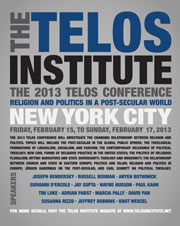
By Stuart McAnulla · Thursday, August 22, 2013 The following paper was presented at the Seventh Annual Telos Conference, held on February 15–17, 2013, in New York City.
 The banking crisis of 2007–8 became interpreted by many commentators as a failure of the neo-liberal economics that had been internationally ascendant for approximately three decades. Following the government bailout of the banks, even some leading evangelists for laissez-faire capitalism, such as Alan Greenspan, came to reflect on “flaws” within their ideology.[1] The younger Greenspan had been a disciple of Ayn Rand, whose fiercely individualistic philosophy had been popularized in her best-selling novels The Fountainhead (1943) and Atlas Shrugged (1957).[2] Yet the political fallout from the banking crisis provoked a resurgence of interest in Rand’s work,[3] with some on the political Right arguing the crisis had actually been provoked by state involvement in the economy. It was contended that the U.S. government had believed that large financial institutions were “too big to fail,” thus emboldening actors within these organizations to take far greater risks than they would otherwise have contemplated. In this regard Ayn Rand has even been referred to as a prophet of the crisis. Rand argued that government control over the economy would tend to induce deep problems that would then be blamed on the free-market and the avarice of businessmen. Consequently, demands would then be made for greater government control and more public spending. However (and as the plot transpires in Atlas Shrugged), these interventions only serve to make economic conditions worse as the creativity of entrepreneurs is further stifled by regulation. This explanation of the crisis has been influential within the renewal of the populist Right, evident in the “Who is John Galt?” banners that have appeared at numerous Tea Party events and anti-Obama protests. The banking crisis of 2007–8 became interpreted by many commentators as a failure of the neo-liberal economics that had been internationally ascendant for approximately three decades. Following the government bailout of the banks, even some leading evangelists for laissez-faire capitalism, such as Alan Greenspan, came to reflect on “flaws” within their ideology.[1] The younger Greenspan had been a disciple of Ayn Rand, whose fiercely individualistic philosophy had been popularized in her best-selling novels The Fountainhead (1943) and Atlas Shrugged (1957).[2] Yet the political fallout from the banking crisis provoked a resurgence of interest in Rand’s work,[3] with some on the political Right arguing the crisis had actually been provoked by state involvement in the economy. It was contended that the U.S. government had believed that large financial institutions were “too big to fail,” thus emboldening actors within these organizations to take far greater risks than they would otherwise have contemplated. In this regard Ayn Rand has even been referred to as a prophet of the crisis. Rand argued that government control over the economy would tend to induce deep problems that would then be blamed on the free-market and the avarice of businessmen. Consequently, demands would then be made for greater government control and more public spending. However (and as the plot transpires in Atlas Shrugged), these interventions only serve to make economic conditions worse as the creativity of entrepreneurs is further stifled by regulation. This explanation of the crisis has been influential within the renewal of the populist Right, evident in the “Who is John Galt?” banners that have appeared at numerous Tea Party events and anti-Obama protests.
Continue reading →
By Christian Kronsted · Tuesday, August 13, 2013 As an occasional feature on TELOSscope, we highlight a past Telos article whose critical insights continue to illuminate our thinking and challenge our assumptions. Today, Christian Kronsted looks at Lowell A. Dunlap’s “Hume, James, and Husserl on the Self,” from Telos 2 (Fall 1968).
 With the publication of A Treatise Of Human Nature, David Hume turned the philosophical community of his time upside down with his provocative skepticism and denial of a cohesive self. Since its initial publication, Hume’s claim that the self is nothing but a bundle of perceptions has plagued philosophers and psychologists alike, and has inspired many to completely abandon the idea of a coherent self. Yet a central question remains largely unanswered: if there is not a self, what is doing the thinking, and how is it done? If a person does not have a “self,” how come human beings think of themselves as unique and separate entities that have subjective experiences? Lowell A. Dunlap’s article “Hume, James, and Husserl on the Self” investigates how William James and Edmund Husserl tackled the notion of personal identity in the aftermath of Hume’s philosophy. With the publication of A Treatise Of Human Nature, David Hume turned the philosophical community of his time upside down with his provocative skepticism and denial of a cohesive self. Since its initial publication, Hume’s claim that the self is nothing but a bundle of perceptions has plagued philosophers and psychologists alike, and has inspired many to completely abandon the idea of a coherent self. Yet a central question remains largely unanswered: if there is not a self, what is doing the thinking, and how is it done? If a person does not have a “self,” how come human beings think of themselves as unique and separate entities that have subjective experiences? Lowell A. Dunlap’s article “Hume, James, and Husserl on the Self” investigates how William James and Edmund Husserl tackled the notion of personal identity in the aftermath of Hume’s philosophy.
Continue reading →
By Jörg Friedrichs · Thursday, August 8, 2013 Jörg Friedrichs’s “Global Islamism and World Society” appears in Telos 163 (Summer 2013). Read the full version online at the Telos Online website, or purchase a print copy of the issue in our store.
The piece is an eye-opener on contestation between global Islamism and cosmopolitan world society. It develops a comprehensive understanding of the former as the communitarian mirror image of the latter. Global Islamism and cosmopolitan world society are presented as varieties of globalization. The objective is to understand global Islamism as a political project and to assess its chances of successfully competing against cosmopolitan world society. This is accomplished by a comparative assessment of the degree to which either of them can achieve social integration, which is a prerequisite for the success of any political project. World society thrives on established forms of political and legal integration, and is buttressed by integration via functional subsystems. Global Islamism relies on the expectation of strong communal engagement and the unapologetic exclusion of dissidents and outsiders. It turns out that global Islamism’s bolder discriminatory practices are a two-edged sword because they also lead to internal divisions, and that global Islamism is not stronger than world society with regard to sociability. Insofar as the integration of Muslims into a universal community of believers is even more utopian than the realization of cosmopolitan world society, global Islamism is at a serious competitive disadvantage and thus bound to be frustrated. Until that happens, conflict between global Islamism and world society will continue to pose significant challenges. It is hoped that these challenges may be better managed when both are recognized as rival globalization projects, and when their mutual incompatibilities are acknowledged.
Continue reading →
|
|