By Telos Press · Monday, March 18, 2013 Who Should Be The Next Mayor Of New York?
Discussions on a Wide-Open Race
St. Francis College is proud to host what promises to be a lively discussion on “Who Should be the Next Mayor of New York,” featuring a selection of reporters and activists from across the political spectrum.
Who: Panelists include John Avlon (CNN), Michael Powell (New York Times), Maggie Haberman (Politico), Harry Siegel (Daily Beast), and Michael Meyers (New York Civil Rights Coalition). The panel will be moderated by St. Francis College Scholar in Residence Fred Siegel.
Where: St. Francis College, Founders Hall, 180 Remsen Street, Brooklyn Heights, NY 11201
When: Tuesday, March 19, 7:00pm–9:00pm
The event is free and open to the public.
Continue reading →
By Giovanni D’Ercole · Thursday, March 14, 2013 The following paper was presented at the Seventh Annual Telos Conference, held on February 15–17, 2013, in New York City. Bishop Giovanni D’Ercole is Auxiliary Bishop of the Archdiocese of L’Aquila, Italy.
 In the paper I am presenting, I shall focus on how I think the Catholic Church can contribute to solving the crucial issues facing humankind today. I will do so by referring to two events that have marked the evolution of the Church in her dialogue with the modern world, namely, the publication of the encyclical Pacem In Terris, and the Second Vatican Ecumenical Council. We are currently celebrating the 50th anniversary of both events. In the paper I am presenting, I shall focus on how I think the Catholic Church can contribute to solving the crucial issues facing humankind today. I will do so by referring to two events that have marked the evolution of the Church in her dialogue with the modern world, namely, the publication of the encyclical Pacem In Terris, and the Second Vatican Ecumenical Council. We are currently celebrating the 50th anniversary of both events.
A quick overview of the globalized world reveals the many contradictions and forms of injustice plaguing it. Underlying the crisis that has now taken on a global dimension is a three-fold question that characterizes what has come to be defined as the postmodern era. First of all, there is a fundamental question that is coming up again today, after the fall of totalitarian ideology. This is the anthropological question, a truly crucial question. The second question is related to the first. The social question has now become critical, and has to do with the very nature of man. Finally, the anthropological and the social question inevitably leads to the theological question, for man, by his very nature, is open to the transcendental and cannot be reduced to a creature that merely satisfies its material needs.
Continue reading →
By Yonathan Listik · Tuesday, March 12, 2013
As an occasional feature on TELOSscope, we highlight a past Telos article whose critical insights continue to illuminate our thinking and challenge our assumptions. Today, Yonathan Listik looks at Jürgen Habermas’s “On Social Identity,” from Telos 19 (Spring 1974).
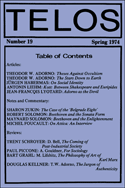 Jürgen Habermas’s objective in “On Social Identity” is clearly defending the usage of instrumental rationality toward the development of a universal morality. For Habermas, the new social identity should be constructed through universalistic moral systems, thereby eliminating possible frictions or incoherence present in modern society. The obsolescence of the state and its replacement by autonomous means of identity construction, such as art, already point to his emphasis on a more particular form of identity construction. Jürgen Habermas’s objective in “On Social Identity” is clearly defending the usage of instrumental rationality toward the development of a universal morality. For Habermas, the new social identity should be constructed through universalistic moral systems, thereby eliminating possible frictions or incoherence present in modern society. The obsolescence of the state and its replacement by autonomous means of identity construction, such as art, already point to his emphasis on a more particular form of identity construction.
Continue reading →
By Juan Carlos Donado · Friday, March 8, 2013 The following paper was presented at the Seventh Annual Telos Conference, held on February 15–17, 2013, in New York City.
Much has certainly been said about the place of otherness in René Descartes’ Meditations on First Philosophy. But one could, or rather, should be more precise and determine that the majority of what has been said about otherness in Descartes’ opus magnum concerns an essential banishment of the other, not to call it an essential exclusion, at the face of the “I.” In a text that, as some would have it, inaugurates the age we call Modern and starting with its genre, critics have no problem directly drawing a line from the monological voice that gives rise to the Modern subject to the egocentricity that perhaps best characterizes an age in which the mechanization of Nature—if we are still to be called Moderns—is rapidly coinciding with its destruction. As if the question of genre in the Meditations were not one of extreme complexity, the monologue, or so the story goes, finally replaces dialogue as the genre of Modernity and the other, slowly fading away, loses its voice under the authoritarian submission to the monophonic first-person singular.
Continue reading →
By J. F. Dorahy · Tuesday, March 5, 2013 As an occasional feature on TELOSscope, we highlight a past Telos article whose critical insights continue to illuminate our thinking and challenge our assumptions. Today, J.F. Dorahy looks at György Márkus’s “The Soul and Life: The Young Lukács and the Problem of Culture,” from Telos 32 (Summer 1977).
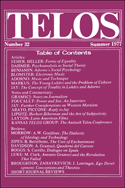 György Márkus’s essay on Lukács, “The Soul and Life,” is a seminal insight into one of the most influential philosophical oeuvres of the twentieth century. This piece, published at a time when only a handful of Márkus’s papers were available to English-language readers, reflects an intimacy with Lukács’s aesthetics that is unsurpassed in Lukács scholarship. (Márkus jointly edited, along with Frank Benesler, Lukács’s posthumously published Heidelberger Philosophie der Kunst 1916–18 and the Heidelberger Ästhetik 1916–1918, works that figure prominently in the essay under consideration.) The discussion in “The Soul and Life” centers on the problem of the possibility of culture as treated by Lukács in his pre-1918, or pre-Marxist, writings. György Márkus’s essay on Lukács, “The Soul and Life,” is a seminal insight into one of the most influential philosophical oeuvres of the twentieth century. This piece, published at a time when only a handful of Márkus’s papers were available to English-language readers, reflects an intimacy with Lukács’s aesthetics that is unsurpassed in Lukács scholarship. (Márkus jointly edited, along with Frank Benesler, Lukács’s posthumously published Heidelberger Philosophie der Kunst 1916–18 and the Heidelberger Ästhetik 1916–1918, works that figure prominently in the essay under consideration.) The discussion in “The Soul and Life” centers on the problem of the possibility of culture as treated by Lukács in his pre-1918, or pre-Marxist, writings.
Continue reading →
By Marcia Pally · Friday, March 1, 2013 The following paper was presented at the Seventh Annual Telos Conference, held on February 15–17, 2013, in New York City.
I’d like to begin with the idea that religion is not only useful for social service provision and various charities but that it has ideas that might be valuable, among them theologies of relationality. These are theologies that take the actions of relationship—not positions like parent/child, sovereign/subject, etc. but verbs—as their core. They, I’ll argue, offer a conceptual framework for addressing a long-running problem at least in the modern developed world. That problem is the ostensible binary choice between situatedness and separability and the unhappy results when we slip too far to one side or the other. Theologies of relationality may offer even non-believers a notion of the kinds of ideas needed to keep us from this self-induced harm.
Continue reading →
|
|