By Telos Press · Monday, February 25, 2013 Telos has always been about big ideas. Populism. Federalism. Traditions. The intersection of politics and religion. The legacy of totalitarianism and the ongoing threat of terrorism. Over the years we’ve dedicated special issues to these and other topics in order to give them the wider critical attention they deserve.
In the spirit of big ideas, we’re offering a 20% discount on select special issues of Telos from today through the end of March. There’s no better time than now to explore our rich history of critical engagement with the pivotal concerns of politics and philosophy.
Browse the back issues of Telos here. Note: Articles from out-of-stock special issues are available in digital form at the Telos Online website.
Continue reading →
By Michael Marder · Wednesday, February 13, 2013 Michael Marder’s “After the Fire: The Politics of Ashes” appears in Telos 161 (Winter 2012). Read the full version online at the Telos Online website, or purchase a print copy of the issue in our store.
 Two fires are kindled at the threshold of the metaphysical era, and both are extinguished, almost simultaneously, as soon as metaphysics exhausts itself (or else gets exhausted, tired, fatigued with itself) in its final Nietzschean inversion. The political reality of the twenty-first century is, as a whole, a comet tail of these ancient blazes that, until recently, seemed to be older than time itself, gave the impression of being eternal, undying, inextinguishable. How to find one’s bearings among the cinders and ashes of what the flames consumed? How to make sense—if make sense we must—of the burnt and smoldering remains, the traces of catastrophes, as much as of hopes and revolutionary desires, littering the horizons of the political today? Two fires are kindled at the threshold of the metaphysical era, and both are extinguished, almost simultaneously, as soon as metaphysics exhausts itself (or else gets exhausted, tired, fatigued with itself) in its final Nietzschean inversion. The political reality of the twenty-first century is, as a whole, a comet tail of these ancient blazes that, until recently, seemed to be older than time itself, gave the impression of being eternal, undying, inextinguishable. How to find one’s bearings among the cinders and ashes of what the flames consumed? How to make sense—if make sense we must—of the burnt and smoldering remains, the traces of catastrophes, as much as of hopes and revolutionary desires, littering the horizons of the political today?
Continue reading →
By Adrian Pabst · Tuesday, February 12, 2013 Pope Benedict XVI’s resignation was certainly sudden but not altogether unexpected. During the pontificate of his predecessor, the then Cardinal Ratzinger seems to have advised the long-suffering Pope John Paul II to renounce the Petrine office. Crucially, in mid-2010 Benedict gave a strong indication that he was considering abdicating. On April 29, 2009, he left his pallium—the sign of Episcopal authority—on the tomb of Pope Celestine V in the Basilica Santa Maria di Collemaggio, in L’Aquila. In the same location Celestine had been crowned pontiff on August 29, 1294—an event that is commemorated as the festival of Perdonanza Celestinana in the earthquake-stricken city every August 28–29. It is unlikely that Benedict’s highly symbolic gesture was a random act. Clearly he felt a deep spiritual connection with the studious monk-pope Celestine, who abdicated in 1295.
Continue reading →
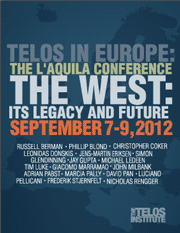
By Greg Melleuish · Monday, February 11, 2013 The following paper was presented at Telos in Europe: The L’Aquila Conference, held on September 7-9, 2012, in L’Aquila, Italy.
 We live in an age of History Wars. We live in an age of History Wars.
Most of them are national in focus.
There is, however, one that touches on the issue of Western civilization, and that is the perceived conflict between Western civilization and world history.
Advocates of world history castigate Western civilization for pretending to be universal when, in fact, it is partial and prejudiced.
Continue reading →
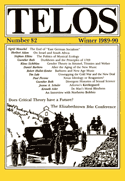
By Maja Sidzinska · Tuesday, February 5, 2013 As an occasional feature on TELOSscope, we highlight a past Telos article whose critical insights continue to illuminate our thinking and challenge our assumptions. Today, Maja Sidzinska looks at Guenther Roth’s “Durkheim and the Principles of 1789: The Issue of Gender Equality,” from Telos 82 (Winter 1989).
 Guenther Roth positively establishes that the principles of 1789—liberté, egalité, fraternité—have been overridden by Émile Durkheim’s essentializing gender prescriptions in the service of social stability. He shows that mutually exclusive and unequal gender roles were central to Durkheim’s theory of organic solidarity. But Roth’s examination does more than just explain theoretical contradictions present in Durkheim’s work. His inquiry invites new investigations into Durkheim’s gender politics, the most intriguing one provoked by his comparative treatment of Durkheim’s and Marianne Weber’s perspectives on marriage and divorce. These contemporaries shared a political outlook yet diverged greatly in their ultimate directives for society. Guenther Roth positively establishes that the principles of 1789—liberté, egalité, fraternité—have been overridden by Émile Durkheim’s essentializing gender prescriptions in the service of social stability. He shows that mutually exclusive and unequal gender roles were central to Durkheim’s theory of organic solidarity. But Roth’s examination does more than just explain theoretical contradictions present in Durkheim’s work. His inquiry invites new investigations into Durkheim’s gender politics, the most intriguing one provoked by his comparative treatment of Durkheim’s and Marianne Weber’s perspectives on marriage and divorce. These contemporaries shared a political outlook yet diverged greatly in their ultimate directives for society.
Continue reading →
By Adrian Pabst · Thursday, January 31, 2013 Adrian Pabst’s “The Politics of Paradox: Metaphysics beyond ‘Political Ontology'” appears in Telos 161 (Winter 2012). Read the full version online at the Telos Online website, or purchase a print copy of the issue in our store.
Since the onset of the Enlightenment, much of modern thought has celebrated the end of metaphysics and the death of God. The project of “political ontology,” which combines post-metaphysical with post-theistic thinking, underpins the scientific rationalism that pervades contemporary philosophy and politics. Faced with the secular slide into skepticism, relativism, and nihilism, this essay argues that the only genuine alternative to “political ontology” is a metaphysical politics of paradox. Philosophically, modernity and postmodernity invented and intensified the onto-theological science of transcendental ontology that can be traced to Scotus, Ockham, Machiavelli, and Suárez. They bequeathed three currents—possibilism, transcendentalism, and absolutism—that flow through figures such as Descartes, Wolff, and Clauberg to Kant, Hegel, and Comte.
Continue reading →
|
|