Time was when standard accounts of modernity and modernization involved the claim of pervasive secularization. Progress meant the disappearance of religion, clearing the way for the unchallenged reign of reason and science. Yet if anything has become clear in world politics in the past decade or two, it is the durability of religion and, especially, the mobilization of religion in political processes. At the same time, it has become apparent how complex and multiform the connection between religion and politics can become and how religion continues to pose new questions to the secularization thesis.
|
One basic account of modernity holds that we are leaving behind a rural past for an urban future. Some see in this account a story of decline. A golden age is passing. We are spiraling into a soulless, dystopian future full of alienation and excess. Others see in this same basic account a story of progress. We are leaving behind a backward age of rural idiocy for an enlightened age of increased choice and prosperity. Some see a simple narrative of decline, others a simple narrative of progress. Yet these pervasive narratives are flip sides of the same coin. They share the premise of a vanishing countryside. There seems to be a need for a book like this amid the celebration of the 150th anniversary of the unification of Italy. Pensare l’Italia (2011, Einaudi) is the title of a tightly organized and explosive dialogue between Ernesto Galli della Loggia and Aldo Schiavone, two conversationalists who relate to each other like night and day. At times their dialogue seems to be a conversation between the deaf or a juxtaposition of two monologues. Although they rarely agree, it may benefit the reader to have access to two books instead of one. As an occasional feature on TELOSscope, we highlight a past Telos article whose critical insights continue to illuminate our thinking and challenge our assumptions. Today, Tomash Dabrowski looks at Maurice Merleau-Ponty’s “Western Marxism,” from Telos 6 (Fall 1970).
Telos Press maintains an active, year-round, and global internship program, a valuable learning experience in which undergraduate and graduate students assist with the publication and marketing of the journal Telos as well as Telos Press books. We are looking for assistance with social media efforts and outreach (Twitter, Facebook, LinkedIn) as well as public relations and marketing research. Our main office is located in the heart of New York City’s East Village. At the ABC (Australia) Religion & Ethics website, Telos Associate Editor Adrian Pabst recently discussed the crisis of global capitalism, Pope Benedict’s vision of a civil economy, and the possibilities of a Catholic Christian “third way”: The year 2011 witnessed a new wave of protest movements and unprecedented popular outrage across the globe. From the protests in North Africa and the Middle East to the Occupy Wall Street movement in the United States to the camps outside St Paul’s Cathedral in London and Moscow, demonstrators have expressed a deep-seated anger at global finance that is shared by many. |
   |
|||
|
Privacy Policy · Data Protection Copyright © 2026 Telos Press Publishing · All Rights Reserved |
||||
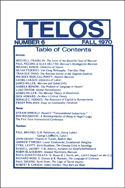 Prior to 1960, the work of György Lukács was largely unknown in France; Lukács’s work had only belatedly gained influence there with Lucien Goldmann’s translation of History and Class Consciousness almost forty years after its first publication, and five years after the 1955 publication of Merleau-Ponty’s study of his work in Les Aventures de la Dialectique. Merleau-Ponty had in a sense anticipated the French debates on Lukács’s otherwise eminent text, already having cited passages from History and Class Consciousness in 1946. “Western Marxism,” however, is a meditation on a Marxism far removed from the type that Merleau-Ponty was enthusiastic about almost ten years prior. Until 1950 his political commitments were supportive, albeit cautiously, toward the Soviet project; the present work is however concurrent with a disillusionment of institutionalized Marxism, a cynicism that had grown in Merleau-Ponty since the Korean War.