By Juan Carlos Donado · Wednesday, April 25, 2012 As an occasional feature on TELOSscope, we highlight a past Telos article whose critical insights continue to illuminate our thinking and challenge our assumptions. Today, Juan Carlos Donado looks at David Buxton’s “Rock Music, the Star-System and the Rise of Consumerism,” from Telos 57 (Fall 1983).
 From its origin to its social significance, almost everything about rock and roll music remains steeped in fierce debate. Exactly when and where was it born? Who, if in fact there is one only, is rock’s founding figure? What exactly did it and does “rock and roll” mean? Although all of them amount to approximations, certain answers have become commonplaces: it was born with bluesman Robert Johnson, with Chuck Berry, with Jerry Lee Lewis, with Elvis Presley, in the Mississippi Delta, in Memphis, and its sound was crafted by means of the technological breakthrough of the electric guitar. It signifies the rebelliousness of a generation, the nonconformity of the young, the break with the status quo. Yet rock and roll’s relationship with capitalism cannot be more complex. From its origin to its social significance, almost everything about rock and roll music remains steeped in fierce debate. Exactly when and where was it born? Who, if in fact there is one only, is rock’s founding figure? What exactly did it and does “rock and roll” mean? Although all of them amount to approximations, certain answers have become commonplaces: it was born with bluesman Robert Johnson, with Chuck Berry, with Jerry Lee Lewis, with Elvis Presley, in the Mississippi Delta, in Memphis, and its sound was crafted by means of the technological breakthrough of the electric guitar. It signifies the rebelliousness of a generation, the nonconformity of the young, the break with the status quo. Yet rock and roll’s relationship with capitalism cannot be more complex.
Continue reading →
By Rüdiger Campe · Tuesday, April 24, 2012 Rüdiger Campe’s “Contingencies in Blumenberg and Luhmann” appears in Telos 158 (Spring 2012). Read the full version online at the TELOS Online website, or purchase a print copy of the issue here.
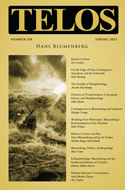 For both Hans Blumenberg and Niklas Luhmann, “contingency” is a key term in their respective philosophical endeavors. While their concepts differ significantly, they complement each other: Blumenberg’s “contingency” is onto-theological and refers to the Judeo-Christian God, the creator of the world. If God has created the world, he also could have created another world. Creation implies the contingency of the world’s beginning or constitution. Luhmann’s “contingency,” on the contrary, is procedural and pinpoints a feature in communication. According to Talcott Parsons, the selection in the action system of communication is not only dependent on the choices of the one partner in communication—Ego—but also on Ego’s assumptions about the selection of the other partner—Alter. Such contingency means dependence and—in Parsons’s famous theory further developed by Luhmann—double dependence. This essay argues that there is an important complementarity between cosmological contingency—the possibility of the world to be created this way or another—and procedural contingency—the mutual dependency of partners in interaction. Taken together, they allow a procedural understanding of origin or constitution. While the essay is mainly interested in structure, it is also suggested that contingency (in the double sense of Blumenberg and Luhmann) may be seen as essentially linked to the German situation after World War II. For both Hans Blumenberg and Niklas Luhmann, “contingency” is a key term in their respective philosophical endeavors. While their concepts differ significantly, they complement each other: Blumenberg’s “contingency” is onto-theological and refers to the Judeo-Christian God, the creator of the world. If God has created the world, he also could have created another world. Creation implies the contingency of the world’s beginning or constitution. Luhmann’s “contingency,” on the contrary, is procedural and pinpoints a feature in communication. According to Talcott Parsons, the selection in the action system of communication is not only dependent on the choices of the one partner in communication—Ego—but also on Ego’s assumptions about the selection of the other partner—Alter. Such contingency means dependence and—in Parsons’s famous theory further developed by Luhmann—double dependence. This essay argues that there is an important complementarity between cosmological contingency—the possibility of the world to be created this way or another—and procedural contingency—the mutual dependency of partners in interaction. Taken together, they allow a procedural understanding of origin or constitution. While the essay is mainly interested in structure, it is also suggested that contingency (in the double sense of Blumenberg and Luhmann) may be seen as essentially linked to the German situation after World War II.
Continue reading →
By Zvi Tauber · Thursday, April 19, 2012 Zvi Tauber’s “Herbert Marcuse on the Arab-Israeli Conflict: His Conversation with Moshe Dayan” appears in Telos 158 (Spring 2012). Read the full version of the article as well as the protocol of the conversation between Marcuse and Dayan at the TELOS Online website. You can also purchase a print copy of the issue here.
Herbert Marcuse visited Israel in late December 1971. Recently I found in The Israel Defense Forces and Defense Establishment Archives (IDFA) an unpublished document concerning his visit to Israel: the protocol of his meeting (December 29, 1971) with Moshe Dayan, the then Israel’s Defense Minister and the topmost Israeli politician at the time. The document was unknown to researchers of Marcuse’s writings and political activity till now, as if the content of the meeting were defined a confidential material. In my short commentary article, I seek to understand why this meeting was never publicized by Dayan or Marcuse. I also reconstruct Dayan’s and Marcuse’s ideas and statements, that came up in their conversation, while comparing them to the well-known political views and positions of each of them. Lastly, I dedicate special discussion and analysis to three relevant themes that were mentioned in that meeting: (1) on possible negotiations between Israel and Egypt in the period between the Six Day War (June 1967) and the Yom Kippur War (October 1973); (2) on Dayan’s explicit admission, that the State of Israel was, in fact, established on Arab land, and on Marcuse’s supporting the idea of the Palestinian State, i.e., the solution of “two states for two peoples”; and (3) on historical prognoses of the politician and the philosopher—Marcuse’s fear of the outbreak of war between Egypt and Israel and his quasi-prediction of Sadat’s assassination.
Continue reading →
By Paul Fleming · Tuesday, April 17, 2012 Paul Fleming’s “On the Edge of Non-Contingency: Anecdotes and the Lifeworld” appears in Telos 158 (Spring 2012). Read the full version online at the TELOS Online website, or purchase a print copy of the issue here.
This essay examines Hans Blumenberg’s reorientation of metaphorology toward the lifeworld and the resulting expansion of his project into a “theory of nonconceptuality.” I argue for an intimate relation in Blumenberg between the lifeworld as a “universe of self-evidence” and the anecdote as a genre in which “no detail is capricious.” Blumenberg’s increasing interest in anecdotal narration and its explication is central to his reorientation of nonconceptuality, since both—the lifeworld and the anecdote—converge at the limit of contingent thought. Through a close reading of Blumenberg’s extensive engagement with the multifarious rewritings of the Thales-Thracian Maid anecdote throughout the history of philosophy, the essay hones in on the tension between non-contingency (lifeworld) and contingency (theory). In explicating the anecdote’s re-narrations, Blumenberg unfolds a dual tension: first, between the individual anecdote’s apparent non-contingent narrative economy and its radical variability over time so as to continually re-write and re-occupy the story of theory’s ‘beginning’; and, second, between thinking and non-thinking, since Blumenberg’s project of nonconceptuality inscribes an essential element of non-thinking within theory. This is the lifeworld for him, which cannot be thought away.
Continue reading →
By Russell A. Berman · Monday, April 16, 2012 Time was when standard accounts of modernity and modernization involved the claim of pervasive secularization. Progress meant the disappearance of religion, clearing the way for the unchallenged reign of reason and science. Yet if anything has become clear in world politics in the past decade or two, it is the durability of religion and, especially, the mobilization of religion in political processes. At the same time, it has become apparent how complex and multiform the connection between religion and politics can become and how religion continues to pose new questions to the secularization thesis.
Continue reading →
By Steven Knepper · Friday, April 6, 2012 One basic account of modernity holds that we are leaving behind a rural past for an urban future. Some see in this account a story of decline. A golden age is passing. We are spiraling into a soulless, dystopian future full of alienation and excess. Others see in this same basic account a story of progress. We are leaving behind a backward age of rural idiocy for an enlightened age of increased choice and prosperity. Some see a simple narrative of decline, others a simple narrative of progress. Yet these pervasive narratives are flip sides of the same coin. They share the premise of a vanishing countryside.
Continue reading →
|
|