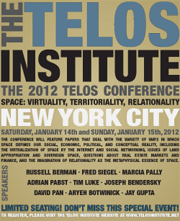
By Mohammad Rafi · Tuesday, March 6, 2012 This paper was presented at the 2012 Telos Conference, “Space: Virtuality, Territoriality, Relationality,” held on January 14–15, in New York City.
 In 2004 the German national football team was invited to Azadi Stadium in Teheran for a friendly game against Iran’s national team. While the German anthem was being played before the game, a large number of Iranians collectively greeted their German guests by performing the Nazi salute. Although this display of naiveté came as a shock to millions of viewers on live German TV, it should not come as a surprise in light of Nazi Germany’s historical propagandist involvement in Iran. Whereas the history of the relations between the two nations dates back to 1873, an affinity was reinforced in the Weimar years and strengthened through the propagation of an Aryan myth during the Nazi reign. I will discuss two pivotal historical associations between Germany and Iran, one based on the Aryan myth grounded in racist ideology, the other connection concerns intellectual influences of German anti-modernists on Iranian thinkers. Both points serve to shed light on a relationship that demands awareness, especially now that tensions between the West and Iran are continuously increasing. In 2004 the German national football team was invited to Azadi Stadium in Teheran for a friendly game against Iran’s national team. While the German anthem was being played before the game, a large number of Iranians collectively greeted their German guests by performing the Nazi salute. Although this display of naiveté came as a shock to millions of viewers on live German TV, it should not come as a surprise in light of Nazi Germany’s historical propagandist involvement in Iran. Whereas the history of the relations between the two nations dates back to 1873, an affinity was reinforced in the Weimar years and strengthened through the propagation of an Aryan myth during the Nazi reign. I will discuss two pivotal historical associations between Germany and Iran, one based on the Aryan myth grounded in racist ideology, the other connection concerns intellectual influences of German anti-modernists on Iranian thinkers. Both points serve to shed light on a relationship that demands awareness, especially now that tensions between the West and Iran are continuously increasing.
Continue reading →
By Hamza Zeghlache · Friday, March 2, 2012 This paper was presented at the 2012 Telos Conference, “Space: Virtuality, Territoriality, Relationality,” held on January 14–15, in New York City.
It is almost impossible to consider architecture independently from space. Indeed, the definition of architecture should implicitly or explicitly include this concept. The first role of architecture is to create and manipulate space. Any architectural object is not only a contained element in space but also an element that participates in the orientation of space and therefore in the making of a place out of a space. Moreover, the architectural object makes space act within a performing stage and defines it as a closed or open space. There is no architecture or architectural action without space. The human use of space and values with which society imbues spatial relations signifies the ground of architecture.
Continue reading →
By Telos Press · Thursday, March 1, 2012 Telos Press is pleased to announce the publication of The Democratic Contradictions of Multiculturalism by Jens-Martin Eriksen and Frederik Stjernfelt. Purchase your copy in our store, and save 20% off the list price.
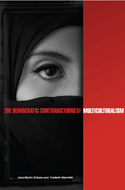 In The Democratic Contradictions of Multiculturalism, Jens-Martin Eriksen and Frederik Stjernfelt examine the ideology and the reality of multiculturalism, assessing the implications of this controversial concept for contemporary politics. They explore many urgent issues, including the responses to the Muhammad cartoons, laws against blasphemy and the hijab, the Islamic ban on apostasy, and the growing restrictions on speech and religion that threaten the freedom that democracy ought to protect. This book is an erudite manifesto for freedom and a confrontation with any kind of attempt—be it left or right—to fence people within their cultures. In The Democratic Contradictions of Multiculturalism, Jens-Martin Eriksen and Frederik Stjernfelt examine the ideology and the reality of multiculturalism, assessing the implications of this controversial concept for contemporary politics. They explore many urgent issues, including the responses to the Muhammad cartoons, laws against blasphemy and the hijab, the Islamic ban on apostasy, and the growing restrictions on speech and religion that threaten the freedom that democracy ought to protect. This book is an erudite manifesto for freedom and a confrontation with any kind of attempt—be it left or right—to fence people within their cultures.
Continue reading →
By Telos Press · Tuesday, February 28, 2012 Time and Location
St. Francis College, Maroney Forum for Arts, Culture & Education
180 Remsen Street, Brooklyn Heights, NY 11201
Wednesday, March 28, 7:00–9:00pm
Free and open to the public
St. Francis College with Telos Press, Encounter Books and The New York Chapter of the National Association of Scholars presents a debate on the virtues of liberal Western Civilization compared to its Islamic rivals, as expressed in author Ibn Warraq’s new book, Why the West is Best, on Wednesday, March 28, at 7:00pm in St. Francis College’s Maroney Forum for Arts, Culture & Education.
Continue reading →
By Marcia Pally · Tuesday, February 28, 2012 This paper was presented at the 2012 Telos Conference, “Space: Virtuality, Territoriality, Relationality,” held on January 14–15, in New York City.
I was very glad to see the investigatory trinity of this year’s Telos conference, which focused not only on our much-discussed virtual spaces but also on old-fashioned territory and relationality. One aspect of the modern era—meaning everything in the West after, say, 1600—is our fascination with our own modernity and latest gizmos. We ascribe to them enormous power to both spiffy up and ruin our lives. A century ago, the telephone was thought to bring progress, expand information, and to destroy the morals of women who could now received telephone calls from men to whom their fathers had not introduced them. People worried, committees were formed, The Times of London was appalled: “We shall soon be nothing but transparent heaps of jelly to each other.”
Continue reading →
By Matt Applegate · Thursday, February 23, 2012 This paper was presented at the 2012 Telos Conference, “Space: Virtuality, Territoriality, Relationality,” held on January 14–15, in New York City.
The following is an exploration of the relationship shared between space, relationality, and virtuality as it comes to bear on a particular genre of revolutionary expression: the manifesto. My argument here is in opposition to thinkers like Naomi Klein who have asserted the virtual power of the internet and social media to be the end of the manifesto genre; something like, we have twitter, we have Facebook, therefore manifestos are obsolete.[1] Rather, my argument is in favor of a metamorphosis where the genre is concerned and where revolutionary expression is evolving. To put it another way, I am interested in thinking a politics of the manifesto genre that exceeds its own instrumentality. So the manifesto is being treated here as a provocation toward thinking the shape and character of a radical politics. By way of a brief and somewhat simplified characterization of the genre, I want to think in opposition to, or beyond, two primary problems where the genre is concerned. First, I want to think the function of the manifesto against an ought or revolutionary telos that would name its future and provide the political program to manifest it. Second, I want to problematize the Schmittian character of the genre, the bi-partisan, “friend” vs. “enemy” relation that is so often asserted where the manifesto names a revolutionary telos.
Continue reading →
|
|