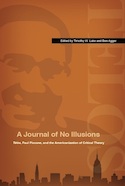
By Maxwell Woods · Monday, October 17, 2011 A Journal of No Illusions: Telos, Paul Piccone, and the Americanization of Critical Theory is now available from Telos Press. Maxwell Woods talked with contributor Robert Antonio about the influence of Paul Piccone and Telos on his intellectual development.
Maxwell Woods: In your article “Absolutizing Particularity,” you discuss Telos and Paul Piccone’s critique of liberalism. How do you view this article today? How did this piece fit into your intellectual world when you wrote it?
 Robert Antonio: Every or nearly every participant at Telos and, probably, most of its serious readers have had serious objections, fears, or dissatisfaction with liberalism as we have known it from the start. However, there have always been different liberalisms, and, as Paul stressed, divergent positions toward them among the Telos circle and readership. When I started reading the journal, “social liberalism” (Keynsianism and the welfare state) was the dominant capitalist regime, but already riven with contradictions and in decay. Many of us split with the journal when “market liberalism,” or neoliberalism, was in ascendance and took different positions toward it. I rejected the Schmittian and populist turn and return to tradition and had more affirmative views about key facets of liberal political and legal institutions, civil society, and social liberalism. However, I don’t believe that liberalism and capitalism as we have known them are sustainable. We have a huge environmental wall ahead and fundamental problems with capitalism’s growth imperative, and we also face multiple deep crises related to finance, real economy joblessness, and inequality. I have always disagreed with Paul’s exhaustion thesis about the liberal-left, but I fear that the consequent crises are upon us and the political culture is not responding; there is a profound lack of political vision and political will. We are in trouble, but not in exactly the way that Paul expected. The crisis and future of liberalism and capitalism is for me the most central issue for social theory and politics today. Thus, I try to follow divergent views about this issue. Robert Antonio: Every or nearly every participant at Telos and, probably, most of its serious readers have had serious objections, fears, or dissatisfaction with liberalism as we have known it from the start. However, there have always been different liberalisms, and, as Paul stressed, divergent positions toward them among the Telos circle and readership. When I started reading the journal, “social liberalism” (Keynsianism and the welfare state) was the dominant capitalist regime, but already riven with contradictions and in decay. Many of us split with the journal when “market liberalism,” or neoliberalism, was in ascendance and took different positions toward it. I rejected the Schmittian and populist turn and return to tradition and had more affirmative views about key facets of liberal political and legal institutions, civil society, and social liberalism. However, I don’t believe that liberalism and capitalism as we have known them are sustainable. We have a huge environmental wall ahead and fundamental problems with capitalism’s growth imperative, and we also face multiple deep crises related to finance, real economy joblessness, and inequality. I have always disagreed with Paul’s exhaustion thesis about the liberal-left, but I fear that the consequent crises are upon us and the political culture is not responding; there is a profound lack of political vision and political will. We are in trouble, but not in exactly the way that Paul expected. The crisis and future of liberalism and capitalism is for me the most central issue for social theory and politics today. Thus, I try to follow divergent views about this issue.
Continue reading →
By Pedro Blas González · Friday, October 14, 2011 Pedro Blas González’s “Czesław Miłosz: Old-World Values Confront Late-Modern Nihilism” appears in Telos 156 (Fall 2011). Read the full version online at the TELOS Online website, or purchase a print copy of the issue here.
 Czesław Miłosz’s The Captive Mind is unrivalled by other theoretical and abstract treatises in its sheer ability to grasp the criminal essence of political reality under communism. The Captive Mind, which was published in 1953 by the 1980 recipient of the Noble Prize in literature, chronicles and dissects the mind and soul of Marxist intellectuals and their readiness to embrace communism. Focusing his attention on the life-trajectory of real writers and thinkers who were acquaintances of Milosz’s, the Polish writer is able to pinpoint the many rewards that communism offers the intellectuals who embrace it. In this and other respects, Miłosz keeps some very distinguished company, with writers like Aleksandr Solzhenitsyn, Karl Popper, Leszek Kołakowski, Arthur Koestler, Jean-Francois Revel, and Paul Hollander, some who lived under communism. These writers have enlightened western democracies about the structure of realpolitiks and dialectical materialism, and the necessary outcome of what some naïvely like to call “praxis.” Miłosz’s formation as a writer and thinker took place during the 1930s, a time that saw Europe in the grasp of the two dominant totalitarian ideologies of the twentieth century: fascism and communism. This historical context was to form the backbone of The Captive Mind. From a historical and humanistic perspective, this context remains very important today, for it gives us an opportunity to revisit the essential human qualities and virtues that have to be subsumed by totalitarianism in order for such governments to rule with an iron fist. Czesław Miłosz’s The Captive Mind is unrivalled by other theoretical and abstract treatises in its sheer ability to grasp the criminal essence of political reality under communism. The Captive Mind, which was published in 1953 by the 1980 recipient of the Noble Prize in literature, chronicles and dissects the mind and soul of Marxist intellectuals and their readiness to embrace communism. Focusing his attention on the life-trajectory of real writers and thinkers who were acquaintances of Milosz’s, the Polish writer is able to pinpoint the many rewards that communism offers the intellectuals who embrace it. In this and other respects, Miłosz keeps some very distinguished company, with writers like Aleksandr Solzhenitsyn, Karl Popper, Leszek Kołakowski, Arthur Koestler, Jean-Francois Revel, and Paul Hollander, some who lived under communism. These writers have enlightened western democracies about the structure of realpolitiks and dialectical materialism, and the necessary outcome of what some naïvely like to call “praxis.” Miłosz’s formation as a writer and thinker took place during the 1930s, a time that saw Europe in the grasp of the two dominant totalitarian ideologies of the twentieth century: fascism and communism. This historical context was to form the backbone of The Captive Mind. From a historical and humanistic perspective, this context remains very important today, for it gives us an opportunity to revisit the essential human qualities and virtues that have to be subsumed by totalitarianism in order for such governments to rule with an iron fist.
Continue reading →
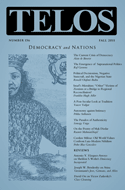
By Raf Geenens · Tuesday, October 11, 2011 Raf Geenens’s “The Emergence of Supranational Politics: A New Breath of Life for the Nation-State?” appears in Telos 156 (Fall 2011). Read the full version online at the TELOS Online website, or purchase a print copy of the issue here.
While cosmopolitan authors are eager to forecast the demise of the nation-state, this article looks at a number of authors who believe that the emergence of supranational politics actually provides the nation-state with a new or at least an altered raison d’être. I explore two lines of argument of this kind. Some theorists fear that the development of supranational institutions will eventually bring about a “depoliticization” of collective life. We risk ending up in a “postpolitical” world where individuals no longer see themselves as political actors with responsibility for the fate of a collectivity, but are instead reduced to purely economic units. Accordingly, these authors defend the nation-state as an irreplaceable context of political agency. Other theorists fear that the concentration of powers at the supranational level risks bringing about a new kind of despotism. In response, they propose to recast nation-states in the role of “intermediary bodies” that can form a counterweight against the centralizing tendencies of supranational institutions. Assessing these two lines of argument, I conclude that the dangers these authors point to are real. I also conclude, though, that there are no reasons to assume that the nation-state is indeed the optimal “political form” to counter these alarming developments.
Continue reading →
By Maxwell Woods · Monday, October 10, 2011 A Journal of No Illusions: Telos, Paul Piccone, and the Americanization of Critical Theory is now available from Telos Press. Maxwell Woods talked with co-editor Ben Agger about the influence Telos has had on his intellectual development.
Maxwell Woods: How do you view your article, “My Telos: A Journal of No Illusions,” and your relationship to Telos today?
Ben Agger: There has been such an explosion of publishing and publications since the late 60s, when Paul [Piccone] started Telos, that I just can’t keep up with journals and books. I used to pore over the latest issue of Telos as important intellectual sustenance, especially the latest intellectual news from Europe. Today there is less urgency about “keeping up” with publications, even though Telos remains a central part of my intellectual identity. As I say in my chapter, Telos helped formed me as I and others grappled with a humanist and phenomenological Marxism that helped explain America and the world during the 60s and 70s. Telos was a primer, although often a difficult one, for all of us on the New Left who were using Hegel, early Marx, Husserl, Sartre, et al. to understand civil rights, the women’s movement, the war in Vietnam—and our opposition to them. It is a sad commentary on the decline of discourse, as I term it, that books and journals matter less in our Internet age of instantaneity.
Continue reading →
By Ronald Olufemi Badru · Saturday, October 8, 2011 Ronald Olufemi Badru’s “The Ontology of Political Decisionism, Negative Statecraft, and the Nigerian State: Exploring Moral Altruism in Politics” appears in Telos 156 (Fall 2011). Read the full version online at the TELOS Online website, or purchase a print copy of the issue here.
This exercise in political philosophy adopts the research methods of conceptual analysis, extensive argumentation, and historical account. Using the theoretical framework of political decisionism, espoused by the German political philosopher Carl Schmitt, the essay attempts to explain the operation of the main actors within Nigeria’s political space. There are two central claims. First, Nigeria’s political leadership has detached morality from the political sphere; political leaders have covertly eroded the authority of both legal and moral norms in satisfying their egoistic interests. Second, the political class regards one another as enemies, leading to numerous incidents of political assassinations and killings among them. These claims aptly instantiate and summarize the Schmittian political decisionism in Nigeria’s politics. However, the paper concludes that since politics in the ideal is service to the public, for an all-round development, and the egoism of political decisionism resists this objective, then there ought to be a new morality of altruism in Nigeria’s politics. Committing to the welfare of the other, rather than that of the self, moral altruism ensures that politics is rightly conducted in Nigeria to achieve the well being of the general other, leading to an all-inclusive social development in the final analysis.
Continue reading →
By Maria Piccone · Friday, October 7, 2011 On Tuesday, October 4, Telos Press hosted a book launch for A Journal of No Illusions: Telos, Paul Piccone, and the Americanization of Critical Theory at St. Mark’s Bookshop in New York City. Tim Luke (co-editor of the book), Russell Berman (editor of Telos), and publisher Mary Piccone (Telos Press) provided an engaging look at the history of a courageous and often controversial journal, its brilliant and volatile founder, Paul Piccone, and Telos‘s ongoing contributions to American intellectual life. We had an outstanding turnout—a testimonial to the past, present, and future of Telos, now celebrating its 43rd anniversary.
Continue reading →
|
|