By Franklin Hugh Adler · Wednesday, October 5, 2011 Franklin Hugh Adler’s “Israel’s Mizrahim: ‘Other’ Victims of Zionism or a Bridge to Regional Reconciliation?” appears in Telos 156 (Fall 2011). Read the full version online at the TELOS Online website, or purchase a print copy of the issue here.
 Mizrahim, Jews who issued from Arab lands, comprise roughly half of Israel’s population. Most arrived after having been expelled from Arab states after 1948, and in number exceed those Palestinians who were displaced at Israel’s birth. They also possessed substantially greater property that was confiscated without compensation upon expulsion. Mizrahim have had a largely ignored and uneasy relation with Zionism, whose master narrative was based upon the return of European Jews to Palestine. An orientalist, anti-Arab blindness that became embedded in Zionism also encouraged a deracination of Mizrahim, as they, too, were Arabs and had been an enduring presence in the region predating by centuries the birth of Mohammad and the ascendance of Islam. In recent years there has been a reassertion of Mizrahi identity, often articulated by subsequent generations, which, at the same time, might become a source of regional reconciliation and help redeem the pluralism and cultural hybridity that once characterized Mediterranean-Levantine civilization. This essay attempts to explore these imaginative possibilities. Mizrahim, Jews who issued from Arab lands, comprise roughly half of Israel’s population. Most arrived after having been expelled from Arab states after 1948, and in number exceed those Palestinians who were displaced at Israel’s birth. They also possessed substantially greater property that was confiscated without compensation upon expulsion. Mizrahim have had a largely ignored and uneasy relation with Zionism, whose master narrative was based upon the return of European Jews to Palestine. An orientalist, anti-Arab blindness that became embedded in Zionism also encouraged a deracination of Mizrahim, as they, too, were Arabs and had been an enduring presence in the region predating by centuries the birth of Mohammad and the ascendance of Islam. In recent years there has been a reassertion of Mizrahi identity, often articulated by subsequent generations, which, at the same time, might become a source of regional reconciliation and help redeem the pluralism and cultural hybridity that once characterized Mediterranean-Levantine civilization. This essay attempts to explore these imaginative possibilities.
Continue reading →
By Telos Press · Saturday, October 1, 2011 Telos Press Publishing is proud to announce the newest addition to our book list: A Journal of No Illusions: Telos, Paul Piccone, and the Americanization of Critical Theory, edited by Timothy Luke and Ben Agger. Get your copy here.
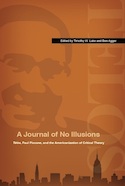 In 1968, a young SUNY-Buffalo philosophy graduate student named Paul Piccone started a journal called Telos. No one then could have reasonably expected for it to become an intellectual institution. Originally conceived as the self-consciousness of the American New Left, the journal soon ranged more widely as its authors introduced European social theory and philosophy to a largely American audience unaware of these traditions. Piccone forged a “journal of no illusions” that was iconoclastic, skeptical, and yet motivated by the hope that critique and engagement could become constitutive principles for politics and everyday practices. In this book, an array of authors, many of whom participated in the development of Telos, examine the ongoing legacy of the journal, and address the ways in which Telos formed a generation of young intellectuals, who asked for a “critical theory” to understand both the impasses and possibilities for a progressive politics. In 1968, a young SUNY-Buffalo philosophy graduate student named Paul Piccone started a journal called Telos. No one then could have reasonably expected for it to become an intellectual institution. Originally conceived as the self-consciousness of the American New Left, the journal soon ranged more widely as its authors introduced European social theory and philosophy to a largely American audience unaware of these traditions. Piccone forged a “journal of no illusions” that was iconoclastic, skeptical, and yet motivated by the hope that critique and engagement could become constitutive principles for politics and everyday practices. In this book, an array of authors, many of whom participated in the development of Telos, examine the ongoing legacy of the journal, and address the ways in which Telos formed a generation of young intellectuals, who asked for a “critical theory” to understand both the impasses and possibilities for a progressive politics.
Continue reading →
By Telos Press · Wednesday, September 28, 2011 For all fans of Telos in the New York City area, we will be holding a book launch for A Journal of No Illusions: Telos, Paul Piccone, and the Americanization of Critical Theory, edited by Timothy Luke and Ben Agger, on Tuesday, October 4, from 7pm to 9pm, at St. Mark’s Bookshop, 31 Third Avenue, New York, NY.
In 1968, when Paul Piccone started a journal called Telos, no one could have reasonably expected for it to become an intellectual institution. Originally conceived as the self-consciousness of the American New Left, the journal soon ranged more widely as its authors introduced European social theory and philosophy to a largely American audience unaware of these traditions. Piccone forged a “journal of no illusions” that was iconoclastic, skeptical, and yet motivated by the hope that critique and engagement could become constitutive principles for politics and everyday practices. In this book, an array of authors, many of whom participated in the development of Telos, examine the ongoing legacy of the journal, and address the ways in which Telos formed a generation of young intellectuals, who asked for a “critical theory” to understand both the impasses and possibilities for a progressive politics.
Continue reading →
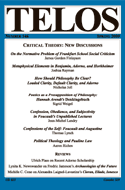
By Russell A. Berman · Monday, September 19, 2011 Telos 156 (Fall 2011) is now available for purchase here.
Will Europe be able to master its debt crisis and prevent the spread of economic instability throughout the eurozone? Will the political leadership in the United States be able to manage the challenge of the debt limit and, more broadly, the ongoing problems with the federal budget? As this issue of Telos goes to press, each of these dramas is still playing out, and the conclusion to neither is predictable. Will the euro crumble, will Washington grind to a halt? Probably not. Yet if Europe’s contagion is ultimately contained, and if the United States dodges the bullet and avoids default, it will only have been in the nick of time. Perhaps some tired observers will heave a sigh of relief and reassure themselves that the system has worked. Of course, escaping catastrophe is better than the alternative, and no one should be wishing for the worst. But this is not a matter of wishful thinking at all. Magic will not save us. On the contrary, this is about contemporary politics and the apparent inability of existing political institutions to address vital matters in an effective manner.
Continue reading →
By Timothy Stacey · Sunday, August 14, 2011 The past few days have seen the worst unrest in the UK since the 2001 Bradford Race Riots. Residents have watched from the questionable safety of their homes as mobs of men, women, boys, and girls attack and set light to shops, cars, and buses. Sometimes bystanders and journalists have been attacked too. Many have been shocked by the tendency of some to smash rather than steal expensive goods. The following is a dispassionate look at the facts and possible causes, followed by a controversially hopeful look into what the riots, and the reactions to them, might mean for the future of community in Britain.
Continue reading →
By Charles Kollmer · Monday, August 8, 2011 As an occasional feature on TELOSscope, we highlight a past Telos article whose critical insights continue to illuminate our thinking and challenge our assumptions. Today, Charles Kollmer looks at Nicholas Joll’s “How Should Philosophy Be Clear? Loaded Clarity, Default Clarity, and Adorno,” from Telos 146 (Spring 2009).
 In an apropos piece of metaphilosophy entitled “How Should Philosophy Be Clear?” Nicholas Joll offers several insights on the concept of clarity in relation to philosophical texts. On initial inspection, Joll’s style seems to reveal a bias towards the Analytical tradition in philosophy: his argumentation is clearly organized, rigorous, and formulated in logical propositions. Yet his work also attains the savvy and self-awareness that renders metaphilosophy convincing, as demonstrated in his first proposition, which states that any notion of clarity will be partisan with regards to the Analytical-Continental divide. In spite of this partisanship, Joll champions a concept of “default clarity” and demonstrates its aptitude for judiciously evaluating argumentation. He shrewdly refuses to overdetermine the prescriptive force of default clarity. Far from an immutable law, default clarity offers broad guidelines with the caveat that “the justificatory burden lies with those who would eschew such clarity.” In an apropos piece of metaphilosophy entitled “How Should Philosophy Be Clear?” Nicholas Joll offers several insights on the concept of clarity in relation to philosophical texts. On initial inspection, Joll’s style seems to reveal a bias towards the Analytical tradition in philosophy: his argumentation is clearly organized, rigorous, and formulated in logical propositions. Yet his work also attains the savvy and self-awareness that renders metaphilosophy convincing, as demonstrated in his first proposition, which states that any notion of clarity will be partisan with regards to the Analytical-Continental divide. In spite of this partisanship, Joll champions a concept of “default clarity” and demonstrates its aptitude for judiciously evaluating argumentation. He shrewdly refuses to overdetermine the prescriptive force of default clarity. Far from an immutable law, default clarity offers broad guidelines with the caveat that “the justificatory burden lies with those who would eschew such clarity.”
Continue reading →
|
|